William In my post about Takamori Tunnel, a reader had commented on a phrase used in the accompanying article describing Takamori as "a town where God enjoyed his honeymoon.” There is a reason for this, and, searching for it, I found that translating the "Aso Daimyōjin no Hanashi " (阿蘇大明神の話) from Aso Shrine's (in Isehaya) Website would be the simplest method. Then it occurred to me that the Website lacks an English mirror site, so I thought I would send them my translation and offer to translate the rest of their site for free. The site address: http://www.asojinja.jp/kami.html
A favor I have to ask is for interested readers to read the original and give advice on my translation. When satisfied, I will send it to the shrine office. Thank you in advance. My translation is as follows:
The story of Aso Daimyojin
Once upon a time, the grandson of Amaterasu Omikami, Ninigi no Mikoto, descended upon a pinnacle in Takachiho, Hyuga to rule the country of Japan.
It was then that the third emperor, Jimmu, set sail from the port of Miyazaki to first reign over the Country of Japan in Yamato no Kuni (now Nara Prefecture).
Emperor Jimmu ordered his grandson, Takeiwatatsu no Mikoto, to rule the land of Kyushu. As the god who developed Aso, he is the central deity of Aso Shrine and is also called Aso Daimeijin.
The spirit of Emperor Jimmu was enshrined by Takeiwatatsu no Mikoto at the site where the Emperor, his grandfather, had lived in Miyazaki. That shrine is now Miyazaki Shrine, whose ancient records describe Takeiwatatsu no Mikoto.
Takeiwatatsu no Mikoto concluded that, to rule Kyushu, he must position himself at its central part. Heading north along the coast and following Gokasegawa River up from Nobeoka, he arrived at Takachiho and Kusakabe (now Takamori-cho, Aso-gun). Here dwelt the god Kusakabe Yoshimi, his uncle, who joyfully welcomed Takeiwatatsu no Mikoto, and here he married Aso Tsuhime, daughter of the god Yoshimi.
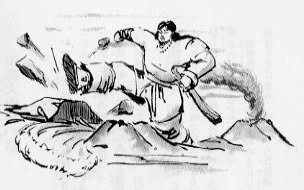
In the land of the mountain that spits fire, the land of Aso, they went in search of a new realm. Aso and Nangō valleys of Aso at that time were covered with sheens of a large lake. They vowed to flush the lake of water and cultivate it. They first tried to trample Futae Pass, but as it was double, it did not break. Then, when they kicked Sugaru in Tateno (now Tateno, Choyo-mura, Aso-gun), the mountain groaned and crumbled and the water of the lake rushed out. It is said that Sugaru is a contraction of "sukimagaaru", meaning both "there is a gap" and "thoroughly." Also, the soil which then flew is said to have created Oyama Toshima in Kumamoto City and Tsuchikure in Kikuyo Town. Sugarugataki waterfall is said to have been named as several deer hunted by Shimono were washed away.
Takeiwatatsu no Mikoto cultivated the now-dry Aso and Nango Valleys, growing crops and creating an abundant land. The tomb of Takeiwatatsu no Mikoto is said to be the "Ichinokami Mausoleum" and that of Aso Tsuhime "Ninokami Mausoleum, " both east of Aso Shrine's Sakura Gate.
Notes:
瓊瓊杵尊 Ninigi no Mikoto (Japanese deity; grandson of Amaterasu、great grandfather of Emperor Jimmu)
神武天皇
じんむてんのう
(個人名) Emperor Jimmu; Jimmu Tenno
健磐龍命 Takeiwa tatsuno-mikotoする According to "Kujihoongi" (Ancient Japanese History), Hayamikatama no mikoto, who was Takeiwa tatsuno-mikoto's child, was the first Asonokuni no miyat