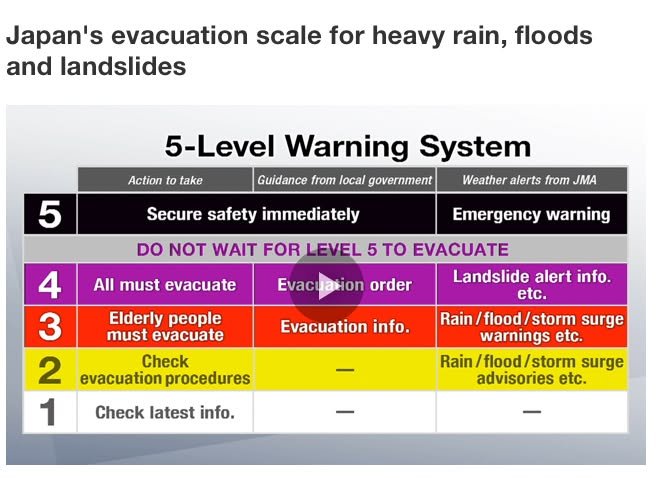
Kirk here with some thoughts on a linguistic issue that was driving me nuts until I figured it out (I think) a minute ago. In the image you see below, level 4 is listed as "All must evacuate." In the video on this page (URL below) the announcer says "everyone must evacuate" with no qualifications:
https://www3.nhk.or.jp/nhkworld/en/news/tags/93/
Of course, we all know that's crazy. There's no way that everyone in a Level 4 area (most of the prefecture) could have gone to a shelter.
I looked for better explanations in Japanese and found this:
https://www.gov-online.go.jp/useful/article/201906/2.html
Under the main category of "避難の方法" (How to "evacuate") it shows a family checking a hazard map and deciding that they can stay where they are (at home). I was somewhat surprised that this information would be listed under "How to "避難/hinan" (evacuate) because I assumed that 避難/hinan, like the English "evacuate," meant to leave one's home. I thought they should have said "How to decide IF you need to 避難." But, come to think of it, the characters in the word 避難 (hinan/evacuate) don't say anything about "leaving." The first character (避) means "avoid" and the second character (難) means "difficulties" or "disaster." So, it's possible to "avoid disaster" by staying at home. In point of fact, some Japanese talk about "避難-ing" at home (自宅で避難):
https://www.o-uccino.jp/article/posts/93932
専門家に聞く"家庭で準備しておきたいもの”在宅避難も視野に入れて
But, of course, in English it's absolute nonsense to say "evacuate at home." One might "shelter" at home but not "evacuate."
So, I think I may have identified the crux of the confusion. In Japanese, people generally associate 避難 with leaving to go to a shelter but it can also mean "ride the storm out at home, if your home is safe." In English, however, "evacuate" definitely means "leave to go to another place."
I'll be curious to see what others of you, especially native speakers of Japanese, think about my hypothesis. If I'm right, I think this is an interesting example of how ambiguity in a Japanese word can cause confusion when translated into an English word that doesn't permit the same sort of ambiguity.