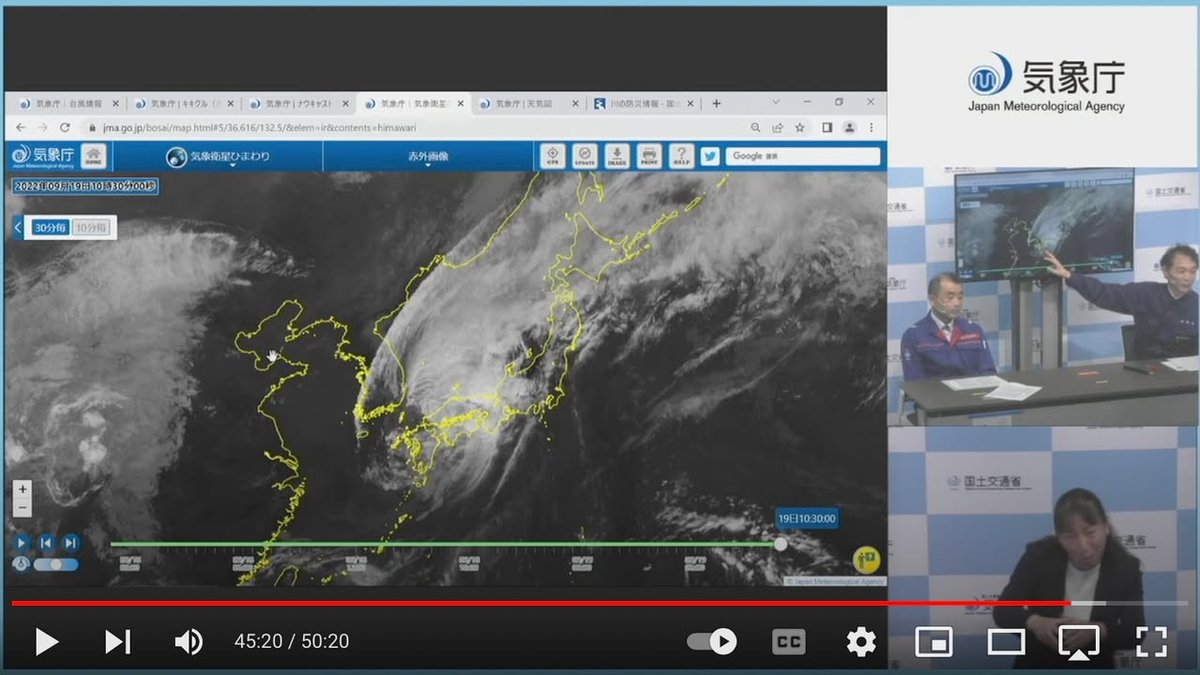
Kirk here with a slightly premature (?) post-mortem on the typhoon. I just happened to watch part of a live press conference with officials at the JMA (Japan Meteorological Agency) where they were explaining why the typhoon wasn't quite as bad as feared. I was watching with NHK's app on my phone but I found the same content (recorded, not live) on YouTube here:
https://www.youtube.com/watch?v=Uv_eIKNZrvg
At about 45:00 into the video, they're talking about why it wasn't quite as terrible as predicted. One point was that the path of the typhoon took it directly over land in Kyushu. Going directly over land sounds bad but, actually, that weakened it. If the path had been a little more to the west, as they had expected, the storm would have remained much stronger and the effect on Kumamoto would have been much greater. In response to a question about why the path was slightly different from what was expected the answer was that it was within the range of possibilities that they were looking at but that they just weren't sure exactly how it would behave.
There has been damage in many parts of Kyushu, including Kumamoto, but so far the damage in Kumamoto has not been as great as was feared. The Kumagawa River is very high and there is still a chance of flooding (or perhaps some flooding actually occurred in some spots -- not sure) but I suspect that it will wind up being a close call that didn't cause major damage.
My impression from this storm and previous storms is that the folks at the JMA are professionals who really know what they are doing. Typhoons are chaotic systems that still can't be predicted with complete accuracy, though prediction is much better now than in recent decades. For that reason, sometimes things aren't quite as bad as feared (this time seems to be such a case) and sometimes they are worse and people who aren't prepared or don't take warnings seriously get hurt. I have complaints regarding communication issues (particularly regarding the question of who needs to evacuate and how to make that decision) but not about the basic 5-level warning system itself or the expertise of the people in the JMA.
So, I hope people don't conclude from their experience with this typhoon that future warnings can be ignored. There are low-probability high-impact issues that need to be taken seriously even if warnings are not always followed by cataclysmic events.