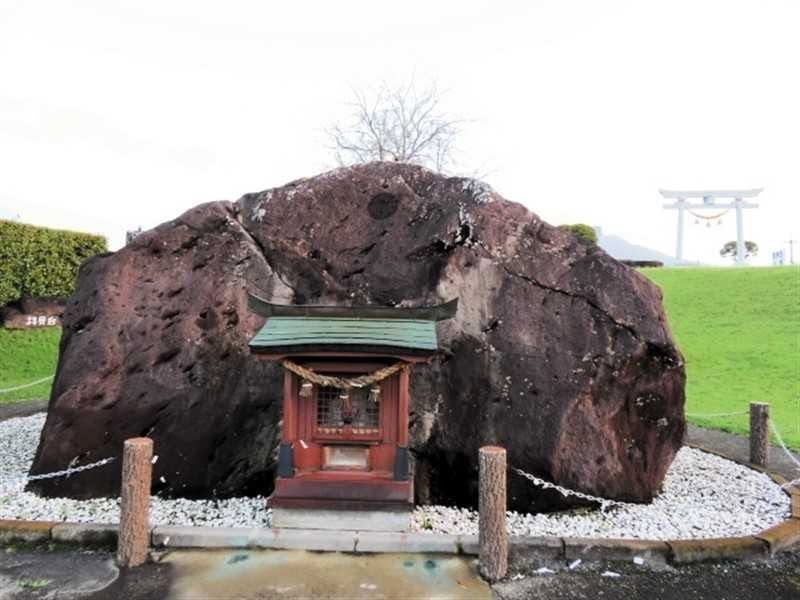
William My liberal arts college forced me to take a laboratory science class, so I took the easiest: Geology. Turns out I'm glad I did. Sometimes one encounters a rock (or many) which shouldn't be there. In Maine, they were mostly moraines, which are piles of rocks, the tail ends of long vanished glaciers. In Kumamoto, they tend to be astonishingly large boulders of granite, intrusive igneous rock which Aso burped up over unimaginable distances in ancient eruptions. (Keep your eyes open: they are scattered throughout the city.) Ancient people not versed in geology attributed their existence to the divine - hence, the Shinto stuff.
One such is in Aso Ōmikami Ashiato Megami Ishi Park, Minamiaso Village (阿蘇大御神足跡女神石 - which literally means "Goddess Stone in the Footsteps of the Great Deity Aso Omikami).
Kumanichi reports on a bit of lichen growing in a circle on the rock which resembles, if one is colorblind, the Japanese flag, or Hinomaru. Take care in distinguishing between moss (苔, koke), which is a plant - it lives by photosynthesis; and lichen (地衣, chi'i - a beautiful word which literally means "earth's clothing"), which is a symbiotic relationship between a fungus (tough but cannot photosynthesize) and an alga (weak but can photosynthesize and by whose byproducts - algae farts - the fungus lives).
Anyway, on this immense megalith, a lichen in the shape of the Hinomaru may be found. Have yourself a field day.
https://kumanichi.com/articles/835161