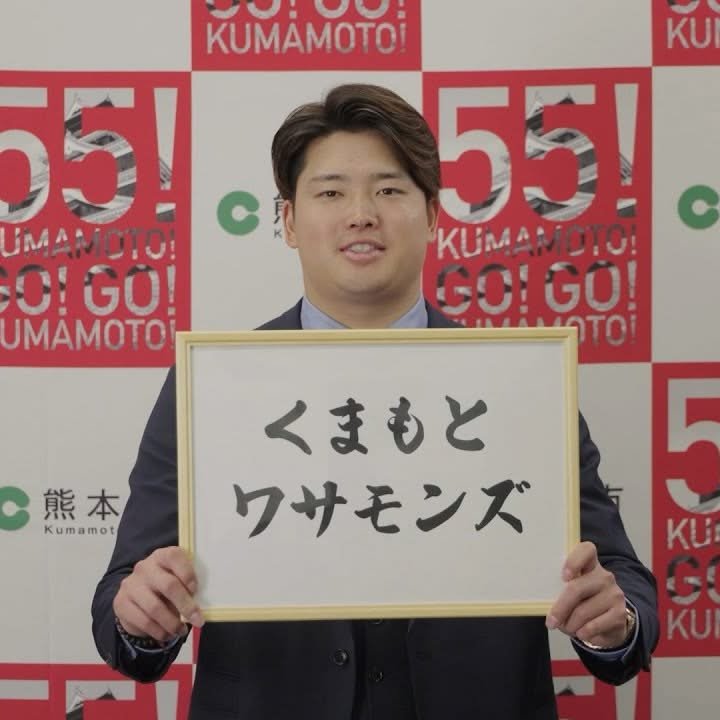
Kirk here. As Kuma Visit explains, In Kumamoto dialect "wasamon" means a person who likes the latest fashions, new things, gadgets, etc. Mr. Murakami's sign says "wasamons," combining Kumamoto dialect with the English "s" to designate plural (people in Kumamoto who like new stuff). In the video linked to in Kuma Visit's post lots of people talk, in Kumamoto dialect, about how they're taking a new (wasamon?) approach to promoting Kumamoto. It made me smile. :)
By the way, here's a little note on the etymology of わさもん. If you were to write it in kanji it would be 早生者. In standard Japanese, 早生 can be read "wase" and means "an early variety of rice." This word can also be written 早稲, which is how it is written in the Waseda, the name of the university (Waseda [早稲田] literally means "field of an early variety of rice"). In the word "wasamon," "wase" came to be pronounced "wasa." The second part "者" (もん) is normally もの (mono) in standard Japanese but is pronounce "mon" in Kumamoto dialect. It means "person." This is the same "mon" as the one in Kumamon (literally "bear person").
Before posting today, I had to look up the etymology. I referred to the following page:
https://kumaque.com/kumamoto-dialect/1888
If you read Japanese, you might want to read about how wasamon fashions in Kumamoto have be referred to when major brands like Louis Vuitton and Uniqlo were preparing to establish new stores in Tokyo (Amazing, isn't it?!).