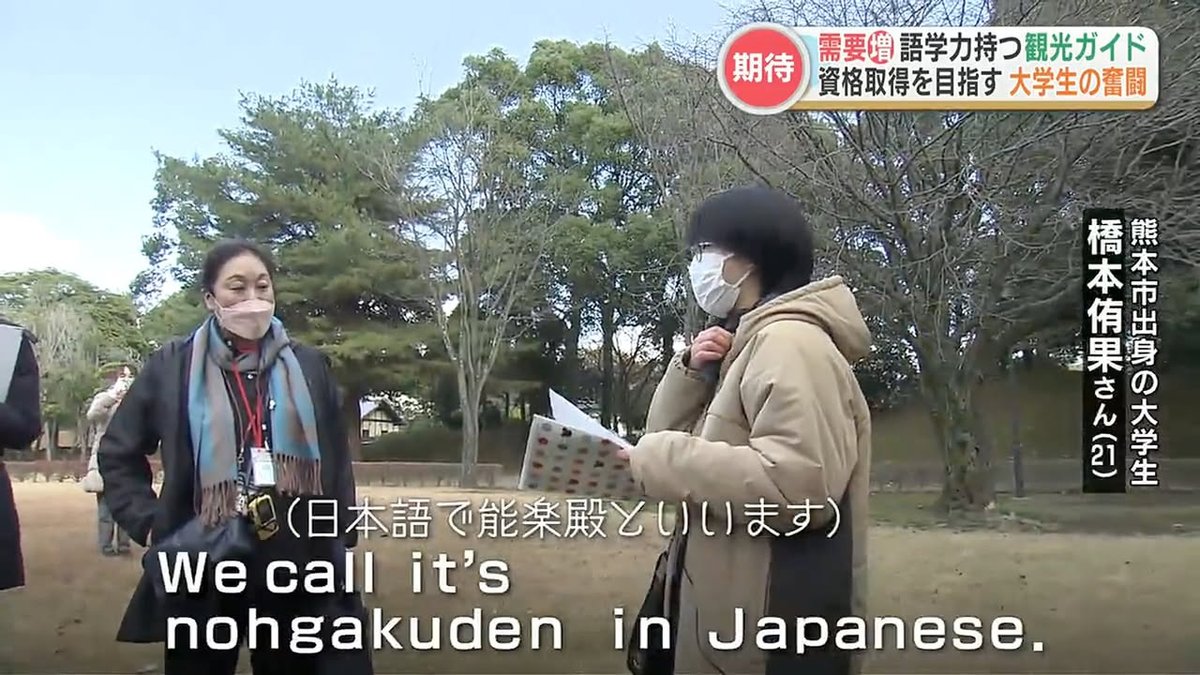
Kirk here. The student shown in the image you see actually said 'We call it nohgakuden in Japanese'; the mistake is that of whoever put the subtitles on the video at RKK. The TV report is about how this university student is studying to become a certified English-language guide.
In one sense, I can understand how staff at RKK might make mistakes with English subtitles like these. They are not specialists in English and they are usually under significant time pressure to prepare their videos for broadcast. On the other hand, I think such mistakes may be a significant problem for young people who are keenly interested in improving their English. If I were such a young person, I can imagine how confused these subtitles would make me. I'd probably assume that the subtitles must be correct and that I failed to hear what she said or that my knowledge of how English works (what's OK and not OK) must be wrong.
Language learning is confusing enough without the proliferation of poor models adding to the confusion. I often hear how Japanese people should worry less about mistakes. Well, yes, if you're in a social situation that requires English, just do your best and don't beat yourself up if you make some mistakes. But, if you're in a position to publish English that will be seen by lots of people, I think it's necessary and good to worry about getting the English right.
You can see the video and text (with the uncorrected English subtitles) here:
https://news.yahoo.co.jp/articles/ae0a7985233356f14a889bce33ab7c0bbd5fe9c2