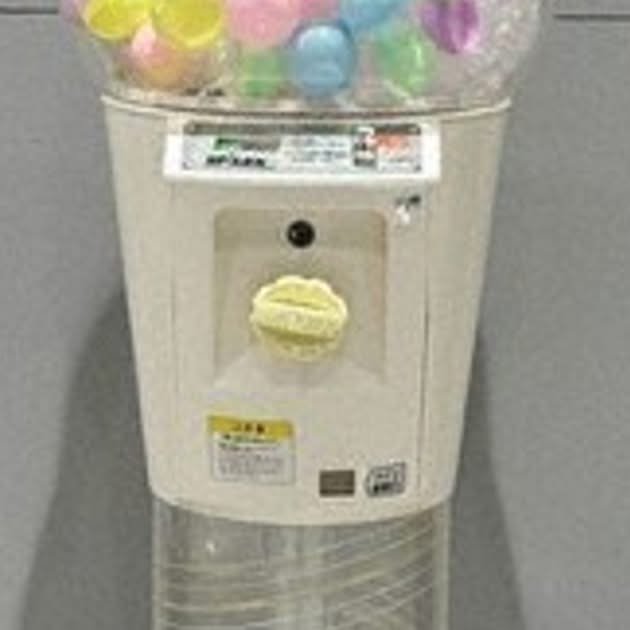
Kirk here for anyone who might be interested in vintage 'gacha'.
2026-02-22 14:22 JST 2026 Kirk here for anyone who might be interested in vintage 'gacha'. Kumamoto Station debuts limited edition 'gacha' capsule machine - The MainichiKUMAMOTO -- A limited-edition capsule toy machine called the https://mainichi.jp/english/articles/20260219/p2a/00m/0bu/03 … ↗ View original post on Facebook For a link to the original post on Facebook, open this page on a computer. Reactions: 3 ← 2026-02-22 07:50 JST 2026-02-23 11:10 JST → Around this time … 2026-02-25 15:34 JSTKirk here. Feeling underpaid in Kumamoto? Well, if we compare ourselves to Lafcadio Hearn, I think we all are. Read this AI generated summary (Claude, my favorite) of a PRESIDENT online article to see just how much better Hearn was paid. ;)---- start AI-generated summary ---Key Takeaways: Lafcadio Hearn (Koizumi Yakumo) and His Time in KumamotoWHY HE WENT TO KUMAMOTOHearn moved from Matsue to Kumamoto in November 1891 primarily for a salary of 200 yen/month at the Fifth Higher Middle School — double what he earned in Matsue. In today's terms, this equates to roughly 96 million yen per year (about $619,000 USD). He also struggled with the cold in Matsue, having spent years in the tropics beforehand.HIS FEELINGS ABOUT KUMAMOTOFrom the start, Hearn disliked the city. He found it less charming and more expensive than Matsue, describing it in letters as "an uninteresting place" and "cold as hell." His family felt like "fish out of water."WHY HE LEFT AFTER ONLY THREE YEARSDespite teaching there until 1894, several factors drove him away: worsening conflicts with colleagues, disputes with publishers, and a general inability to warm to the place. He moved to Kobe, accepting a position at the Kobe Chronicle newspaper at half his Kumamoto salary — a significant pay cut — which shows how strongly he wanted out.HIS FINANCIAL SITUATIONHearn was doing quite well financially. His Kumamoto salary was roughly equivalent to 96 million yen per year (about $619,000 USD) in today's terms. He had accumulated savings of about 160 million yen (roughly $1,032,000 USD), and his royalty income for one year reached around 52 million yen (approximately $335,000 USD).WHAT CAME NEXTHis first major book on Japan, Glimpses of Unfamiliar Japan, was published in 1894 to great acclaim in America. This success, combined with an offer from Tokyo Imperial University at a monthly salary equivalent to about 16 million yen (roughly $103,000 USD per month) — four times his Kobe salary — eventually brought him to Tokyo, where he taught English literature and continued writing prolifically.The article paints Hearn as someone who thrived creatively but struggled persistently with interpersonal relationships and institutional friction — Kumamoto being a prime example of that pattern.Note: Contemporary yen equivalents are from the original Japanese article, which uses a conversion of 1 historical yen = 40,000 modern yen. USD figures are based on an exchange rate of approximately 155 yen per dollar (February 25, 2026).---- end AI-generated summary --- 2026-02-25 12:41 JSTKirk again. I just posted about how RKK and other local media don't seem to be inclined to tell people about local demonstrations against missiles in Kengun. For reasons that are not hard to understand, the PRC is keen to do so. I'm not a fan of Chinese propaganda but, just the same, it's interesting to me that one can learn things from foreign news reports that the local media (at least RKK in this case) doesn't cover.Over 1,000 Japanese protest govt's plan to deploy long-range missiles in Kumamoto 2026-02-25 12:29 JSTKirk here with a share from Mieko Ueno, our local (my neighborhood) member of the city council. Here's an AI translation of the Japanese text:--- start quote ---Stop Long-Range Missile Deployment at Kengun Self-Defense Force Base! Ring of PeaceOn February 23rd, an action called "Stop Long-Range Missile Deployment! Ring of Peace" took place, forming a human chain around the Kengun Self-Defense Force base in Kumamoto City to demand the withdrawal of plans to deploy long-range missiles there.A "Ring of Peace" made up of 1,200 people.We don't need missiles at the Kengun SDF base!We don't need ammunition depots either!What we want to pass on to our children is "peace." --- end quote ---I am not sure yet, but my impression at this point is that this hasn't been reported on TV. I just checked RKK's online archive and nothing. Plenty of "soft" topics but nothing about this. :(https://www.facebook.com/mieko.ueno.37/posts/pfbid02jPw3GuYgqsYr66anmdFhdEJtqr8QSFv2CMkLq8z39ae3ExbCuq4RN74rWrYunE8Vl 2026-02-24 21:23 JSTKirk here. Yesterday the weather was nice so my wife and dog and I went for a little walk in the Ezuko area. I forgot the name of this kind of sakura but every year it blooms quite early in the season. Spring is on its way! 2026-02-23 11:10 JSTKirk here with a local issue that is part of a global phenomenon: bees are in trouble. Here's a summary from Claude (my favorite AI service) that I think helps put the issue in Kumamoto in perspective:----- start of text from Claude -----This article fits into a genuinely concerning global story that has been building for about two decades. Let me put the pieces together for you.The US "Colony Collapse Disorder" backstoryStarting around 2006, American beekeepers began reporting massive, mysterious losses where worker bees simply vanished from hives. It was alarming enough to get a name — Colony Collapse Disorder (CCD) — and serious scientific attention. The "mystery" framing held for a while, but the scientific consensus gradually converged on a combination of causes rather than a single smoking gun: neonicotinoid pesticides (which impair bees' navigation and immune systems), the Varroa mite (a parasitic mite that weakens bees and spreads viruses), habitat loss and monoculture farming reducing floral diversity, and pathogens. The pesticide piece became especially politically charged, leading the EU to ban several neonicotinoids in 2018. US losses have continued at roughly 30-40% of managed colonies per year even after the initial panic subsided.What the Kumamoto article adds to the pictureThe Japanese situation reflects the same multi-factor stress pattern, but with heat emerging more prominently as a driver — which makes sense given Japan's increasingly brutal summers. Kumamoto is in southwestern Japan, which has seen some of its hottest summers on record in recent years. Heat stresses bees directly (disrupting colony thermoregulation and brood development) and also alters the timing and availability of flowering plants that bees depend on. The Varroa mite appears here too, just as in the US and Europe.The fact that Kumamoto ranks second in Japan for honey production and is still allocating $3.27 million in emergency response money signals how serious the agricultural downstream effects are — bees there pollinate tomatoes, watermelons, and strawberries, which are major commercial crops.The global patternBee population stress is now documented across North America, Europe, East Asia, and parts of South America. The stressors vary somewhat by region — pesticide exposure is more central in the US and Europe debates, heat and abnormal weather are increasingly prominent in Japan and other parts of Asia — but researchers generally describe a "perfect storm" dynamic where bees weakened by one factor become much more vulnerable to others. A colony that can handle Varroa mites under normal conditions may collapse when also dealing with heat stress or a bad forage season.The agricultural stakes are high globally because roughly a third of the food humans eat depends on insect pollination, with honeybees doing the largest share of that work among managed pollinators. The Kumamoto article's mention of exploring "alternative insects" for pollination is a sign that some planners are beginning to think about contingency strategies — other bee species, or even other insects — rather than assuming honeybee populations will recover.The headline cause may differ depending on where you're reading the news, but the underlying story is the same: managed honeybee populations are under sustained, multi-front pressure worldwide, and the agricultural systems that depend on them are starting to feel it in practical, budgetary terms.----- end of text from Claude -----Japan's Kumamoto Pref. boosts honeybee loss measures with $3.27 million budget - The Mainichi 2026-02-22 14:22 JSTKirk here for anyone who might be interested in vintage …Kumamoto Station debuts limited edition 'gacha' capsule machine - The Mainichi (this post) 2026-02-22 07:50 JSTAtsuko here. Sharing a beautiful winter sunset viewpoint in Kumamoto.(⁎ᴗ͈ˬᴗ͈⁎)https://www.facebook.com/share/1BdKXru4Pm/?mibextid=wwXIfrーーーーーーーーーーーーーーーーーーーーーーー21 February 2026 Day two of spectacular views.By evening, approximately 350 visitors had gathered, quietly captivated by the breathtaking sight of the setting sun merging with the sandy tidal flats.We are grateful to have shared this moment with everyone who came!Tomorrow the weather will take a turn for the worse, but the day after tomorrow promises clear skies all day long!We look forward to meeting you all at the Okoshiki Coast Viewing Point.ーーーーーーーーーーーーーーーーーーーーーーーOkoshiki Kaigan placehttps://www.facebook.com/share/1CixwD9tuj/?mibextid=wwXIfrThe season of spectacular views has arrived!【Guide Map to Okoshiki Coast Viewpoint】※The name "Okoshiki Coast Mudflat Scenic Area" has been changed to "Okoshiki Coast Viewpoint" from May 2025.Ground Course: https://youtu.be/mF_VZwRFGNMViewable on YouTube via the link.For the return journey, follow the directions via the QR code on the observation point's information board POP.【Okoshiki Coast Tide Table - February 2026】This month's spectacular viewing days are four days from 20th to 23rd February.Additionally, from 4th to 7th February and on 19th February (five days in total), whilst not quite reaching spectacular viewing day levels, you can witness the collaboration between the sandy tidal flats stretching into the distance and the setting sun.We look forward to welcoming you at the Okoshiki Coast Observation Deck.Yellow and orange on the tide chart indicate low tide coinciding with sunset.Yellow (Spectacular View Days)・・・View the vast tidal flats and sunset.Orange・・・・・・View the expansive tidal flats and sunset.Blue .................. Offers views of the vast tidal flats, though not coinciding with sunset.Additionally, the car park being constructed above the Okoshi Coast Observation Point is nearing completion. Work on the existing car park is scheduled to commence in early January.Please also note that the road from the Toguchi side is closed to traffic on weekdays due to widening works.Details regarding the construction works will be posted once information is received from the relevant department at the City Office.※ The Okoshi Coast tide table has used values from "Tide MieYell" since 2015. Please note that low tide times and tide levels may differ slightly depending on the tide table used. 2026-02-20 21:20 JSTKirk here. Now, at least the families can get some closure and mourn.3 Bodies Found on Volcano's Crater 4 Weeks After Sightseeing Helicopter Crashed at Tourist Attraction 2026-02-17 23:22 JSTJoe Tomei here with an exchange event at my school, Kumamoto Gakuen on 3 March. It's an exchange event where my colleague, Dr. David Iwashita, will first give a presentation to be followed by short talks by students who are returning to Kumamoto and some opportunities to discussMarch 2 (Monday) 13:00-14:30 Shin 1 gokan, Kumamoto Gakuen UniversityIf interested, please contact [email protected]. Hope to see you there! 2026-02-17 15:35 JSTKirk here with an article comparing Kurokawa's hot springs with Yufuin and Beppu. Of course, they all derive their heat from Mt. Aso.The Ultimate Kyushu Onsen Guide: Kurokawa vs. Yufuin vs. Beppu 2026-02-16 12:52 JSTKirk here with a share I happened across today.