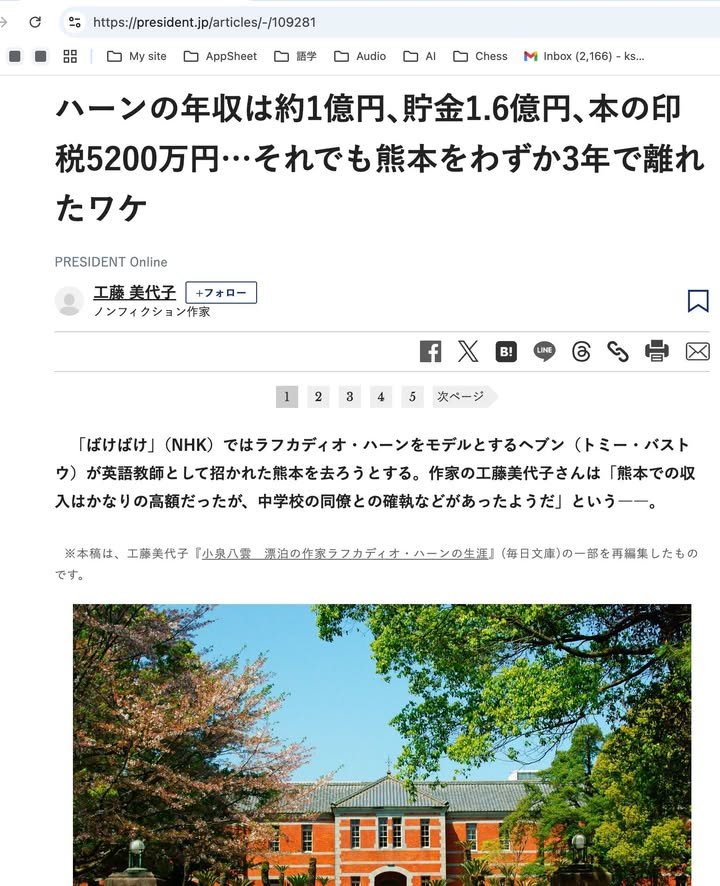
Kirk here. Feeling underpaid in Kumamoto? Well, if we compare ourselves to Lafcadio Hearn, I think we all are. Read this AI generated summary (Claude, my favorite) of a PRESIDENT online article to see just how much better Hearn was paid. ;)
---- start AI-generated summary ---
Key Takeaways: Lafcadio Hearn (Koizumi Yakumo) and His Time in Kumamoto
WHY HE WENT TO KUMAMOTO
Hearn moved from Matsue to Kumamoto in November 1891 primarily for a salary of 200 yen/month at the Fifth Higher Middle School — double what he earned in Matsue. In today's terms, this equates to roughly 96 million yen per year (about $619,000 USD). He also struggled with the cold in Matsue, having spent years in the tropics beforehand.
HIS FEELINGS ABOUT KUMAMOTO
From the start, Hearn disliked the city. He found it less charming and more expensive than Matsue, describing it in letters as "an uninteresting place" and "cold as hell." His family felt like "fish out of water."
WHY HE LEFT AFTER ONLY THREE YEARS
Despite teaching there until 1894, several factors drove him away: worsening conflicts with colleagues, disputes with publishers, and a general inability to warm to the place. He moved to Kobe, accepting a position at the Kobe Chronicle newspaper at half his Kumamoto salary — a significant pay cut — which shows how strongly he wanted out.
HIS FINANCIAL SITUATION
Hearn was doing quite well financially. His Kumamoto salary was roughly equivalent to 96 million yen per year (about $619,000 USD) in today's terms. He had accumulated savings of about 160 million yen (roughly $1,032,000 USD), and his royalty income for one year reached around 52 million yen (approximately $335,000 USD).
WHAT CAME NEXT
His first major book on Japan, Glimpses of Unfamiliar Japan, was published in 1894 to great acclaim in America. This success, combined with an offer from Tokyo Imperial University at a monthly salary equivalent to about 16 million yen (roughly $103,000 USD per month) — four times his Kobe salary — eventually brought him to Tokyo, where he taught English literature and continued writing prolifically.
The article paints Hearn as someone who thrived creatively but struggled persistently with interpersonal relationships and institutional friction — Kumamoto being a prime example of that pattern.
Note: Contemporary yen equivalents are from the original Japanese article, which uses a conversion of 1 historical yen = 40,000 modern yen. USD figures are based on an exchange rate of approximately 155 yen per dollar (February 25, 2026).
---- end AI-generated summary ---