Posts
Fiona here, with a couple of event announcements...
Firstly, on Saturday May 18th from 7pm, there's a Quiz Night, in English, open to all and free of charge, at Britz English School in Onoue, close to the Prefectural Office. You can find out the details, and sign up as a player or even a quizmaster at the Escape from Britz Facebook page. We also hold games nights pretty often, and are happy to welcome casual but competitive board game enthusiasts!
Secondly, as creator and gamesmaster at the only escape room in Kumamoto, it's the final call for anyone who would like to play my current game. It's The Great Britz Treasure Hunt and is aimed at escape room novices, families and teams of English learners (both adults and children). I'll be winding down this game shortly to make way for the third installment coming in June. Again, you can find out more and make a booking through the Escape from Britz page.
I'll be posting again once I'm ready to unveil my latest game...
Fiona
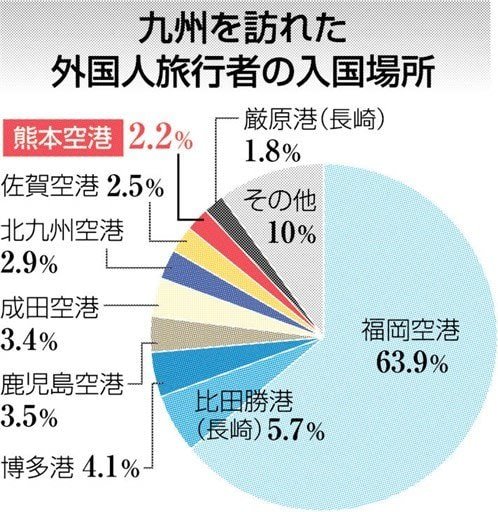
Sad news: Kumamoto airport ranks second to last of Japanese ports welcoming international passengers to Kyushu. At 2.2%, it just edged out Nagasaki port's 1.8%, a margin which statisticians refer to as a "smidgen."
Glad news: There is plenty of room for growth! Plans are afoot (alight?) to vastly expand international flights with the pending privatization of the airport. (The below graph includes all points of entry for non-Japanese visiting Kyushu, including sea ports.) - William
https://this.kiji.is/498268246206727265?c=92619697908483575
Shoubu (しょうぶ、菖蒲) are iris leaves. The kanji is homonymous with 勝負, meaning "victory or defeat" - that is, a battle, a symbol of spirit to meet challenge. Customary on Children's Day is to place shoubu above the house entrance (as are now on mine, though my children have long departed) and to have children bathe with them in what is called a 「しょうぶ湯」- "shoubuyu," or "iris bath".
Kumanichi notes that local sentos (銭湯、public baths) offered free admission to children on 5/5 and provided a cute photo. These baths were crucial after the quakes, admitting free those with no water or gas. If you've never visited a sento, you should. Here is a link to local sento. -William
https://tinyurl.com/y2uqzvu8
https://this.kiji.is/497724659564774497?c=92619697908483575
しょうぶ湯で健康に 熊本市内の7銭湯で伝統行事 | 熊本日日新聞
こどもの日の5日、熊本市内の銭湯7カ所で「しょうぶ湯浴場まつり」があった。小学生以下は無料開放。多く...

Atsuko, who I think has been doing a great job since she became a Kumamoto International editor, posted about an e-book that contains information about various things one can experience here in Kumamoto:
https://www.facebook.com/Kumamotoi/posts/2599147313492018?__tn__=-R
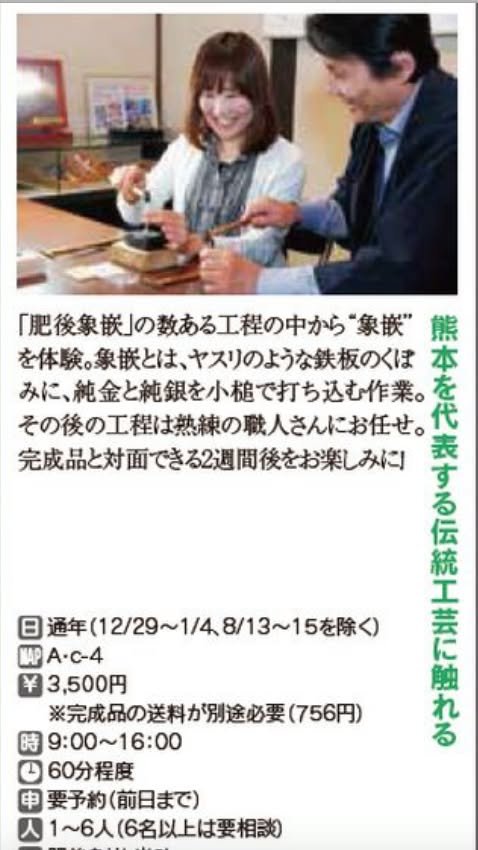
The attached image is one item from that e-book. It's an opportunity to make your own Higo Zogan (silver or gold inlay, damascene) under the guidance of an expert craftsman. If you don't know about Higo Zogan, check out the following page:
https://japan-brand.jnto.go.jp/crafts/metal_work/99/
My image cuts off the address and phone number so I'll post another screenshot as a comment to this post.
-- Kirk
Hi again. If you would like to enjoy Kumamoto culture or you should treat any guests in Kumamoto, the guide book will help you. I got paper one before. But this webpage might be more helpful. It introduces lots of Japanese traditional culture and products. For example, you can taste Sake, make Shoyu, make Wagashi and Karashirenkon, make lots kinds crafts.....
Please check these and enjoy Kumamoto well.ーAtsuko(*Ü*)
https://m.facebook.com/story.php?story_fbid=1013273925394078&id=483894111665398&comment_id=2175121109209348&refid=52&__tn__=R
http://static.kumamoto-ebooks.jp/actibook_data/190109103_machisaki/HTML5/pc.html#/page/2

It was so sorry Kumamoto Volters could not win today's the last game, 77-82.
Kumamoto Volters is a professional Basketball team. They belongs B2 League. If they could win today's and tomorrow's games, they can belong B1 League. Their home gym was in Mashiki town. Yes, they also got the Kumamoto earthquake. They did lots volunteers. They sweared to win for Kumamoto and play for victims. Now,they became a good team instead of earthquake, heavy environment.
They are almost to be a B1 team this year. They lost today's chance, unfortunately.
But it was so nice, existing game!!! They did well. We enjoyed their powerful play so much.
I hope their next year's challenge.
GO GO VOLTERS, Just KEEP Going with us.
ーAtsuko(*Ü*)

Hi International friends,
Hope you all are having good break this Golden week.
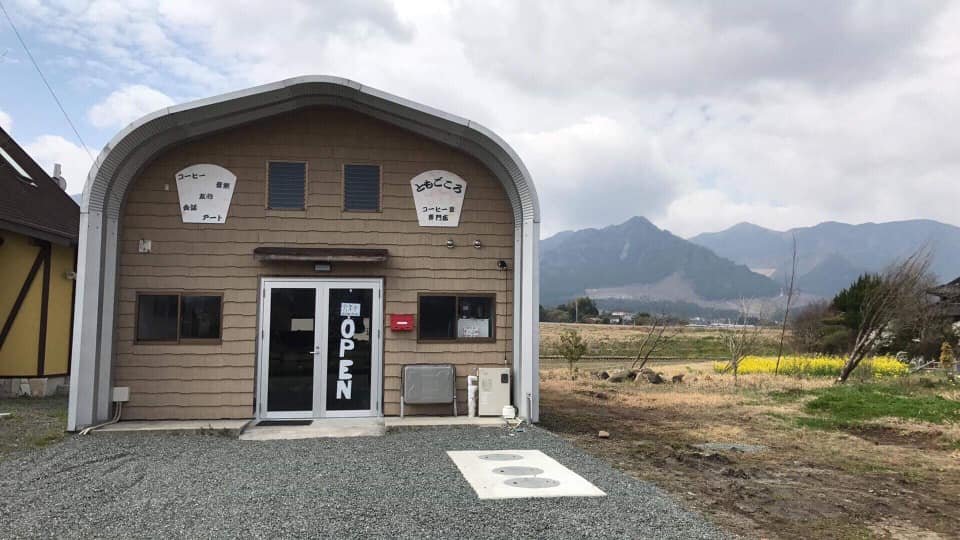
I am sharing with you new cafe information in Minami Aso.
The name of the cafe is Tomogokoro.
Address is 1350-8 Ka-in, Minami Aso Village.
Smiths family holds Bible study and Sunday service there on Thursdays and Sundays.
The schedules are as follow:
Sunday service (Japanese) is at 11 a.m.
Thursday evening service (English) is at 5:30 p.m.
Apart from that they have another bible study in Hilltop international school in Tatsuda on Sunday afternoon 5pm.
The Internet address for Tatsuda bible study is this:
http://www.shinseibaptist.com
Everyone who is looking for bible study or fellowship is welcomed to attend 😃
-Olivia-
This is a few days old now. I've been in holiday mode so I wasn't paying attention to the news at the time but yesterday I saw a TV report about volcanic ash covering crops and cars in Takamori. A resident interviewed on the show said it had been a few years since they had experienced a dusting of ash like this. Here's hoping that this is the peak of the activity and the volcano goes back to sleep soon.
-- Kirk
P.S. Kusasenri, the plateau near the volcano, is still open -- or, at least, was still open at the time of the TV report I saw. Kusasenri is outside the 1 km range mentioned in the article.
Mount Aso belches smoke over Kyushu in first eruption since mid-April | The Japan Times
A small eruption on Mount Aso shot smoke as high as 1,600 meters over Kyushu on Friday, the Meteorological Agency said. The eruption in Kumamoto Prefecture

Aso's volcanic activity is in its fourth day. Kumanichi notes this photo, which shows 「火映現象」- a phenomenon of combustion inside a volcanic crater that creates ruddy reflection against the smoke or clouds - was taken over a 20-second period. The stars provide a beautiful background.
The eruption has been producing some 4,000 tons of sulfur dioxide daily, which eventually must come back to earth - much to the consternation of nearby farmers. Many will likely lose their entire crop. More photos at the link. - William
阿蘇中岳噴火続く 「火映現象」確認、農家は農作物への影響懸念 | 熊本日日新聞
福岡管区気象台は4日、3日午後発生した熊本県の阿蘇中岳第1火口の小規模噴火が4日も継続していると発表...

Kirk here with a fairly long discussion of the exclusion of Masako-sama and other royal women from the enthronement ceremony. This is probably too long for a Facebook post but, if you're interested in the topic, I hope you'll keep reading.
The pictured article is from the New York Times but I heard an NPR story with a similar headline:
Japan's New Emperor Naruhito Ascends Throne, But His Wife Wasn't Allowed In The Room
https://www.npr.org/2019/05/01/719157947/japans-new-emperor-naruhito-ascends-but-his-wife-wasnt-allowed-in-the-room
Both reports point to the exclusion of all women of the imperial household from the enthronement ceremony. This exclusion was also reported in English by NHK but without a note of criticism:
"Among the Imperial family members, only male adults will be in attendance. That will be Crown Prince Akishino and Prince Hitachi, the younger brother of Emperor Emeritus Akihito."
https://www3.nhk.or.jp/nhkworld/en/news/20190501_10/
Based on what I have seen on TV and what I have been able to find in Japanese on the internet, Japanese media reports that question the exclusion of the royal women are few and far between. Here's one that I was able to find, however, the does present a critical perspective:
天皇即位儀式に片山さつき大臣出席、皇后・雅子さま同席許されず…国民から疑問続出
https://biz-journal.jp/2019/05/post_27750.html
The headline indicates that many Japanese people question the exclusion of Masako-sama. According to the article, Masako-sama's exclusion has been particularly hard for people to stomach because a controversial female cabinet minister, Katayama Satsuki, was allowed at the ceremony. Katayama is controversial in part because accusations of improper political funding, which she denied at first, but for which she later issued "corrections":
Minister Katayama hit with more corrections to political funding reports
https://mainichi.jp/english/articles/20181201/p2a/00m/0na/023000c
"Three political groups headed by regional revitalization minister Satsuki Katayama have corrected entries in their political funding reports for 2017 by a total of more than 6 million yen, according to reports released on Nov. 30."
For most Japanese people, the biggest strike agains Katayama is probably the corruption charges. I, however, hold a grudge against her because she has tried to when points with her xenophobic base by engaging in foreigner-bashing:
http://www.debito.org/?p=11970
and
https://ameblo.jp/funnyfunnynews/entry-12217357850.html
At any rate, a scandal-ridden, xenophobic minister can attend but the Her Highness the Royal Empresses can't. That's one point of discussion for some Japanese.
However, I suspect that most Japanese people haven't been made aware of any controversy about the decision. Most media reports I've seen give the impression that those responsible for determining the content and tone of the reports believe that -- on this occasion, at least -- the role of the media should be closer to that of a cheerleader than to a watchdog. One approach is to pass over unsavory topics like the exclusion of women all together. The vast majority of reports falls into this category. Another approach might be termed "glass-half-full" reporting. Reports such as the following, which laud Katayama's breaking of the glass ceiling as the first woman to attend such an event, while glossing over Masako-sama's exclusion, constitute examples:
https://headlines.yahoo.co.jp/hl?a=20190501-00000045-jij-pol
and
https://www.nikkansports.com/general/nikkan/news/201905010000398.html
The last way of dealing with the matter is to report about it as a "foreign" perspective:
女性皇族出席できない儀式に批判も ご即位、韓国で大きく報道
https://www.fnn.jp/posts/00417014CX/201905011225_CX_CX
「新天皇即位、妻は見られず」 海外報道、反応様々
https://www.asahi.com/articles/ASM515G6TM51UHBI01T.html
This may be better than not bring the matter up at all. However, perhaps by design, the approach reduces the likelihood that readers/viewers will be led to think deeply about the rectitude of the decision to exclude imperial women precisely because the criticism is presented as "foreign." People who are so inclined can simply dismiss the critiques as the "misunderstandings" of people who can't really comprehend how wonderful Japan is. Or, the critics can can be dismissed as persons who suffer from that all-too-common disease of the mind called "anti-Japanese emotion" (反日感情).
In that sense, I think the first Japanese article I quoted is particularly noteworthy because it talks about discussion among those in charge of the preparations for the ceremony. In other words, whether or not female royalty should be allowed to be present wasn't a foregone conclusion. It is also noteworthy because dissatisfaction among ordinary Japanese people, not just foreigners, is described.
One final note: This occurred in the context of discussion about whether or not a woman might someday be allowed to become Emperor. This is not just a hypothetical question because, as you can see by the tiny contingent of male royalty that WERE allowed to attend, male royalty are in short supply. One way to keep the question of female accession to the throne open might have been to allow female royalty to be present at an accession ceremony. Conversely, not allowing attendance seems to say that such accession is out of the question. And, that's something about which a lot of Japanese have other ideas. The following Japanese news article reports that 70% of poll respondents were in favor of allowing a woman at the top of the imperial hierarchy:
https://www.jiji.com/jc/article?k=2019041200827&g=soc
So, it would seem that questioning the exclusion of women from such a ceremony is probably a matter about which a good number of Japanese have qualms -- not just befuddled and/or anti-Japanese foreigners.
https://www.nytimes.com/2019/04/29/world/asia/japan-emperor-women.html
As a New Emperor ls Enthroned in Japan, His Wife Won’t Be Allowed to Watch
The new empress, Masako, will be barred from attending the ascension ceremony of her husband, Naruhito — an example of the diminished status of women in Japan’s imperial family.
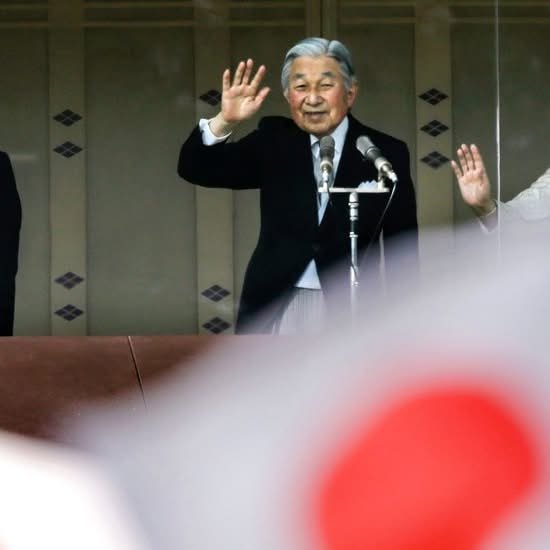
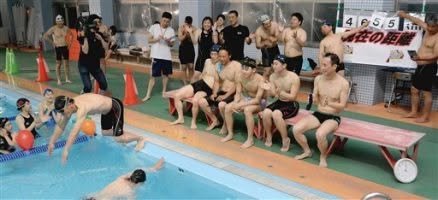
Nagasu Town (長洲町) is the goldfish capital of Japan. So when the town's denizens decided to hold a 24-hour swim relay to greet Reiwa, they didn't choose their goldfish - after all, what team of goldfish can swim for 24 hours straight? - and instead utilized 139 human volunteers, from kids to some in their 70s, who swam laps from noon on April 30 to noon on May 1, day and night.
Reportedly, the goldfish were not impressed. - William
https://kumanichi.com/news/1001366/
It's nice to stop raining and start our new Era happily. Now I would like to introduce 2 local festivals during GW.
One is Nagasu Kingyo Matsuri 長洲 金魚祭り. Nagasu is famous of its Kingyo, Golden fish. At there, they will hold Golden fish scooping match 金魚すくい大会. On May 3, It's for individual match, for 200 kids, 200 adults. On May 4, It's for team match. Each team needs 4 people.
https://www.town.nagasu.lg.jp/kankou/kiji0035412/index.html
And the other one is Ueki Suika Matsuri, 植木 スイカ祭り. Lots of Kumamoto-i reader seem to have felt sorry about robbed watermelon in Ueki town. Now, we should cheer them with joining and enjoying this festival. This festival is held today too. But especially on May 5, they will have match races who is the fastest eater of watermelon,スイカの早食い大会 !!
Hoping to check the details and enjoy them as Kumamoto citizens!
I'll check your winning comments on TV.ーAtsuko(*Ü*)
http://www.yumedaitikan.jp/2019/04/02/すいか祭り開催のお知らせ-3/
『第24回火の国長洲金魚まつり』開催!~大型連休は金魚の町 長洲町で過ごしませんか?~

It’s official today.
We entered the era of Reiwa (令和).
-Olivia-
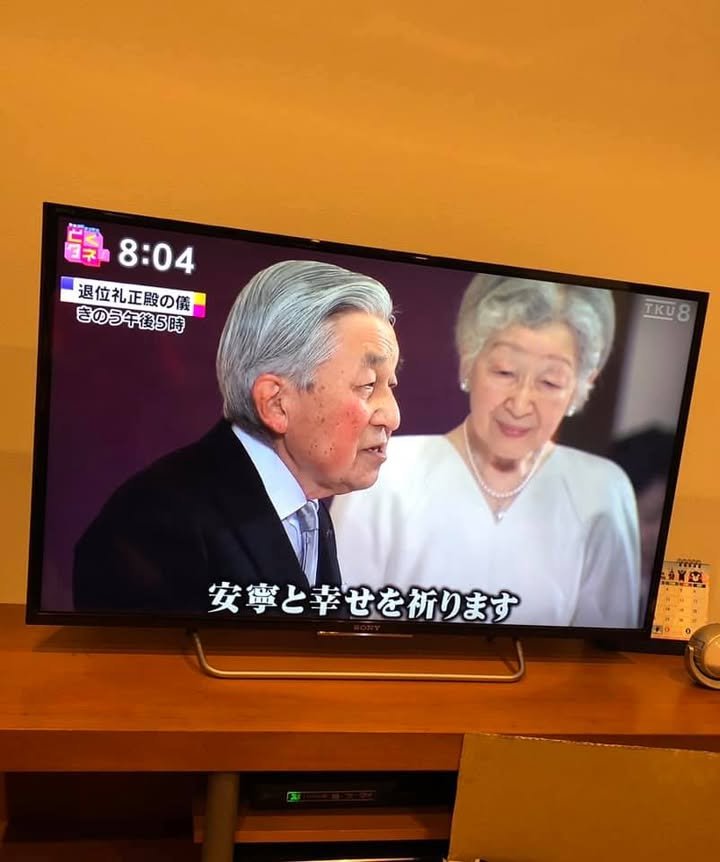
This article was little bit old one. But the readers of this page seem to like to discuss and know about Japanese well. I'd like to share it here again.
Words show lots things like our life and thinking, I think. How many words do you know in this article?
Hoping enjoy these Heisei words at the last day of this Era. ーAtsuko(*Ü*)
Heisei it ain't so! An era of great vocabulary is ending
The language of Heisei has reflected, absorbed and sometimes propelled change. Words were imported and exported, invented and discarded, revamped,...

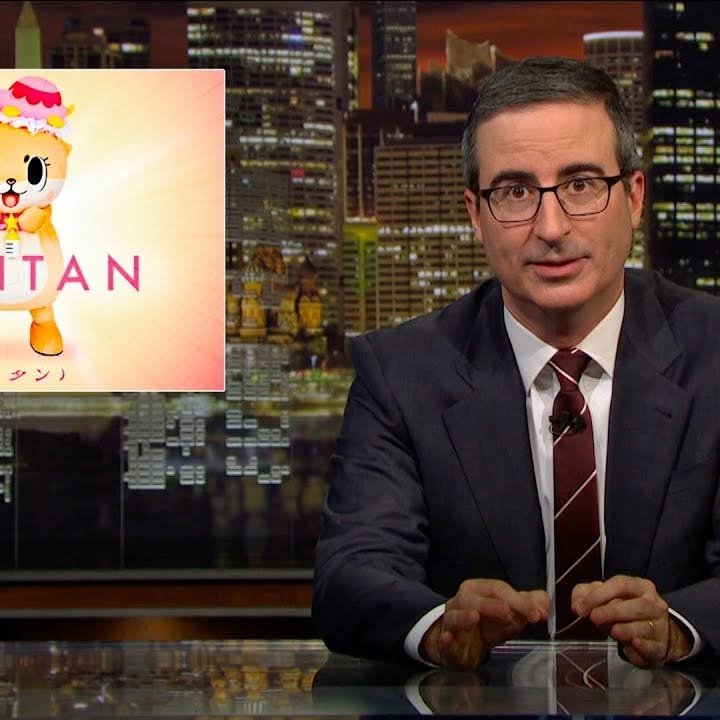
A note from the Kumamoto International Mascot Desk (it's difficult to type in our costumes): Chiitan, a giant otter wearing a turtle as a hat, is the unofficial mascot of Susaki (須崎市), our neighbor to the northeast in Kouchi, Shikoku, whose official mascot is Shinjo-kun, also a giant otter but with an upturned ramen bowl on his head rather than a turtle. Both are modeled after Chiitan, an actual otter, who, being an actual otter, abides no headwear.
With that, one can read trouble brewing: "Rival otter mascots with unconventional head-wear do not good bed-mates make." (Shakespeare?)
Fortunately, British comedian John Oliver intervened, sending in his own mascot, Chiijohn. You must watch this to the end. - William
Chiitan: Last Week Tonight with John Oliver (HBO)
The Japanese city of Susaki cut ties with their unofficial otter mascot, Chiitan, leaving their official otter mascot, Shinjo-kun, all alone. So we came up w...
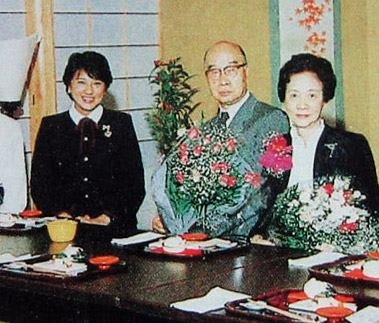
I don't mean to rain on the parade of the changing of the imperial guard, but, as this is a page about Kumamoto, I thought I'd describe the connection between the new Imperial Empress, Masako, and Minamata. Masako is the granddaughter of Yutaka Egashira (in the center of the photo) who was president of Chisso from 1964 to 1971 and then Chairman of the Board of Directors until May of 1973.
Mr. Egashira was not with the company when it began to dump lethal mercury in Minamata Bay. He had been called in to help put the company back on its feet after the pollution came to light:
"Yutaka Egashira, who while working for the Industrial Bank of Japan was assigned to take over management of one of its creditors the Chisso Corporation to prevent it from financial collapse."
https://en.wikipedia.org/wiki/Masako,_Crown_Princess_of_Japan
Mr. Egashira did not start the discharge of mercury but it continued though the first four years of his administration. Chisso did not stop the production process that caused the pollution until 1968.
Then, at an infamous stockholder's meeting held in November of 1970, Mr. Egashira is credited with hiring yakuza (mobsters) to intimidate the Minamata disease patients and their supporters who had purchased single shares of stock in order to gain the right to attend the shareholders meeting.
"Chisso president later chairman Yutaka Egashira (Later maternal grandfather of Masako, Crown Princess of Japan) used yakuza in order to threaten and silence patients and their supporters."
https://en.wikipedia.org/wiki/Chisso
While Mr. Egashira was Chairman of the Board, Chisso hired thugs to brutally beat Eugene Smith for the crime of publicizing what Chisso had been up to:
"Chisso had American photographer and photo-journalist W. Eugene Smith beaten by yakuza goons after Smith published a highly regarded photo-essay showing the caustic injuries and birth defects Chisso had caused the Minamata population."
https://en.wikipedia.org/wiki/Chisso
"On July 7, 1972, during the course of a protest against the Chisso Corporation, a chemical company in Minamata that had been dumping industrial waste into the water, Mr. Smith was severely beaten by six men. As result of his injuries, he is now almost entirely blind."
https://www.nytimes.com/1974/04/09/archives/blinded-in-beating-photographer-still-presses-a-crusade-colleagues.html
I haven't seen any reference to Mr. Egashira having ordered Eugene Smith's beating, but given his previous hiring of thugs for the shareholder's meeting and his continued high station in the company, it seems likely that he knew about and approved the plan.
All of this is more-or-less common knowledge and so it was considered when the prospect of Masako becoming the Crown Princess through her marriage to Prince Naruhito came up.
"Egashira’s link to Chisso was initially considered a sticking point for Masako’s marriage to Naruhito, but top palace officials eventually approved it after concluding Egashira was sent to Chisso from a now-defunct Industrial Bank of Japan to reconstruct the financially strapped chemical firm in the 1960s. They said Egashira was not responsible for the pollution scandal."
https://www.denverpost.com/2006/09/25/obituaries-in-the-news-14/
True, he didn't start the pollution and it was under his administration that the pollution finally ended. OK. But, as I've just described, there were a few other things that happened under his administration as well.
-- Kirk (Curmudgeon in Chief)
P.S. I don't have anything against Empress Masako. Grandchildren can't control grandparents. But, I think the history of Minamata disease should be known. This is one example of how deep into the heart of Japanese society the Chisso rot extended.
These are time table of the changing to New Era, New Emperor, New age!!
Check it out and enjoy them together !! ーAtsuko(*Ü*)
The key ceremonies in Japan's Imperial succession
Emperor Akihito’s abdication, one of several ceremonies marking the transition to his heir, Crown Prince Naruhito, will be a brief, relatively...

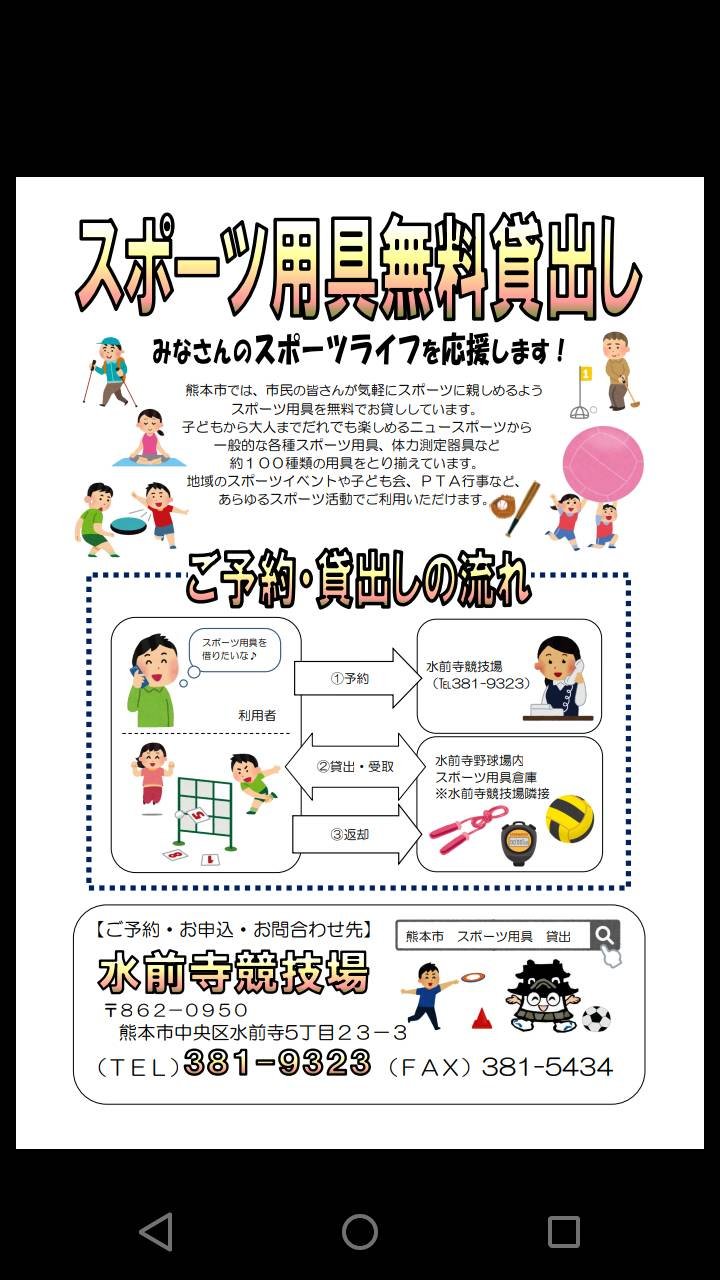
It's the nice weather to play sports during GW.
If you want to play sports with your friends and want to borrow some sports goods easily, I recommend to contact Suizenji Kyougijyou 水前寺競技場.
You can borrow these various lots goods by free. They accept only some group and team. They don't allow to borrow for someone personally, private.
This office opens during GW too. You should call there and book before you use the items. Hoping you enjoy sports with your friends together and have lots fun.-Atsuko(*Ü*)
https://www.city.kumamoto.jp/hpKiji/pub/detail.aspx?c_id=5&id=639&class_set_id=2&class_id=234