Posts
This post is not directly related to Kumamoto. If you have an interest in how crimes committed by non-Japanese are presented in the media, you may want to keep reading.
The other day, I saw a report about the following incident on a news program I had recorded:
https://www.youtube.com/watch?v=jLDHOF9dEs4
It's an attempted murder case in which the suspect is alleged to have attacked the policemen who came to see him about a traffic violation. What surprised me was that they only referred to the suspect as "the man" (男は) and did not identify him by name. This surprised me because recently there was a big flap about a Vietnamese person who resisted arrest and fled with handcuffs still attached:
https://www.japantimes.co.jp/news/2017/09/02/national/crime-legal/vietnamese-turns-biting-cop-escaping-handcuffs/#.Wa4BQK2B2-o
The name of the suspect (along with a picture and his nationality) was published early on, even though he was less violent than the man accused of attempted murder.
I wondered if there were any clear rules about when to go public with personal information and when not to. According to this website that appears to be sponsored by a group of lawyers, there are none:
https://www.fuhyo-bengoshicafe.com/bengoshicafe-12954.html
"この点、法律上特に実名報道の基準はありません。報道機関内で通用しているガイドラインなどもありません。"
In the particular cases I mentioned, there may be a reasonable explanation for the difference in treatment of the suspects, but at this writing I can only speculate about what that might be.
That's all I wanted to say -- just a little note about something I will continue to think about as I consume TV news.
-- Kirk
警察官2人を切りつけ 殺人未遂容疑で男を逮捕 金沢
27日夜、金沢市の住宅で、交通違反の捜査で訪れた警察官2人がこの家に住む男にいきなり刃物のようなもので切りつけられてけがをし、男は車で逃走しましたが、およそ1時間後に警察に身柄を確保され、殺人未遂の疑いで逮捕されました。警察官2人はいずれも意識があり、命に別状はないということです。 警察によりますと、27日午後1...

We, at Kumamoto International, have received an inquiry about whether any events have been planned to be held in Kumamoto on World Peace Day (国際平和デー), September 21st. I looked on the web and found references to events to be held in Hiroshima but nothing about Kumamoto. Does anyone know anything about an event planned for Kumamoto?
-- Kirk
P.S. You can see the entire documentary about Jeremy Gilley’s efforts to encourage waring nations to observe World Peace Day at
https://www.youtube.com/watch?v=pVo4lQe8MhQ
https://www.youtube.com/watch?v=FcnoPgu_-RA
ピースデイ・国際平和の日を制定した、イギリス人俳優ジェレミー・ギリ氏の活動を追ったドキュメンタリー。 http://www.ufpff.com/dap 「一年に一度でもいいから、戦争や紛争、あらゆる暴力を止めたい」 ザ・デイ・アフター・ピースはそんな夢を抱き、強い願望と不屈の精神で国連が定めた日、ピースディを作っ...

**End Sept./October Start** Full-time English instructor in/willing to move to Sakura City, Tochigi (Near Utsunomiya City)** Work is contracted through a Kumamoto-based language provider, Parakaro. よろしくお願いします。Contract for six months to one year. Teach Adult English courses at an automobile parts manufacturer. Lessons are due to start from as early as the last week in September.
The details are as follows:
Start date – End Sept./October
Work hours – 40 hours a week
Work content – Mainly English teaching on the premises of said company, with some extra text development, translation or checking work in downtime
Pay – (Tentatively) 250k per month + rent subsidy (exact amount to be decided during negotiations).
Requirements – Teaching experience, a willingness to follow a curriculum, friendliness.
Visa - Must already have appropriate working visa status. *Please provide proof with initial, introductory email*
Preferences (but not necessarily a requirement) – Japanese ability, a driver’s license.
Texts and systems, along with full training and support, are provided.
Existing apartment provided by company - in Sakura City, Tochigi. Rent subsidy given, but utilities extra. Commute to company premises takes either 25 minutes by bicycle or 5 minutes by train, plus a 10-minute walk from station. Bicycle included with apartment. Aforementioned train travel expenses covered.
The job will go to the first available candidate but other work may be available. Interested parties are asked to please send an introductory email, with CV and proof of working visa status. You will subsequently be asked to sign-up via e-Roster:
Email: [email protected] (FAO: Danny McGregor)
E-Roster: http://hyper.parakaro.co.jp/eroster/pub/Entrance.action
Contact: Danny McGregor (Parakaro - 860-0073 熊本市中央区大江1-25-34)
パラカロ : http://www.parakaro.co.jp/index.html
Email: [email protected] (anytime)
Mobile: 080-5809-5801 (M-F / 9am-6pm)
Office: 096-361-1222 (M-F / 9am-6pm) **Edited to say: Posted by Ruth**
Parakaro e-Roster
Hello, everyone! As some of you know, I work for Parakaro, in Oe, Kumamoto City. We provide language courses and translation/interpretation services. We're currently looking for an *English Instructor/Co-ordinator*, so if you're interested, please read the description below and get in touch! Feel free to share this job posting. E-mail: [email protected] (FAO: Danny McGregor) - Many thanks, Ruth
Parakaro Corporation is looking for additional staff to take on English instructor and course co-ordination duties at our Kumamoto City office. We are interested in hearing from both native English speakers and non-native English speakers who want to use, and improve, their English, and Japanese skills – and, indeed, other language(s). Are you self-motivated and feel that you would thrive in a relaxed, internationally-attuned work environment? If so, please get in touch with a short introductory email and CV: [email protected]
Teaching duties may involve day-time and/or one or two evenings per week on the premises of a major semiconductor manufacturer, or similar client based in a nearby business park. Student ability level: Beginner to Lower Intermediate level.
We also have various interpretation, translation and proof-reading projects; those interested in this kind of work will also be given the opportunity, and training, to do so once they manage their main English teaching and office projects.
Contract Start/Duration: Interviewing immediately! Start as early as September/October on either a P/T or F/T basis. We are willing to discuss a mutually beneficial work schedule which also suits your private life - or other commitments if you can only work on a P/T basis.
Location: Oe, Kumamoto City (Opposite KKT) / 熊本市大江1丁目
Remuneration: ○ Co-ordinator pay to be discussed at interview stage.
○ ¥2500~ p/h + all travel expenses for teaching. Negotiable, based on experience and evaluation.
In-house texts, lesson plans, training and support will be provided throughout the courses.
Requirements: ○ Visa which allows such work
○ English teaching experience preferred
○ Understanding of Japanese customs
○ A full driving license and own car/motorbike are preferable
○ A can-do attitude, friendliness and willingness to learn
If interested, please send an introductory e-mail and CV to Danny at Parakaro: [email protected]
We also ask interested parties to register their details on e-Roster, our online recruitment site, at http://hyper.parakaro.co.jp/eroster
Person in charge: Danny McGregor,
Language Course General Manager,
Parakaro Corporation,
1-25-34 Oe,
Chuo-ku,
Kumamoto 862-0971
Phone: 096-361-1222 / Fax: 096-361-1223
e-mail: [email protected]
After the quakes hit Kumamoto last year, difficulties faced by pet owners became of reoccurring topic of discussion on this page. For a list of the many posts containing the words "pet" or "pets" go to
https://www.facebook.com/search/123734781033296/stories-by/str/pets/keywords_posts/intersect/
So, I thought readers who were interested in how pets and their owners got through the quakes last year might also be interested in this good news about a step forward that's been made in the U.S.
The key idea is that, because most people cannot bring themselves to abandon a loyal pet when evacuations are called for, failure to accommodate pets leads their owners to refuse to evacuate or to refuse shelter -- decisions that can have life and death consequences for the humans who make them as well as for their non-human companions.
-- Kirk
https://www.washingtonpost.com/news/animalia/wp/2017/08/31/how-the-chaos-of-hurricane-katrina-helped-save-pets-from-flooding-in-texas/?utm_term=.3f7df5d1f540
How the chaos of Hurricane Katrina helped save pets from flooding in Texas
Many New Orleans residents refused to leave their pets behind in 2005, leading to deaths — and changes in the law.

Happy Sunday, everyone! I follow a page run by the town of Arita in Saga prefecture, which is about two hours by car from Kumamoto, and recently they shared some info about an event that I thought some of you might be interested in. It's a classic car rally called the "Tour de Arita" and it's taking place on November 18th (as well as at Huis Ten Bosch on the 19th), but they're also looking for people with classic cars to participate. Registration for classic car owners is by the 10th of September, which is why I'm posting now. If you or someone you know has a classic car and would be interested in participating, please think about getting in touch with them! Arita is a beautiful little town famous for its traditional style of pottery and is still home to many potters, craftspeople and artists. The rally has been going on since 2014 and there are some great pictures on the event's website and facebook page, which I've shared below.
Arita is actually a sister city to my hometown, Alameda, California, which I didn't even know until after I'd been there! It's a beautiful area with tons of interesting culture and history and is a great place to take kids. I'm sure this is going to be a really fun event.
-Grace
http://td-arita.com/
https://www.facebook.com/tourdearita/
『ツール ド アリタ』のラリー参加者募集中!|有田観光協会 ありたさんぽ
有田観光協会ホームページ「ありたさんぽ」。イベントや観光施設、オススメコースを、有田焼からグルメまで情報満載。ぜひ有田へお越しください。

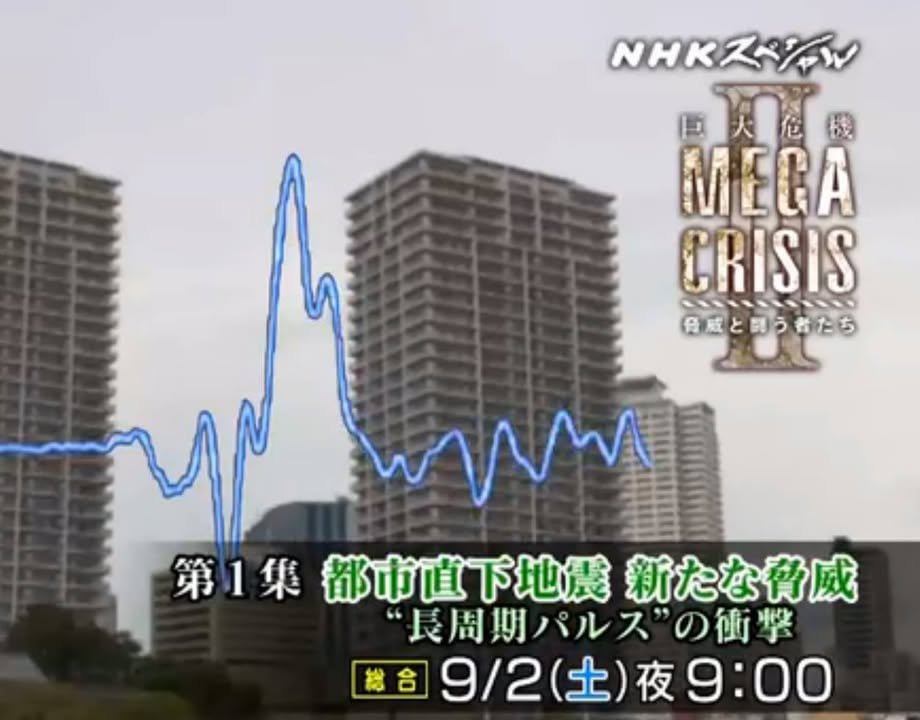
Tonight (Saturday), NHK will air a special about mega disasters. One topic will be the threat of "long wave pulse" earthquakes. The wave pattern you see in the image was recorded in Nishihara Mura last year. It took three seconds to complete one cycle in the wave. The quake was devastating for Nishihara Mura but a point to be made in this program (according to previews I've seen) is that powerful long wave pulses pose a particular threat to high-rise buildings.
If you feel comfortable with the language and are interested in the topic, you may want to catch tonight's show.
-- Kirk
http://www6.nhk.or.jp/special/detail/index.html?aid=20170902
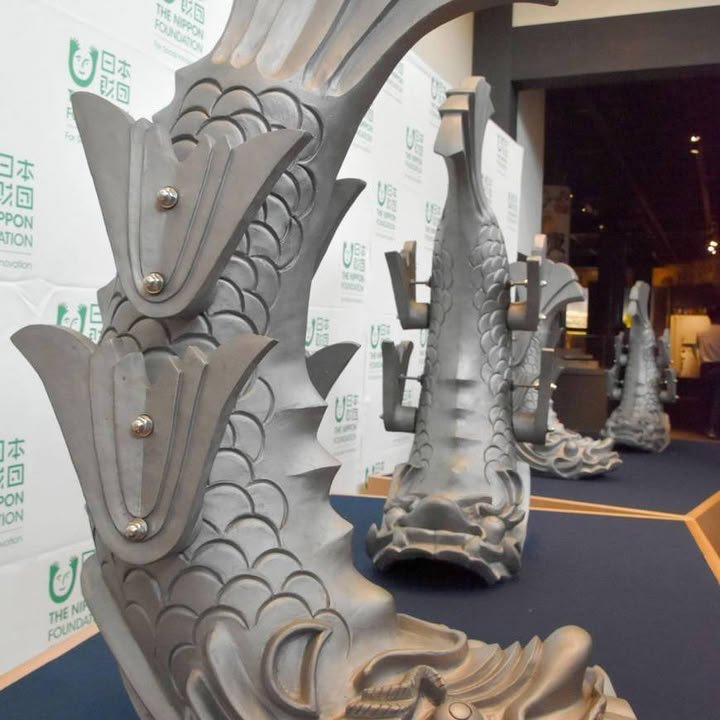
A YouTube video of a Japanese news segment about the new ornaments is embedded on this page.
By the way, here's an explanation about shachihoko courtesy of Wikipedia:
"A shachihoko (鯱鉾 or 鯱) or shachi (鯱) is an animal in Japanese folklore with the head of a tiger and the body of a carp. It was believed that this animal could cause the rain to fall,[why?] and as such, temples and castles were often adorned with roof ornaments (shibi) crafted in the form of a shachihoko, in order to protect them from fire."
https://en.wikipedia.org/wiki/Shachihoko
-- Kirk
https://www.japantimes.co.jp/news/2017/08/31/national/kumamoto-castle-shachihoko-back-original-guardian-statues-sustained-damage-2016-quake/#.WalsVa2B3m0
Kumamoto Castle shachihoko are back after original guardian statues sustained damage in 2016 quake | The Japan Times
The city of Kumamoto on Wednesday unveiled new statues for the roof of its iconic castle, to replace those damaged by last year's major earthquakes. The fo
From the Kumamoto International desk of Unusual Requests: An unusual request. An elderly couple I know are vacating a house and are looking for two people to evacuate all of the valuable stuff before the cranes come and take the remainder to the incinerator. They don't want to keep the valuable stuff; they just want two people to sort through it and figure out what can go with the wreckers and what is worth saving.
Benefits:
-1,000/hour for probably five hours of work.
- You can keep whatever you find that is cool.
Drawbacks:
- They're a lovely, friendly couple but are instinctively suspicious.
Please let me know if you're interested. The location is in Koto-machi, near the zoo and not far from the tram. Time is short. - William
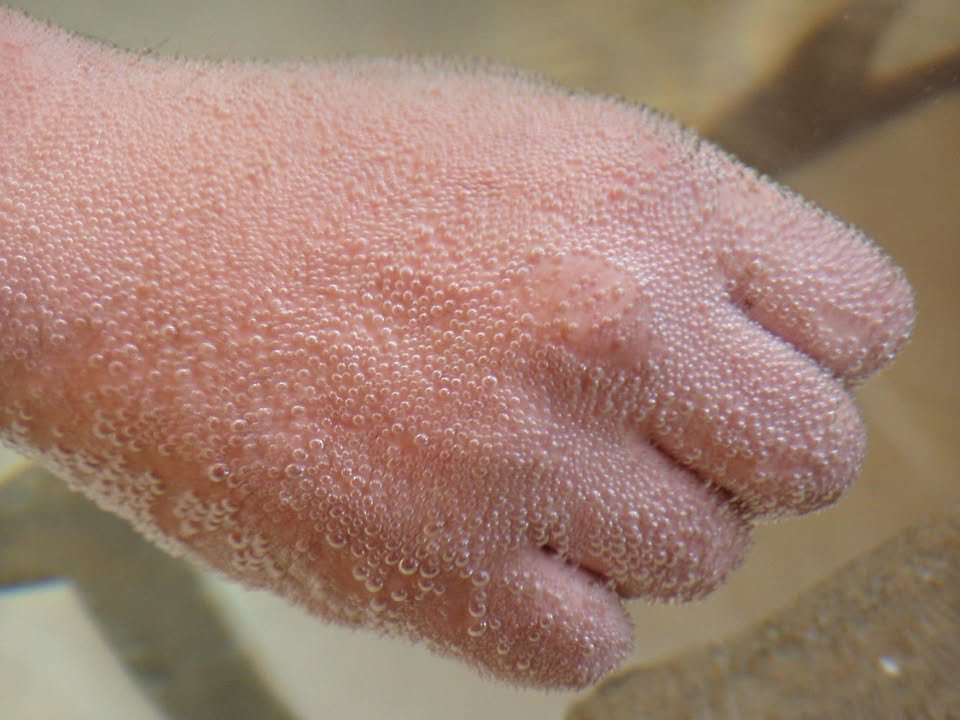
I just got back from a little trip to the Oita area. I had the pleasure of stopping by Shichirida Onsen, which is known for its naturally carbonated hot spring water. The photo is one I took from a web page about a similar onsen but it accurately shows the way my arms and legs looked in the spring water. The onsen itself is not fancy at all but the spring water is quite unique and, in my opinion, worth a visit if you like onsen. The temperature is not very high so it's good for a nice long soak.
The following web page is in Japanese but even if you don't read the language, I think the pictures will give you an idea of what to expect and the Google map will help you find it.
-- Kirk
http://spa.s5.xrea.com/broom/ooita/shichiridashitaf.htm
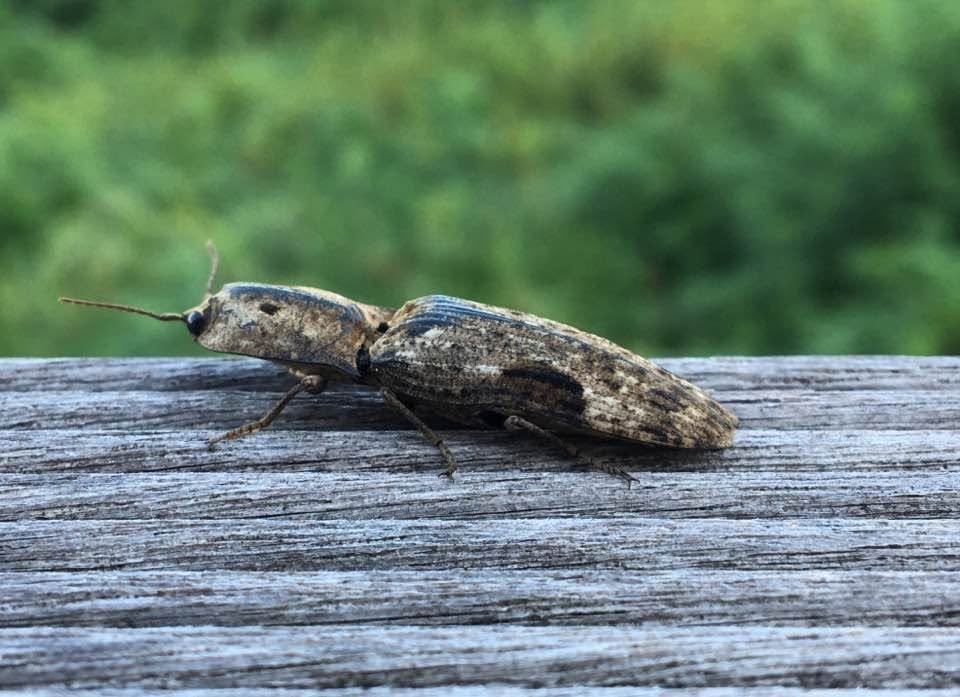
A note from the Kumamoto International Entomophilia and Entomophobia Desks (merged to achieve balance): Our friend Jeff, who lives on Mt. Kimpo, has captured a beautiful image of what everyone on his feed was saying "Whaー?" until someone suggested that it might be a "click beetle," so I Googled that and found that in Japanese, it's called a "kometsukimushi" ( コメツキムシ). Love 'em or hate 'em, Jeff took an excellent photo - and now you can amaze your friends with this knowledge when need calls. - William
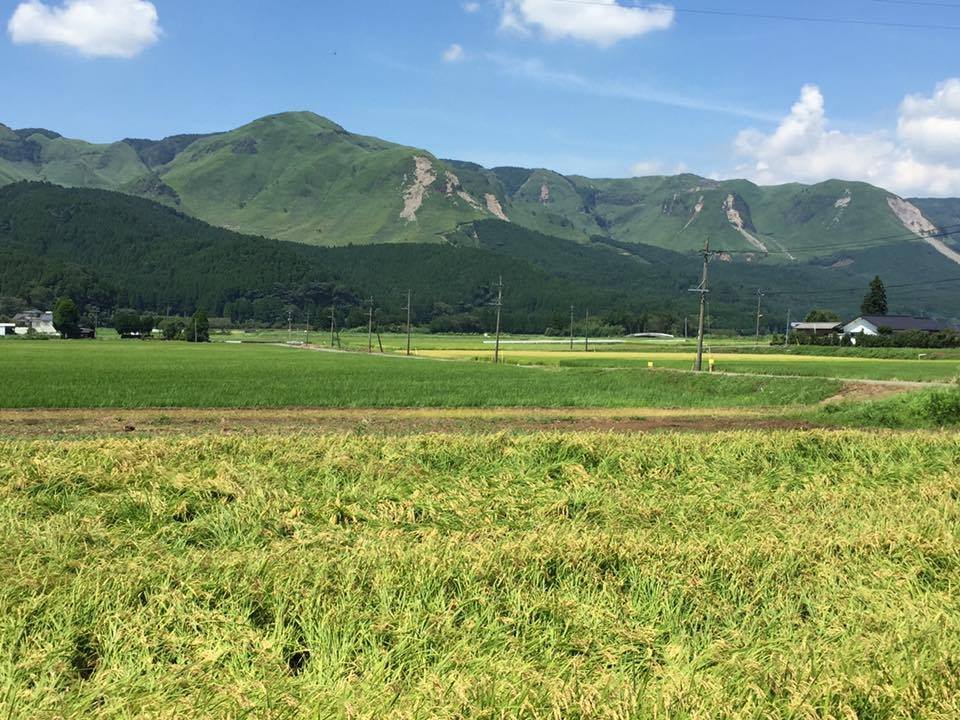
Our friend AnnMarie-san posted this beautiful photo and message on her own page. Little by little. - William
Rice ready to be harvested in Aso. Earthquake damage visible in the mountains.
16 months on and there's loads of reconstruction work going on. Tunnels and roads being newly constructed. Buildings being pulled down and others going up. Fields being reshaped and earthquake faults being studied and in some cases preserved.
There's a video on this page that you might want to check out. -- Kirk
http://www.asahi.com/ajw/articles/AJ201708280041.html
Repaired bridges give quake-hit village a route to Kumamoto city:The Asahi Shimbun
MINAMI-ASO, Kumamoto Prefecture--Quake-damaged bridges were repaired and roads were reconnected, giv

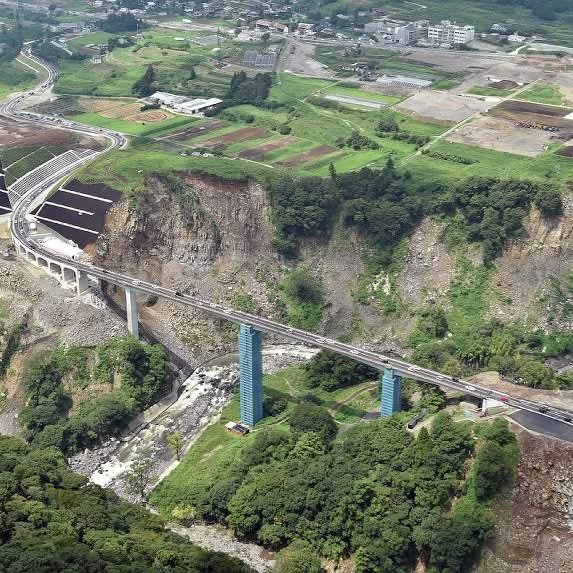
I haven't found anything in English yet but this is one of many reports in the Japanese media about the completion of a bridge called the Aso Choyo Ohashi that will take much of the traffic that the collapsed Aso Ohashi once took. -- Kirk
https://mainichi.jp/articles/20170828/k00/00m/040/153000c
熊本地震:復興に架ける橋 阿蘇長陽大橋が開通 - 毎日新聞
昨年4月の熊本地震で損壊した熊本県南阿蘇村の阿蘇長陽大橋(全長276メートル)の復旧工事が完了し、27日、約1年4カ月ぶりに開通した。熊本市内と阿蘇地域のアクセスが大きく改善され、阿蘇観光の復興などに期待の声が上がった。
Grace had written recently about Reigando. Here is a further suggestion most useful for people who have access to a car.
There is a network of hiking trails called the "Kyushu Shizen Hodou" (九州自然歩道), one of which passes over Mt. Kimpo. If you park your car at the mountain top and find the trail (it branches from the service road to the summit), it will take you down to the labyrinth of the mountain's west-facing mikan orchards - and from there, you're on your own, but pretty much every tiny road or path will bring you to Reigando. If you're lucky, you'll find one of the shacks that contain the conveyor-belt devices that separate mikan by size. And don't feel shy about sampling the fruit from the trees - the farmers really don't care (in fact, they're likely to give you a free bagful if you ask - but that would mean you'd have to lug that back up the mountain when you return.)
It's not an easy hike, but my kids used to do it as elementary school students. Bring supplies (liquid!), as there are zero stores (though plenty of mikan), and a camera as the views are breathtaking. - William
This is only tangentially related to Kumamoto in that it pertains to rumors about foreigners that can spring up after a major natural disaster. In a previous article I wrote a bit about how, in comparison to the 2011 Tohoku earthquake and tsunami disaster, there was very little demonization of foreigners in Kumamoto:
https://www.facebook.com/Kumamotoi/posts/1372592256147536
Another related issue we have discussed here is former Tokyo Governor Ishihara's comments on the need to use the military to put down rioting foreigners (Sangokujin) in the event of an earthquake:
https://www.facebook.com/Kumamotoi/posts/1201385006601596
The most infamous case of maltreatment of foreigners after an earthquake in Japan occurred after the devastating 1923 Kanto earthquake. Hundreds to thousands of Koreans (the numbers are being disputed), mixed in with people of other nationalities (including Japanese who were mistaken for Koreans) were massacred. As has happened with other ignominious events in Japanese history, some conservative politicians and authors try to minimize, deny, or ignore such events. Sadly, Koike seems to be in that category of politicians. It is worth noting, however, that even arch-conservative Ishihara, Koike's predecessor, sent a eulogy for the victims of the massacre each year while he was governor.
If you'd like to know more about what Koike would prefer be forgotten, you may find the following links to be of interest:
The Great Japan Earthquake of 1923
http://www.smithsonianmag.com/history/the-great-japan-earthquake-of-1923-1764539/
Yokohama recalls texts describing 1923 ‘massacre’ of Koreans
https://www.japantimes.co.jp/news/2013/08/29/national/history/yokohama-recalls-texts-describing-1923-massacre-of-koreans/
Book Review
The Great Kantō Earthquake, the Korean Massacre and its Aftermath: The Responsibility of the Japanese Government and People, by Shōji Yamada
https://www.harvard-yenching.org/the-great-kanto-earthquake
All of these English sources site "6,000 or more" as the number of killed. On the following Amazon.co.jp page for a Japanese book by Shoji Yamada on the topic, the first reviewer says that the number of victims was "in the thousands" but that it's no longer possible to know the exact figure.
https://goo.gl/BR1Bm6
Note that this book has four reviews: 2 five star and 2 one star. The one-star reviewers clearly don't like the conclusion. One argues that the Koreans were a threat to Japan (implying that what happened was justified) while the other merely suggests reading a book that denies that the incident occurred at all.
Regardless of the range of numbers (hundreds to thousands), I think this was a very significant event that should be remembered so that it will not be repeated.
-- Kirk
http://www.asahi.com/ajw/articles/AJ201708240043.html
Koike says no to eulogy for Koreans killed in 1923 quake:The Asahi Shimbun
Tokyo Governor Yuriko Koike has angered organizers of an upcoming memorial service for Koreans massa

For many years, Kumamoto had the good sense of holding their fireworks show at Ezuko, which offered both beauty in the lake reflection and convenient public access. They then switched to holding the show at the castle, which turned out to be a nightmare in access terms and which almost led to one of those "hundreds trampled in human stampede" articles that you read on CNN. So, for a few years, they decided not to do anything (Note: that's generally the easiest decision for anything).
However, with the earthquake and all, the fireworks are back - in Ezuko! October 14. Get a raft and drift down - that is my suggestion. - - William
https://this.kiji.is/274005026673378806?c=9261969790848357
江津湖花火大会、10月14日に正式決定 - 熊本日日新聞
熊本市の江津湖花火大会実行委員会(会長・大西一史市長)は25日、今年の大会を熊本地震から1年半の10月14日(荒天時は15日に順延)に開催することを正式に決めた。地震からの復興祈念と位置付け、東区の水前寺江津湖公園広木地区で1万発を打ち上...

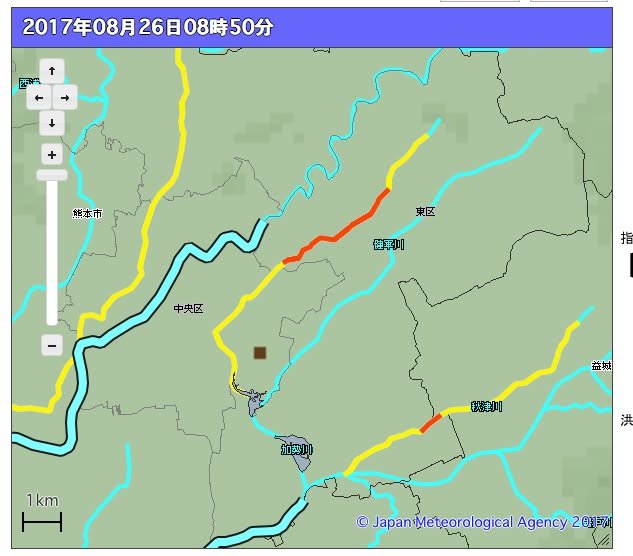
Flood warnings have been issued for parts of Kumamoto. The two images you see below show streams or rivers that are getting closer to flood level. The images are taken from
http://www.jma.go.jp/en/suigaimesh/flood.html
(English)
and
http://www.jma.go.jp/jp/suigaimesh/flood.html
(Japanese)
The JMA seems to have been unable to translate the names of the rivers. That's understandable but it's disappointing that they chose to erase what they could not translate. This is another example of an unfortunate assumption that seems to be all too common -- that presenting information in English means purging it of any and all Japanese information. It fails to recognize that people who access information in English might be able to recognize the orthography of a river in their neighborhood or might want to show the image they have found to a family member or neighbor who does read Japanese.
Another problem with the JMA's otherwise impressive system is that it can be surprisingly difficult, whether you are looking at the Japanese version or the English version, to figure out just where the stream marked in red is. In this case, it's actually not too far from my home. Still, because the JMA map isn't connected to a more detailed map of Kumamoto City, I had to compare it to a Google map in order to try to solve the puzzle of just where the marked stream is located -- and even after doing that I'm not entirely sure.
At any rate, I hope this little discussion proves to be merely academic today and that none of us have to deal with any actual flooding. If you live near a stream or river, however, I think it's a good idea to learn how to take advantage of the information that is available on the web so that you don't need to sit and puzzle over it (like I did today) at a time when you should be taking steps to evacuate.
-- Kirk
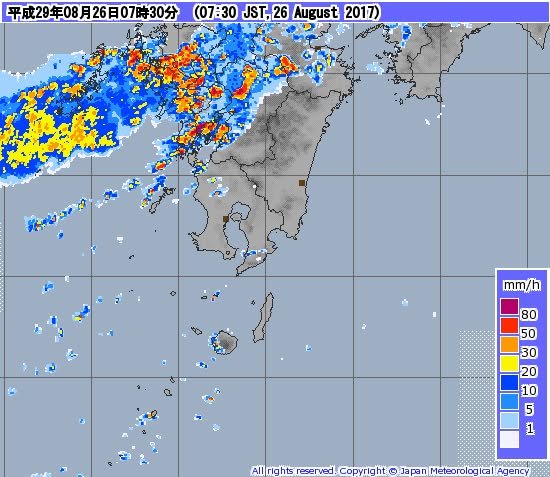
Good morning, fellow Kumamotians! You might notice heavy rain accompanied by thunder. This will likely continue through noon. I hope you don't have any plans for the AM. - William