Archive of the Kumamoto International Facebook group, 2011–present.

1792

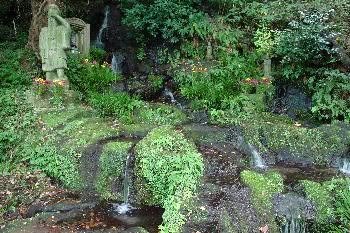
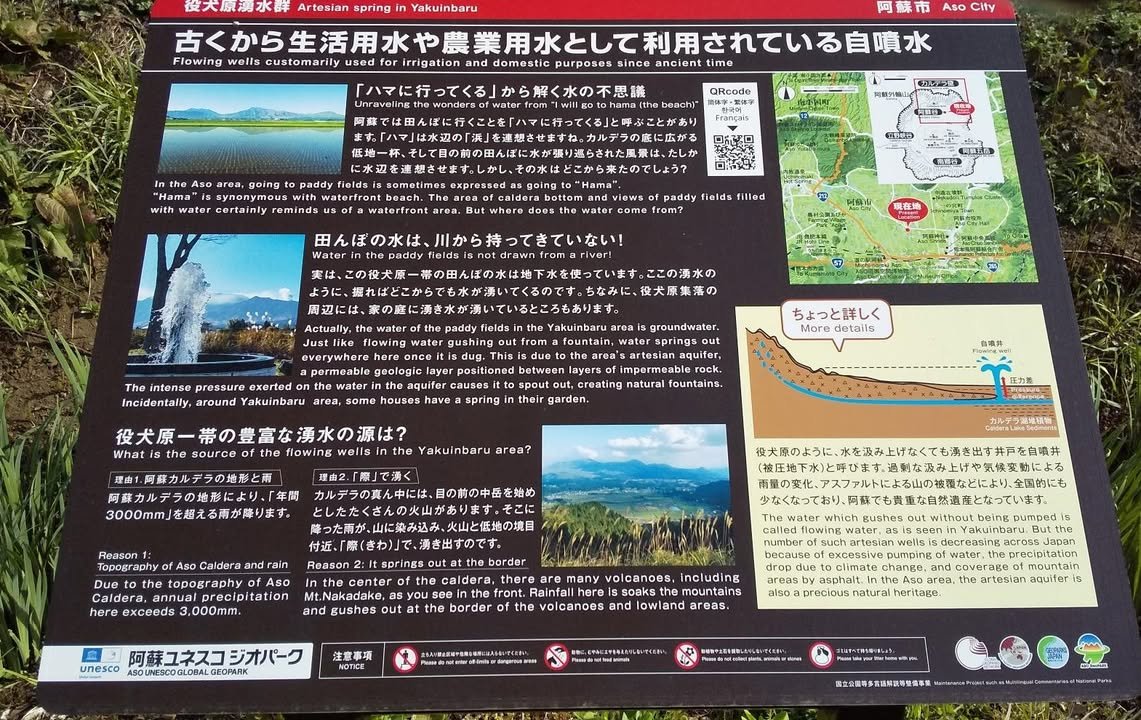
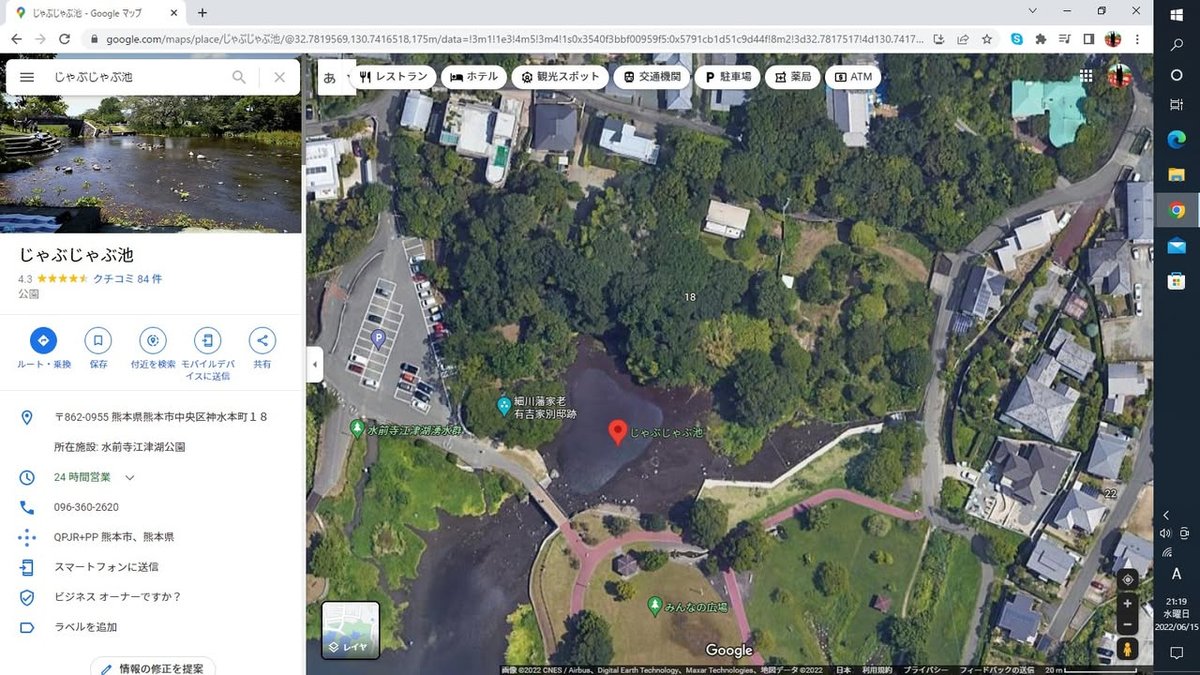
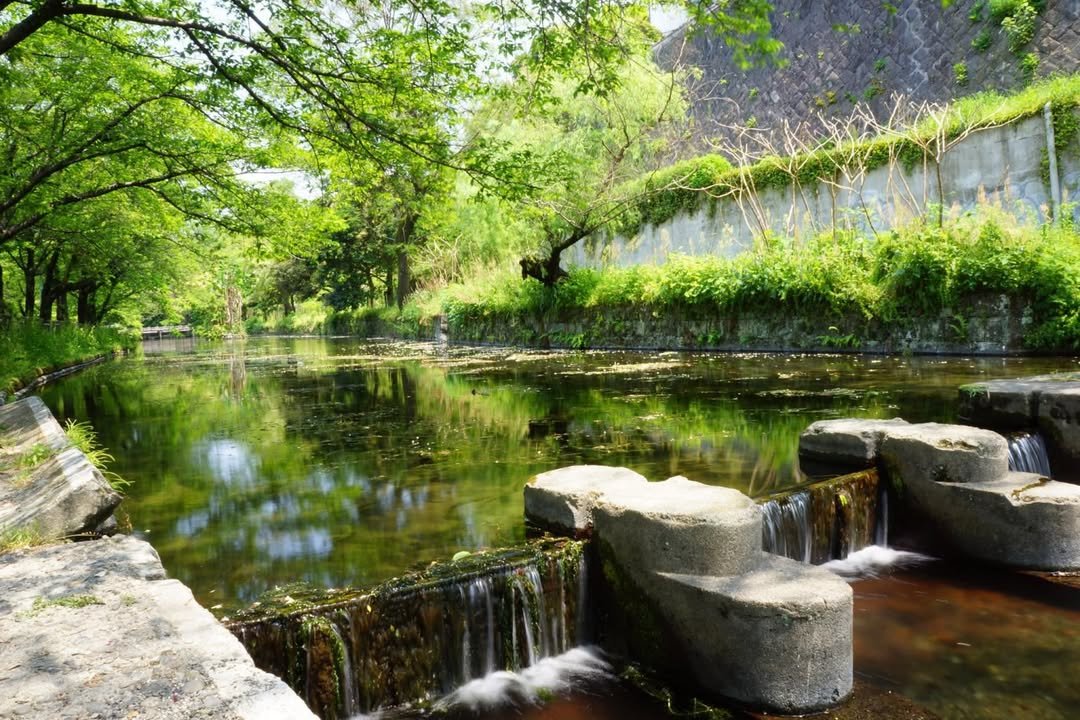
William  Reading Kirk's post about Suizenji brought to mind the cause of the many springs in Kumamoto. Simply: we get much rain, particularly in the mountains. The water sinks through the volcanic soil and seismic cracks of both Aso and Kimpo into a gigantic artisanal reservoir which flows towards the Kumamoto alluvial fan, where a 30,000 year old underlaying layer of basalt covered by a thin layer of sediment forces the water to the surface. Kumamoto is the only city in Japan whose entire water supply is artisanal (that is, from wells).
Hailing from California, where water is the most valuable commodity, I appreciate this very much.
A couple of images of where your oh-so tasty Kumamoto water comes from, and an introduction to the Suizenji-Ezuko Spring Group:
https://www.city.kumamoto.jp/kankyo/hpkiji/pub/detail.aspx?c_id=5&id=20470
https://www.web-gis.jp/GM1000/LandMap/LandMap_19_009.html

2022-04-03 23:55 JST
4151

Kirk here reporting that it was very pleasant today in Suizenji. My wife and I paid just 1,000 yen each to get unlimited access for a year -- a good deal I think, especially if you don't live very far away and like to walk.

2022-04-03 23:14 JST
500

William Kumanichi has an informative article on the revitalization of downtown (Japanese, but Google Translate is your friend, so I have done so and pasted it below, unedited). The article discusses the new Kumamoto Castle Hall (熊本城ホール), located at Sakuramachi; a link to the facility is below. All of this activity is attributed to what is termed the "straw affect", which apparently is a result of improved transportation (in this case, the Shinkansen Kumamoto Station) resulting in business relocating to that hub. On the positive side, Kumamotoites need no longer travel to Fukuoka for good shopping; on the other, these new shopping facilities siphon off business from neighboring areas, including Kamitori and Shimotori. Pictured at bottom: Kumamoto Castle Hall and a map of the planned revitalization area.
Kumamoto Castle Hall site: https://www.kumamoto-jo-hall.jp/
Kumanichi article: https://kumanichi.com/articles/611657
(From the Kumanichi)
Kumamoto City celebrated its 10th anniversary on the 1st, becoming a government-designated city in April 2012. How has the prefectural capital, which has come to occupy one of the 20 "big cities" nationwide, promoted town development under the new system such as the authority transferred from the prefecture and the administrative districts? Report on the 10-year history and changes in the city.
◇ ◇ ◇ ◇
"If there is a plaza, the city will be lively." Saya Kimura (29), who visited from Kita Ward, smiled at the Hanabata Square venue (Chuo Ward) of the "National Urban Greening Fair" held in Kumamoto City. The 1.5-hectare plaza was developed by the city for about 2.4 billion yen as a place for citizens and tourists to interact, and became available in the fall of last year. Katori Yokoo, a 72-year-old housewife from Higashi Ward, hopes that the new coronavirus will settle down quickly and that many people from all over the country will come.
■ Straw phenomenon ■
Behind Kumamoto City's aim to become an ordinance-designated city, there was a sense of crisis about the "straw phenomenon" in which people, goods, and money were absorbed by other cities due to the opening of the entire Kyushu Shinkansen line. The aim was to be a "city of choice" in terms of tourism and economy. In order to enhance the city's comprehensive strength, the city has promoted multiple development projects in collaboration with the public and private sectors.
The redevelopment of Sakuramachi and Hanabata districts in Chuo Ward was particularly emphasized as the "face of the city". Kyushu Sangyo Kotsu Holdings (HD)'s commercial complex "Sakuramachi Kumamoto" opened in September 2019 in the area adjacent to the plaza and became one of Kumamoto's landmarks. Of the total project cost of about 79 billion yen for the redevelopment building including the bus terminal, the city paid 12.6 billion yen including half the national subsidy.
The large-scale customer attraction facility "Kumamoto Castle Hall" in the redevelopment building is a new base for tourism strategies that attract academic societies and international conferences. After completion, the city bought it separately for about 30 billion yen.
On the other hand, around JR Kumamoto Station in Nishi-ku, the prefecture has elevated the conventional line along with the development of the Shinkansen. Condominiums, hotels, national joint government buildings, etc. were built, and in April last year, JR Kyushu's commercial facility "Amu Plaza Kumamoto", which can be said to be a complete finish, opened. Along with the Shirakawaguchi station square, where the city cost about 9.6 billion yen, the "entrance" of the prefectural capital, which had a lonely impression, has been transformed into an orderly subcenter.
■ Bitter start ■
However, the creation of liveliness through redevelopment did not go as planned due to the corona. The number of visitors to Sakuramachi in the first year was about 13 million, which is almost half of the pre-opening target of 25 million. Keisuke Mori, president of Kyushu Sangyo HD, complains, "Due to the drastic decrease in tourists and refraining from going out, we could not take advantage of the location near Kumamoto Castle and the bus terminal."
Kumamoto Castle Hall was also closed and reservations were canceled one after another, resulting in a deficit of nearly 150 million yen in FY2009 (as of the end of December). It was a bitter start for the city to make up for the deficit to the designated manager who runs the hall.
On the other hand, there is also the aspect that the "city of choice" has progressed. Due to the effect of the Shinkansen, the number of annual guests in the city increased by 720,000 from 10 years before the opening of the Shinkansen to 19 years before the Corona disaster. The number of business locations, which was 2 in FY2011 before the government-designated city, increased to 16 in FY2012, and has remained in the 10s per year since then.
■ Machinaka reproduction ■
Following the Sakuramachi / Hanabata district, we will also work to improve the attractiveness of the central area. The city has started the "Machinaka Revitalization Project", which encourages the rebuilding of dilapidated buildings through deregulation and financial support, mainly in the Shimotori area. With similar efforts, Fukuoka City's "Tenjin Big Bang" is also conscious of the move, aiming to rebuild 100 projects by FY2017.
Urban development in Kumamoto City has been accelerated by the Shinkansen and government-designated cities. Hideki Miyano, General Manager of the Business Cooperation Department of the Regional Economic Research Institute (the same city), said, "Amid the declining population and competition between cities, coexistence with Fukuoka will continue to be an issue for Kumamoto. Need to increase. "

2022-04-03 14:54 JST
420

William Opinions regarding zoos differ both interspecies and intraspecies, such as this hypothetical conversation:
"Bob! Howzit feel to be a caged orangutan again this mornin'?" "No complaints. mate, 'cept I can't feel me leg." "That's yer arm ya'got holda there, Bob." "Crickey! Good on ya - thought a jaguar had gone an' eaten me leg right off."
Good zoos offer zoological education at the primary and professional levels and through inter-zoo exchanges promote biodiversity. Plus, inmates don't have to worry about jaguars.
Conversely, zoos are prisons which deprive wildlife from the environment to which tens of thousands of years of genetic memory have such accustomed them.
Kumamoto Zoo has announced a male chimpanzette born to Marc (42) and Milk (15 - and don't prejudge that age gap: it's the way chimps swing), yet to be named. Milk has taken the child to her breast; promisingly, both parents seem to be actively engaged in childrearing. This chimpanzee birth is the zoo's third as part of the zoo's breading program, following that of Milk's first child in December 2008, who died of weakness the same day, and a birth recorded in 1979, who died after a few months.
https://kumanichi.com/articles/612082

2022-04-03 00:24 JST
1941

William According to the Kumanichi evening edition, Godzilla has been rampaging around downtown Kumamoto City since the morning of 4/1. Mayor Ohnishi has issued a statement: "Sometimes, the only way to heal our wounds is to make peace with the demons who created them."
Video at the link: https://www.youtube.com/watch?v=JyFU8HL6fHI

2022-04-01 19:43 JST
31150

Kirk here with a little illustration I made up after I read Fiona's post, which is here, by way:
https://www.facebook.com/Kumamotoi/posts/7092504690822902
I hadn't heard of dekopon being called "Sumo oranges" but I was aware that they are also known as Shiranui. Wikipedia says that "Shiranui (不知火, unknown fire, Shiranuhi in the historical kana orthography) is an atmospheric ghost light" that appears in the Ariake Sea off Yatsushiro at certain times of the year.
I thought that "Sumo orange" might make a cute character so I did an image search but didn't find anything. Hence, my do-it-yourself version. :)

2022-04-01 12:51 JST
300

William I don't collect a lot of things. Hats, sure, particularly those belonging to unusual ethnic groups, and coins of course. And clocks. I've got about a dozen, all sleeping at that instant when I removed their batteries - or their batteries removed themselves. One of them is frozen at 9:26, the time when the first Kumamoto quake jiggled the clock battery free. It's good to see I'm not alone in my hobby. Kumanichi reports on such a man.
https://kumanichi.com/articles/610294

2022-04-01 11:41 JST
21104

Fiona here with some citrus news. Apparently the lowly dekopon, also known as a shiranui (the name of a town in Kumamoto prefecture) is being rebranded as a Sumo orange in the US and selling in huge quantities thanks to a viral TikTok video.
How one determined Trader Joes shopper made this ugly orange go viral
Felt the unexpected urge to buy a large, dimply orange lately? Thank the Sumo orange evangelist of Trader Joe’s – and TikTok

2022-04-01 11:29 JST
71111

Kirk here with some news about a new position I’ve been given. In recognition of my many years of service to the local community and in view of the knowledge I have accumulated about Kumamoto during that period, RKK has designated me as their “Senior Foreign Correspondent” (主任外国人特派員) and set aside a three-minute slot for me to express my views on local events and issues. I recorded my first session the other day in which I proposed that the name “Kumamoto” be changed to “Voltomoto” and that Kumamon be replaced by an electric eel called “Voltomon.” I know, I know . . . this was my “April fools” post last year (see URL below) — but the more I thought about it, the better the idea started to seem to me, so I thought I’d make the proposal for real this time.
https://www.facebook.com/Kumamotoi/posts/5139433589463365
I asked about when my next column was scheduled to be recorded and aired and they said something about freezing temperatures in a fiery inferno. Must be some kind of media lingo or something. I’ll let you know when I hear back from them.
By the way, they originally wanted to call my column “青い目から見た . . .” (“A blue-eyed perspective on . . .”) but I said “Hey! Look at my eyes! They’re green!” Well, “hazel” really, but I didn’t know how to say that in Japanese. At any rate, that’s why the column is titled “緑の目から見た熊本” (“A green-eyed perspective on Kumamoto”). After I get the name of this place changed to “Voltomoto” I’m going do a column about how everything in Kumamoto looks green to me — you know, because I have green eyes.
Happy April 1st!

2022-04-01 01:02 JST
3723

Hi Atsuko here.
It's good season to enjoy Hanami and short trip.
The cherry blossoms are in full bloom in Kariakusa Park in front of my house, and every day it is crowded with parents and children with tents and children on spring holiday.
Here is the next tradition after cherry blossom viewing.
ーーーーーーーーーーーーーーーーーーーー
Annual Carp Streamer Festival at 杖立温泉 Tsuetate Onsen
The event will be held again this year starting April 1.
During this period, the lights will be illuminated from 7:00 p.m. to 10:00 p.m.
More information about Tsuetate Onsen
https://en.minamioguni.jp/archives/220431

2022-03-31 15:18 JST
2101

William Cherry blossom season is most over - or is it? This depends on the variety of the tree: some bloom early, some late. Pictured are two gorgeous photos from our friend Liz Suenaga taken at Honmyoji (本妙寺). Note the color difference in the right photo: those are different varieties.
A link to a recipe on how to preserve cherry blossoms in salt for a tasty snack: https://www.lettuceclub.net/recipe/dish/5701/
and a link to cherry blossom varieties: https://www.japan-guide.com/e/e2011_species.html

2022-03-31 09:15 JST
1120

William While the tragedy unfolding in Ukraine has resulted in a positive security impact for Japan as Russia moves its troops from Asia to Europe, Japan's Self Defense Forces (SDF - read army, air force, navy, marines) have not been inactive. Kumanichi reports on, well, reports of bright lights in the sky. Do not be alarmed: these are not aliens having come to harvest your organs.
This is training the SDF conducts from their Yamato base several times a year to illuminate nighttime destination and targets of troops - or so the SDF says, per this article. I personally have never seen it. If anyone notices anything unusual, please PM us. Video at the link.
熊本の空に「謎の光」 相次ぐ目撃…正体は?|熊本日日新聞社
 「東の空に不思議な光が見えました」。熊本市東区の女性会社員(47)から、29日午後6時25分ごろに撮影したという動画が「SNSこちら編集局」(S編)に寄せられた。同様の目撃情報はSNSでも投稿が相次いでおり「UFOか!?....

2022-03-30 21:39 JST
1010

William Divisions exist akin to geologic fault lines among Japanese ramen types. Kumamoto is particularly famous for its pork-based ramen, while Tokyo goes soy sauce-based. Eww. Keika Ramen 「桂花拉麺」, founded in Kumamoto in 1955, introduced tonkotsu ramen to Tokyo and is known among ramen lovers world-wide. In addition to their in-store bowls, they sell instant ramen in supermarkets. Recently, due to personal circumstances, I have found myself consuming them: thumbs up, though obviously their restaurants are best. Google a location near you. https://keika-raumen.co.jp/shop.html

2022-03-30 17:47 JST
1403

Kirk here with news about a deer crossing the Shirakawa in Toroku (渡鹿), an area in Kumamoto City that means "deer crossing." Click on the link to see the video.
https://rkk.jp/news/index.php?id=NS003202203291747310111

2022-03-29 21:07 JST
10180

William Translation is tricky. Generally, I term Kumamoto pre-1600 as "Higo fief" or "Higo domain" and post-1600 "Kumamoto," though I have seen examples otherwise. One reason I do so is that Kumamoto was not unified until the rivalry between two daimyo, Konishi Yukinaga and Kato Kiyomasa, was resolved.
Both were born outside Kumamoto. Both received their fiefs - Konishi in the south, centered around Yatsushiro, and Kato in the north, centered around Kumamoto City - for their service in Hideyoshi Toyotomi's Kyushu Campaign to pacify the Shimazu Clan, which ruled over most of the island at the time. Both later served in Hideyoshi's two Korean invasions (during one of which Kato famously killed a tiger).
However, no love was lost between the two. Konishi was a devout Christian; Kato loathed Christians. Their rivalry ended in the decisive Sekigahara campaign of 1600, during which Konishi supported Ishida Mitsunari, while Kato supported Tokugawa Ieyasu. After Tokugawa's victory, Yukinaga was offered the privilege of committing seppuku but refused due to his Christian faith and was executed; Kato thereupon received Konishi's fief, and Kumamoto in its modern dimensions was created.
This is why I refer to pre-1600 Kumamoto as "Higo." What is your opinion?
Below: Kato (left) with his monkey (right) - the fusuma behind him is marked with his kamon (家紋, family crest), which is still the symbol of Kumamoto; and Konishi decked out for battle.

2022-03-29 17:00 JST
2605

William Tsujunkyo (通潤橋, literally "moisture passage bridge"), a symbol of Kumamoto located in the town of Yabe, was completed in 1854 and, at 84m in length with an arch spanning 27m, is the largest stone aqueduct in Japan, built to irrigate an otherwise arid plateau to its south. The bridge was designed to sag in the center, with openings created to allow flushing of sediment. Removing the stump-sized wooden plugs to do so results in cascades of water, and this has become a major tourist attraction.
Kumanichi notes that access to the bridge, previously free, will now cost Y500 for adults and Y300 for children through HS age. My wife suggested that, as a rapidly depopulating town whose remaining residents are mainly elderly, Yabe simply needs the money.
https://kumanichi.com/articles/602968

2022-03-28 15:00 JST
2110

Charles Waterman here:
Does anyone know how to send something from Kumamoto to the US using **FedEx or UPS**? We will need *speedy* delivery for some visa related documents for an incoming teacher that will be ready in a week or so, we hope. The Japan Post will be way too slow, unfortunately.

2022-03-28 13:49 JST
210

William A crime almost as heinous as Chisso Corp. releasing methylmercury into Minamata bay is the glacial pace at which the government proceeds with lawsuits. Kumanichi takes up the case of Mr. Hideki Sato (67), plaintiff leader, who suffered from methylmercury poisoning during fetal development and childhood. The group filed its appeal In October, 2015 - finally rejected yesterday - after their original suit was defeated in 2013, with the Fukuoka High Court ruling that the plaintiff's symptoms, which include leg cramps, dizziness, tinnitus, and difficulty in holding objects, were likely due to other illnesses. Mr. Sato noted that, even though the dangers of eating local fish and shellfish were vaguely known since 1957, poverty demanded that Minamata residents nonetheless continue to consume them.
汚染魚、家族で食べていた 原告団長佐藤さん、両親と祖母は「患者」|熊本日日新聞社
 水俣病被害者互助会の裁判闘争は15年目に入った。原告団長の佐藤英樹さん(67)=水俣市=はきつい時があっても、「自分一人だけのことではない」と自らを奮い立たせてきた。案じ続けてきたのは、自分たち原告と同.....

2022-03-27 13:19 JST
400

William Fumarolic gasses (噴気孔ガス, funkikō gasu) are those emitted by a fumarole, a vent into what is mostly groundwater heated to steam by volcanic activity. They are a potential source of energy and are already being utilized throughout Japan, including in Kumamoto, in Oguni and Aso Village (an image of the Oguni plant is below). It seems much potential remains for this free, renewable power source. More can be read (just a bit) about the topic here: https://www.renovainc.com/en/development/minamiaso_yunotani_geothermal/202009_1674/

2022-03-26 20:31 JST
1101

William A bit more about Kumamon's profitability. I'd stated before that cumulative profits have reached Y1 trillion. This article states a figure 810 billion yen since 2011, when the prefectural government began tracking figures (Kumamon was "born" in 2010), and 157.9 billion yen in 2019 alone - so close to a trillion, though perhaps not quite. Still, that's a whole lotta yen, much of which comes from licensing fees by Taiwanese, Chinese, and Korean companies, where Kumamon remains quite popular. No wonder he (she?) always looks so content. English-language article at the link.
Sales of Kumamon mascot goods hit record 158 billion yen in 2019
Products bearing the image of "Kumamon," the black bear mascot of Kumamoto Prefecture, racked up sales of at least 157.9 billion yen ($1.4 billion) in 2019, according to the local government

2022-03-26 14:03 JST