Archive of the Kumamoto International Facebook group, 2011–present.

2711

Kirk here with an article from which I learned something new about Suizenji Jojuen:
---- start quote ----
In order to create a garden pond in a low swampy area where there was natural springwater, an advanced civil engineering technique, along with an artistic sensibility was required.
The Hosokawa clan constructed the Shōryūji Castle in Kyoto Prefecture during Oda Nobunaga’s reign (1573-1582), and built a tenshu (castle tower) before the Azuchi castle tower existed. Then, at the Kokura Castle in Fukuoka Prefecture, which later became the clan’s residence, they built a castle with advanced technology by reclaiming low lying swampy land.
The skillful techniques needed to stabilize the pond shore at Suizen-ji Jōjuen and the embankment skills used to create the beautiful landscape mountains, were indeed made possible by the peaceful utilization of military technology, such as the foundation of stone walls and methods of building defensive banks cultivated through constructing castles.
---- end quote ----
The article seems to have been written first in Japanese and then translated into Engish; there's a link to the Japanese text at the end of the article. Here's the portion about the engineering involved in Suizenji Garden:
そして水が湧く低湿地を整えて園池をつくるには、芸術的感性とともに高度な土木技術が必要だった。細川氏は信長の時代に京都府の勝龍寺城を築いて、安土城天主より早く「天主」を建て、その後居城にした福岡県の小倉城では低湿地を先進技術で埋め立てて城を築いていた。
水前寺成趣園の池の岸を安定させる巧みな技術、美しい築山を生み出す盛土の技は、まさに築城で培った石垣の基礎や防御の土手(土塁)の造成方法などの軍事技術を平和に活かしてできた。庭園は人をもてなしてつなぎ、芸術を生み出す創造的な空間である。水前寺成趣園の精神を21世紀の私たちはどう受け継ぎ活かせるだろうか。
Suizenji Garden: Where the Art of War and Culture Resonate with One Another | JAPAN Forward
One of Japan’s most renowned landscapes, Kumamoto's Suizenji Garden is a stunning representation of engineering wisdom gained from wars and the artistic culture of the Edo era.

2022-03-07 13:58 JST
14102

Hello friends, Atsuko here sharing a Kumanichi post about our neighbors.
The war is not happening somewhere far away, but right next door.
No war.
No hate.
Be kind to everyone! ╰(*´︶`*)╯
Kumamoto Nichinichi Shimbun | March 04, 2022 11:41
https://kumanichi.com/articles/577013
Hidetaka Tsuji (left) and his second son Yusei. The photo on the tablet is his wife Valeria. 3 March, Kumamoto City, Kumamoto Prefecture.
ーーーーーーーーーーーーーーーーーーーーー
Boy who evacuated to Kumamoto City wants to see his mom in Ukraine Attacks "sad''
 
 Just before the Russian invasion, a young boy left his mother in Ukraine and took refuge with his father in Kumamoto. Yusei is the second son of Hidetaka Tsuji, 52, a sports instructor in Chuo-ku, Kumamoto City. He said, "It is sad that my favorite country, Ukraine, is under attack. I want to see my mom." He is heartbroken by the devastation in the region.
 Yusei is a family of four: Tsuji, his Ukrainian mother Valeria (44), and older brother Yusuke (16). Valeria moved to Dnipro, an industrial city in eastern Ukraine, with her two sons in 2015 to obtain a certificate to teach rhythmic gymnastics and to take care of their mother. After Yusuke returned to Kumamoto in 2007 to prepare for his high school entrance exams, the father and sons began to live separately.
 Amid rising tensions with Russia, Mr. Tsuchi left Japan on February 17 and met Valeria at Warsaw Airport in Poland to pick up Yusei. Not expecting an actual war to break out, Valeria returned to Ukraine, but Russia launched an invasion on February 24. In retrospect, it was a hair's breadth away.
Mr. Tsuchi said, "I hadn't been able to see him in Corona, and my second son was just returning home temporarily. My wife said, 'He will come to Japan to pick us up in a month or two,' but I never thought Putin would actually start a war..." Mr. Tsuchi said. Yusei said his friend asked him to buy some Japanese souvenirs.
Now that the war has started, he communicates with Valeria by videophone. Dnipro said that fighter jets fly overhead and sirens sound two or three times in the middle of the night, and each time they are evacuated to the basement of their apartment building. Valeria is concerned about how this war is being reported in Japan because of the media coverage that justifies Russia.
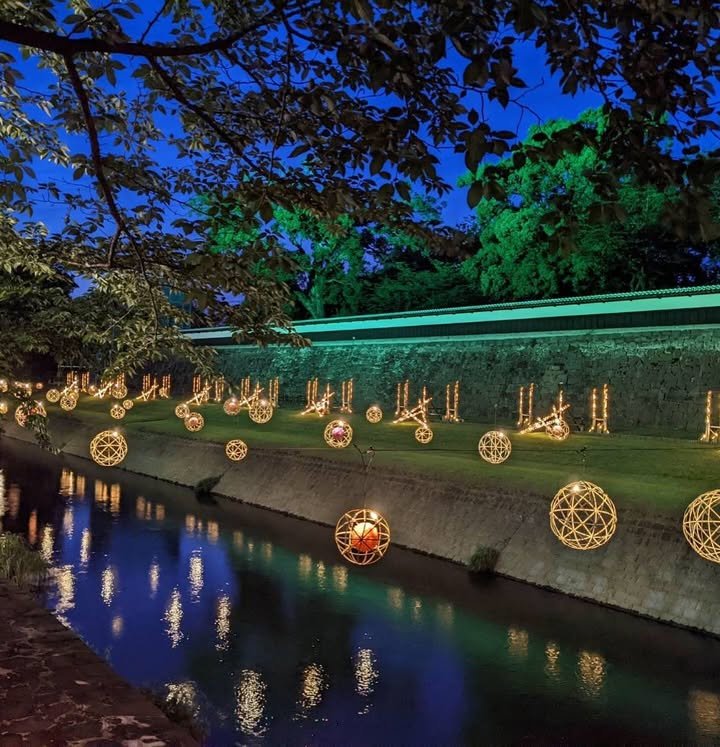
The Ukrainian people are always cheerful and kind," Yusei said, adding that on the first day he sent photos and videos of the Kumamoto Castle keep lit up in the same colors as the Ukrainian flag to Valeria and his own friends, who were delighted.
Mr. Tsuchi said, "I hope the senseless war will stop soon. The best weapon is SNS (member exchange website). I hope that many people will take an interest and send the message that Russia is wrong," he added emphatically.

2022-03-06 11:07 JST
19121

Kirk here with a folllow-up to William's post about the bombing of Kumamoto in WWII. The photo in it piqued by interest so I tried to figure out where it was taken and from what angle. The Shinmachi place name, the curving tram line (which I assume followed the same route that is does today), and the Tsuboi River (visible beyond the curving tram tracks) made it relatively easy to make an educated guess.
I've zoomed in to make the location clearer. Most of the smoke from the bombing is beyond the Tsuboi River and so not visible in my zoomed in version. The original is here: https://mainichi.jp/english/graphs/20200709/hpe/00m/0na/002000g/5 )
One thing about this that interests me is that Shinmachi has a lot of old buildings and so I was under the impression that it wasn't hit as hard as other parts.
When I look at photos of the devastation of war they seem rather otherworldly to me. But, what I'm seeing on the news from Ukraine is reminding me that people were living peacefully in those devasted structures when they were struck. Pray for peace.
William's orginal post is here:
https://www.facebook.com/Kumamotoi/posts/6975113239228715

2022-03-06 10:43 JST
1051

William Kumamoto had the misfortune during the war of being host to Mistsubishi Heavy Industries, which made airplanes (they're still there), and a couple of airports. The result was predictable. My heart goes out to all caught in the tragic carnage of Ukraine. Do not let the travesty Kumamoto endured to be unremembered.
In Photos: Discovered photos show destruction of US WWII air raid on SW Japan city - The Mainichi
An area that appears to be on the Shinmachi side of the Tsuboi River in the city of Kumamoto is seen being bombed in this image owned by Takao Imayosh

2022-03-05 21:52 JST
510

William Kumanichi reports that this years kousa (黄砂 - fine particle matter blown from the Gobi across Japan) is particularly bad. It has certainly walloped me. Stay indoors, wear a mask, and see a specialist if needed.
https://kumanichi.com/articles/578309

2022-03-05 20:05 JST
550

William Today's Kumanichi post. It might not be of import unless you are a ladybug. (They're called "tentoumushi" in Japanese, perhaps because they have ten toes, but like all insects, they have only six.)
https://kumanichi.com/articles/577246

2022-03-05 08:24 JST
2602

William As the (very proud) father of a daughter, I observe Hina Matsuri every year. Generally, offerings are offset at rivers following the festival. Though the sentiment is understood - that one's daughter mist follow the flow of life bestowed to her - we keep hers here and set them up every year. Her home is here, and it will remain so, wherever for for however long she she may live.
She is a true Higokko. Encourage your children to embrace that identity.
https://www.nippon.com/en/features/jg00031/

2022-03-05 01:37 JST
2110

William Just this.

2022-03-04 21:52 JST
1800

William Good news for train lovers. The "SL Hitoyoshi", which runs between Kumamoto and Tosu (Saga Prefecture), is slated to restart after equipment repairs. It is a slow way to go nowhere, but those journeys are generally the best.
https://kumanichi.com/articles/577061

2022-03-04 16:40 JST
3524

Kirk here with an English article about the lighting of Kumamoto Castle with the colors or the Ukrainian flag. It's been a few days since William posted about this (and got a HUGE response -- Reach: 4,478; Engagement: 814; Shares: 41) and now it seems that the Mainichi is trying to follow his lead. ;)
The article says that Saturday, March 5th, will be the last evening to see the colors with your own eyes.
Original Kumamoto International post:
https://www.facebook.com/Kumamotoi/posts/6956103971129642
Mainichi copycat ( ;) ) article:
Japan's Kumamoto Castle lit in Ukrainian flag colors to mourn invasion victims - The Mainichi
KUMAMOTO -- Kumamoto Castle in this southwest Japan city is being lit in the colors of the Ukrainian national flag to show condolence for the victims

2022-03-04 11:20 JST
500

Kirk here with news about the extension of the so-called "pre-emergency measures" ("man'en boushi tou juuten sochi" [まん延防止等重点措置] in Japanese or "manbo" for short) in Kumamoto. The measures will end on March sixth in many nearby prefectures (Fukuoka, Saga, Nagasaki, Miyazaki and Kagoshima) but continue in Kumamoto until Marchi 18 in Kumamoto:
Pre-emergency measures to be extended for 18 prefectures | The Asahi Shimbun: Breaking News, Japan News and Analysis
Japan will extend pre-emergency measures for a majority of the 31 prefectures scheduled to see the restrictions end on March 6, including for Hokkaido, Tokyo and Osaka, Prime Minister Fumio Kishida said on March 3.

2022-03-03 21:23 JST
2312

Kirk here with a little news about a local business trying to support the people of Ukraine:
"NANKAN, Kumamoto -- A bamboo chopstick manufacturer in this southwest Japan town has launched an initiative to sell products in the colors of the Ukrainian flag and donate the proceeds to the country. The 150 pairs available for the initial pre-order on Feb. 28 sold out in about two hours."
Speaking of donations, I have no idea where to donate. If anyone has some information, please post it in a comment.
Japanese firm makes blue and yellow chopsticks to support Ukraine, first batch sells out - The Mainichi
NANKAN, Kumamoto -- A bamboo chopstick manufacturer in this southwest Japan town has launched an initiative to sell products in the colors of the Ukra

2022-03-03 09:07 JST
3120

Kirk here with an inquiry that the page received: "Hello! I called the waste management office of Kumamoto to register my mattress for disposal and they told me I will be paying 10,900. I went to the konbini to get stickers as instructed from the call but they showed me a 500-yen and 900-yen sticker. I am a little confused about the ¥10,900. Should I buy stickers that would total to ¥10,900?" Does anyone have any insight? Does the fee sound about right?

2022-03-02 22:27 JST
130111

This morning, Kumamoto City was shrouded in heavy fog, giving the castle a rather mystical look.
https://blog.rkk.jp/sorairo/2022/03/

2022-03-02 21:19 JST
1351451

William Most are no doubt aware of Russia's invasion of Ukraine. In display of support for those facing invasion of their country, Kumamoto Castle has been lighted in the yellow and blue of Ukraine's flag. How long this will continue is unclear. https://kumanichi.com/articles/574386

2022-03-01 22:11 JST
630

Kirk here with mollusks (shellfish) on my mind. The so-called "clam scam" (asari mislabled as "harvested in Kumamoto") got me thinking about what caused the precipitous decline of asari that forced people to rely on imported clams in the first place. And that got me thinking about why it was that the numbers of so-called "Kumamotos" (oysters that are now popular in the U.S.) fell to the point that they had to be reintroduced from the States. Looking for information about oysters in the Ariake Sea led to what I'm writing about today: carmel candies. I'll write about Kumamoto oysters and reasons for the decline of asari clams some other day. What I'm writing about today is of no great consequence but I hope you enjoy this bit of Ariake Sea mollusk trivia. ;)
If you've been in Japan for a while, you're probably familiar with Glico (グリコ), a brand of candies. I think the box you see in the image must be from about 1929:
https://goldenyokocho.jp/articles/1138
https://www.glico.com/assets/files/201703-NL-glicohistory-2.pdf
If you can read the Japanese on the box, you can see that it's being promoted as healthy, not just tasty. If fact, it says you can run 300 meters on just one carmel -- good mileage! ;) The candy could be sold as a sort of nutritional supplement because it contained glycogen, which is abundent in mullusks such as oysters. In fact, the company name, Glico (グリコ; Glyco on the 1929 box -- not sure when the spelling changed), is an abbreviation of the Japanese word for this substance (グリコーゲン). The company founder, Riichi Ezaki got the idea in 1919 when he was in Saga and sampled glycogen-rich oyster broth given to him by local fisherman.
I'm not sure if the candies really had oyster juice in them or not but the article I read indicated that they did indeed contain glycogen. And, although I wouldn't normally recommend eating carmels to improve one's health, they certainly didn't seem to hurt Mr. Ezaki; he lived to the ripe old age of 98.
The place name "Kumamoto" doesn't come up in this story but Saga and Kumamoto are neighbors on the Ariake Sea and I don't doubt that oysters being consumed in Saga would have been eaten in Kumamoto at the time too.
Personally, I find it interesting that some modern snacks in both Japan and my own country, the U.S., got their start as healthfood. I think there are probably many examples but Dr. Pepper in the U.S. comes to mind. Today, Dr. Pepper is generally regarded as junkfood -- caffeinated sugar water -- but it got its start as an elixir that was supposed to "cure what ails ya," as they used to say.
Maybe Americans and Japanese aren't so different after all. ;)
Sources:
THE MEDICINAL HISTORY OF SODAS EXPLAINED
https://www.grunge.com/248371/the-medicinal-history-of-sodas-explained/
グリコ 有明海にヒント 創業者・江崎利一 カキ栄養素から考案 佐賀県
https://www.nishinippon.co.jp/item/o/278328/

2022-03-01 14:42 JST
1251

Kirk here with some local reaction to the Russian invasion of Ukraine. I got a question about whether or not any local demonstrations were planned or had taken place so I did some looking. Via "Google news" I found an article about a protest that occurred in Kurume (just a stone's throw to our north):
https://www.nishinippon.co.jp/item/n/882727/
Then, searching on Facebook, I found this post about a group in Yatsushiro voicing their opposition.
https://www.facebook.com/permalink.php?story_fbid=3159192697694470&id=100008113128550
But so far I don't have any leads about upcoming events in Kumamoto.
On TV I've seen several protests in which Russian citizens (many of them quite fluent in Japanese) came out to demonstrate in solidarity with their Ukrainian brothers and sisters, one person saying it's Putin's war, not theirs. Apparently, resistance and opposition within Russia is stronger than expected. I'm glad about that.
Let's all pray for peace!
P.S. If you have any thoughts about what should be done here in Kumamoto or on this page, please share them in a comment.

2022-02-28 15:59 JST
1922

Kirk here. Yesterday Atsuko wrote about a confection with the name "Musha Gaeshi" (武者返し). William has explained the meaning of this term in the past but I'd like to review it for anyone who may not know or may have forgotten and add a bit of information that I suspect will be new to most of you.
The image you see is from the following post by William:
https://www.facebook.com/Kumamotoi/posts/2230097940396959
As William has explained in other posts, the term "mushagaeshi" means "warrior repelling" (武者 [musha] is an old term for warrior and the verb 返す [kaesu] means to "repel" or "throw back"). The idea is that the increasingly steep incline would tend to repel any warriors that might try to scale the walls in an attack.
The image, however, tells a different story. In short, the idea is that the design was really intended to make the castle walls earthquake resistant. The image is from a documentary aired by NHK that I happen to have recorded and used in a class about Kumamoto that I teach to foreign students.
According to the program, curved castle walls were a new thing for KATO Kiyomasa. The walls of another castle Kato made a few years before he built Kumamoto castle are straight, not curved. That castle was Ulson Castle (built during Kato's invasion of Korea beginning in 1593). You can see the straight walls here:
https://en.wikipedia.org/wiki/Ulsan_Castle
The change in Kato's approach came as a result of the Keicho-Fushimi earthquake of 1596, which occurred in the Kyoto area. This quake devastated the recently constructed Fushimi Castle and, according to the program, Kato saw the devastation with his own eyes. This led him to begin experiments with different methods of stacking stones to make them more resistant to shaking. I'm not sure how he might have done this, perhaps with smaller models, but, at any rate, the program indicated that the curved design was the result of such research.
In 2016 many castle walls fell but the walls that suffered the worst damage were those put up AFTER Kato's death; on the whole, his original walls have stood up to earthquakes quite well.
Given this understanding of the original intent of the curved design, the walls might as well be called "jishingaeshi" (地震返し; earthquake repellent). But, of course, no one says that. As Atsuko indicated, Musha Gaeshi is now the name of at least two kinds of sweets, a brand of shochu (distilled rice liquor), and has been made part of the design of Kumamoto Station (the point of William's original post). The phrase is more-or-less synonymous with Kumamoto. But, now you know the REAL reason for that lovely shape! ;)

2022-02-28 11:33 JST
1232

William Camping in Japan is pretty relaxed. As long as you take care of fire (camping stove, not open fire) and trash, you can pretty much stake out a place and stay for free. (Be friendly.)
Kumanichi remarks on a new campground at Ubayama (産山). I don't recommend as I dislike established camping grounds, but the name "Ubayama" is interesting. Apparently, a couple of gods (well, probably one was a goddess) were getting it on and the result was the mountain.

2022-02-27 17:50 JST
1102

Hi, Atsuko here with sweet news again.
I love original 武者返しMusha Gaeshi but the new one looks tasty too.(๑˃ᴗ˂)و♡
https://twitfukuoka.com/?p=195664
ーーーーーーーーーーーーーーーーーーーーー
Godiva collaborates with Kumamoto's famous confectionary "Musha Godiva collaborates with Kumamoto's famous confectionary "Musha Gaeshi" to launch nationwide
Godiva Japan will start selling "Musha Gaeshi Chocolate" from Godiva Monthly Chef's Selection, which Godiva develops together with chefs from all over Japan, at Tsuruya store (Kumamoto City) from Wednesday, March 2, 2022, and at Godiva limited stores in Kyushu from Saturday, March 19, 2022. In April, Godiva announced that it will expand the area and sell limited quantities at Godiva limited stores nationwide.
The new Godiva Monthly Chef's Selection is a collaboration with Kumamoto's representative confectionary "Musha Gaeshi", a pie confectionary with a blend of Japanese and Western influences, inspired by the stone walls of Kumamoto Castle, built in 1607 and a spiritual center for the citizens of Kumamoto.
Godiva collaborates with "Musha Gaeshi," a famous confectionary representing Kumamoto, to launch nationwide.
It is made with red beans from Hokkaido and a mild crusty sweet bean paste made with 72% cocoa dark chocolate from Belgium, wrapped in a crispy cocoa pie crust that is carefully kneaded by artisans.
It is not too sweet, but has a moderate sourness and bitterness from the chocolate, giving it a mature taste. You can enjoy the harmony of mellow red bean paste and chocolate.

In the prefecture, the product will be available from March 19 (Sat) at Godiva Amu Plaza Kokura, Izutsuya Kokura, Tenjin underground shopping mall, Daimaru Fukuoka Tenjin, Mitsukoshi Fukuoka, Iwataya main store, Hakata Hankyu (ATELIER de GODIVA), Marinoa City Fukuoka, Iwataya Kurume, and Yume Town Kurume.

2022-02-27 15:10 JST