Archive of the Kumamoto International Facebook group, 2011–present.

When the moon passes through the Earth's shadow, a lunar eclipse occurs. The name for this in Japanese, "gesshyoku" (月食) is delightful, literally meaning "eaten Moon" (the equivalent for solar eclipse is "nissyoku - 日食). The Moon is still visible as its transit allows some direct light, and even when totally masked, light bends, giving the Moon an eerie reddish cast: hence its English nickname, "blood moon." One will occur on Saturday, 7/28, and will be visible from Japan (assuming it's not cloudy).
But you'll have to get up early in the morning (or stay up late, kinda like watching the World Cup): It begins around 02:30 and ends around 04:30 as the moon sets (look west). Maybe get up early and then go back to bed. The attached chart is based on Tokyo time, but Kumamoto should not be much different. - William

Eclipses visible in Tokyo, Japan - Jul 27, 2018 Lunar Eclipse
Which upcoming lunar and solar eclipses are visible in Tokyo, Japan and what do they look like?

2018-07-18 17:28 JST

"Hizashi" (日差し) is a rather interesting word probably best translated as "sunshine" or "sunlight". For example, "yowai hizashi (弱い日差し) is "soft sunlight", while "aki no hizashi" (秋の日差し) is "autumn sunlight."
This being summer, the phrase "hizashi ga tsuyoi" (日差しは強い) - the sunlight is glaring - is quite common. I've lived in many places as hot as Japan, but nowhere where the 日差し is so 強い. (This may be why Japanese tend to have very thick eyelids and narrow, dark eyes - all of which I lack.) I've noticed that neither my dog nor I are much affected by the heat, but we're both quite affected by the 日差しの強さ.
Stifling weather is expected to continue in Kumamoto for the foreseeable future. My advice is to stay out of the sun. - William

2018-07-17 22:02 JST

In 1876, Japan abandoned the Chinese lunar calendar for the Gregorian, and the populace, being mostly concerned with basic survival issues, were mostly like, "meh." Some holidays were switched to a fixed date, notably New Years, while some were not - and to add to the complexity is local custom; as a result, many holidays are celebrated at different times in different locations.
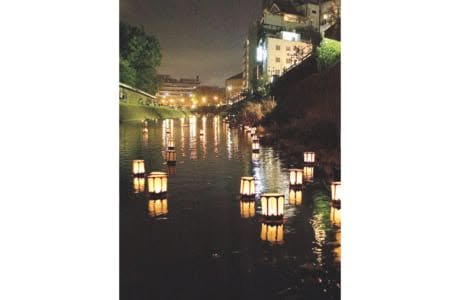
Which brings us to Obon (お盆), which rivals New Years as the most important Japanese holiday. Most Kumamoto people residing on the plains celebrate Obon from July 13, while those in mountain regions do so in early August. The holiday's purpose is to welcome home the spirits of one's ancestors and is often accompanied by sweets placed on the family alter (butsudan, 仏壇 - apparently, deceased spirits like sweets) and lanterns to help guide them home. Three days following, celebrations are often held to see off the departed. These are often conducted by placing candles on floating objects which are placed in a river or in the ocean; the event is called "lantern-floating" (とうろうながし、灯篭流し, though the tradition has faded as concern over resulting pollution has arisen).
As such, July 15 will see a progression of candle-lit objects down Tsuboi River, and August 15 the same in Kawashiri. The scene is quite touching, and if you're a photographer, you should head out. Below is an example shot snatched from the Web. - William

2018-07-15 20:37 JST

Joe Tomei with a Friday (that I forgot to post last night, whoops!) Funky places post.
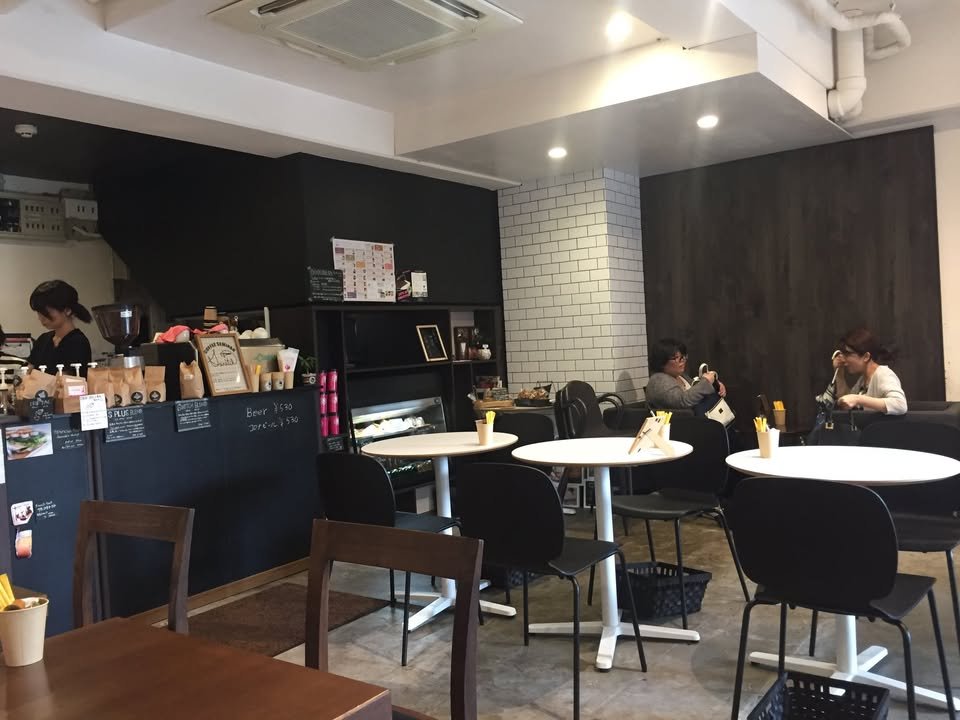
I have to confess, the Starbucks across the street from my employer has turned me into a Starbucks guy, but it would be remiss of me to fail to note that there are now more coffee places in town than you can shake a stick at, and many of them are deserving of the Funky appellation. So last week, I wanted to check out a place at the end of the covered section of Kamitori called Joe's Coffee on the assumption that given my name, I would receive the VIP treatment. However, Joe's Coffee has been replaced Cafe Switch and it now features a barista and some quite nice sandwiches. I didn't introduce myself as things were rather busy.
Of course, everything is Kumamoto is connected and this Cafe Switch is apparently a branch of a second Cafe Switch discussed in this article
http://voyapon.com/kamitori-kumamoto-shopping-arcade/
whose facebook page is at
https://www.facebook.com/%E3%82%AB%E3%83%95%E3%82%A7-%E3%82%B9%E3%82%A4%E3%83%83%E3%83%81-Cafe-switch-242233185837679/
The article notes that "they also offer their own latte art courses to the general public, for any baristas-in-training who may be interested."
The google map for Friday Funky Places is located at
https://drive.google.com/open?id=1qUH94Bac7Hr939b7_8gtvebaJZffGRsX&usp=sharing

2018-07-14 08:56 JST

We had posted on June 7 a beautiful photo taken by our friend Yoshiko Toyama of one of the roads that access Ariake Sea. Apparently, many of these roads were crippled by the quakes, including one crucial for the nori harvest located in Uki Town's Sumiyoshi Machi - this is the intersection between the sea and Midorikawa, a main river of Kumamoto.
The road, known as Nagabetakaisyouro (長部田海床路[ながべたかいしょうろ]- try saying that really fast!), had lost its power pillars and thus night lighting, crucial for cars navigating at nighttime low tides. The night road has also been a magnet for photographers. Kumanichi reports that all 24 pillars and ancillary infrastructure have recently been restored. Google Map the location for some wonderful evening/nighttime photography. - William

「海上の絶景」復活 宇土市の長部田海床路 - 熊本日日新聞
夕焼けを背景にした長部田海床路。電柱に照明が点灯する=宇土市昨年の台風で折れていた電柱が復活した長部田海床路。沖合約1キロまで舗装路と電柱が続く 沖合に向かって舗装路が延びる宇土市住吉町の長部田海床路...

2018-07-13 00:16 JST

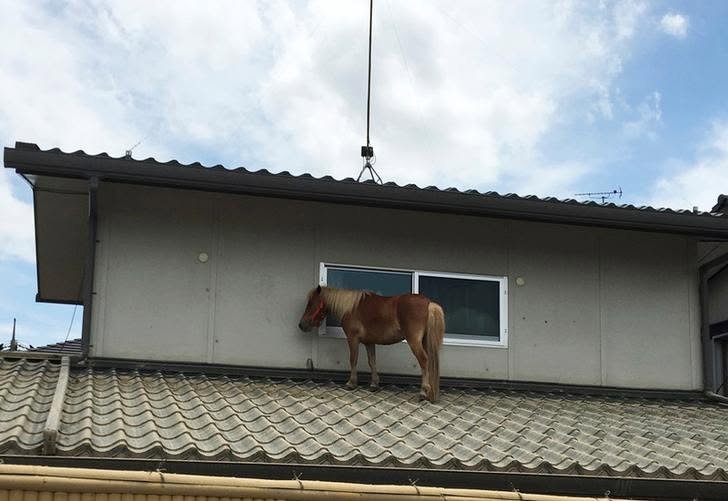
An old story in America refers to what is known as a "post turtle" (and as someone who spent summers in Arkansas, the metaphor is vivid - you can read a version of the joke here if interested: https://www.urbandictionary.com/define.php?term=Post%20Turtle ): "You know he didn't get there by himself, he doesn't belong there, he doesn't know what to do while he's up there, and you just want to help the poor guy get down."
This photo of some unfortunate pony stranded on a roof in Hiroshima reminded me of the post turtle metaphor. Our thoughts go out to those victims of the recent floods. - William

2018-07-12 08:13 JST

"Butterflies flutter by" is a phrase most native English-language speakers know, though they (butterflies, not native speakers) don't flutter due to ineptitude, scientists figure - they are quite able to fly rapidly in a straight line when need suits, but in order to confuse predators, scientists have noted, their flight pattern when feeding is as random as anything ever measured.
(I will refrain here from comparing butterflies with my daughter.)
Butterflies lay eggs on the particular plant their larvae, known as caterpillars, will feed on voraciously as they grow rapidly; they then metamorphose, fly away, and thereafter never call or text unless they need something (I will again refrain here from comparing butterflies with my daughter).
Attached is a guide for identifying butterfly types common in Japan which is useful as it allows one to identify species by color. (Just memorize the Japanese names of one or two species and use them at random to impress your Japanese friends, who likely won't know any better - and, again, I will refrain here from bringing up my daughter). - William
http://www.pteron-world.com/topics/search/search.html

2018-07-11 16:30 JST

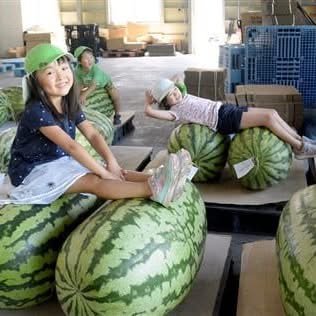
Some are rather neutral regarding watermelon (me!) while some are fanatic (my daughter!). Some watermelon are big, while some are small. One can reserve opinion regarding issues such as watermelons and daughters and still be impressed by these: 110 kilogram watermelons grown in Ueki from seeds originating from America, which Kumanichi describes as "rice-bale-shaped" - 米俵のような縦長の形 - as Japanese watermelons are generally round. The article notes that they will be sold at various supermarkets around town - or perhaps you could wait to receive one as a gift (which would then require lugging a 110-kilogram watermelon as an obligatory regift to your neighbor. This is what is known as "progress.") - William
重さ110キロにびっくり 植木町でジャンボスイカ品評会 - 熊本日日新聞
巨大なジャンボスイカに喜ぶ山本保育園の園児ら=熊本市北区 ジャンボスイカの大きさを競う品評会が10日、熊本市北区植木町のJA熊本経済連第一集送センターであった。JA鹿本の園芸部OB会と植木町青年部野菜...

2018-07-11 11:27 JST

I thought folk might like to know about this new website, set up by Japan Times journalist and writer Amy Chavez - ‘Book on Asia’. In the issue featuring:
“BOA Issue No. 2 is all about Emily Bronte, Wuthering Heights, and its influence on Japan. The Hon podcast features author Judith Pascoe and her book "On the Bullet Train with Emily Bronte." Seán Michael Wilson (aye, that's me) expounds upon the makings of his graphic novel version of Wuthering Heights, and we introduce several translations and adaptations of Bronte's novel, including A True Novel, by Minae Mizumura (translated by Juliet Winters Carpenter).”

Two Archives - Books on Asia
Issue 2 In this issue of Books on Asia, we delve into Emily Bronte’s classic Wuthering Heights and the popularity of the novel in Japan, which is also the subject of Judith Pascoe’s book On the Bullet Train with Emily Bronte. A fun, engaging read, Dr. Pascoe deliberates on some of the 20 or so J...

2018-07-10 09:32 JST

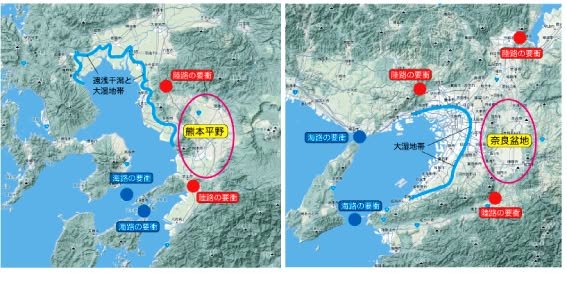
While technically an alluvial plain due to its two main rivers, Shirakawa and Midorikawa, Kumamoto can also be considered a basin when taking the Shimabara peninsula on the other side of Ariake sea into account, and basins can get very hot very quickly (one article I read while looking into this compared Kumamoto with Nara - they do have strikingly similar topography, though quite different latitudes - and in the immortal words of Jimmy Buffet, "Changes in Latitudes, Changes in Attitudes"). Today is forecast to be 35°C (95°F), with astounding humidity. To all our friends, take care over the next few days. - William

2018-07-10 07:38 JST

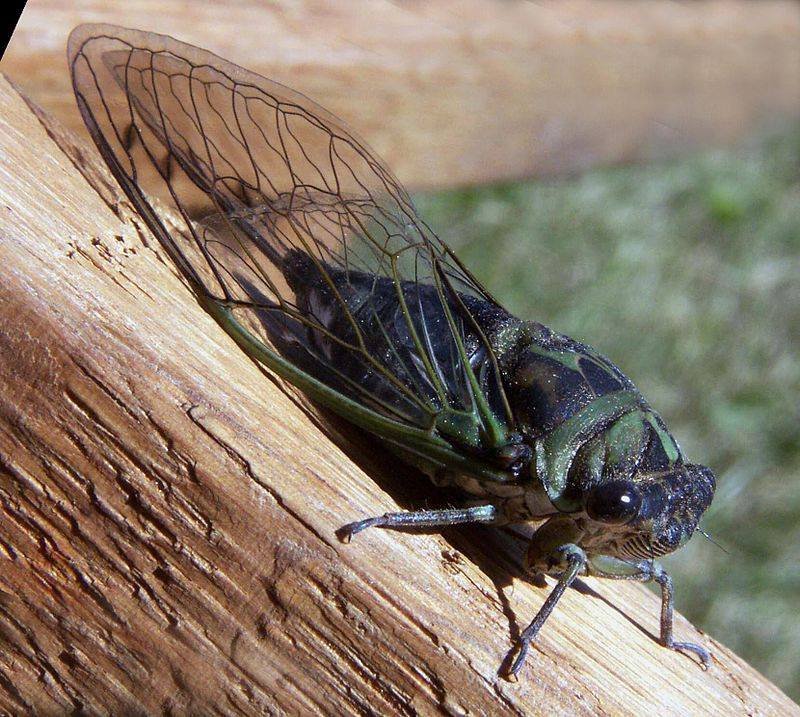
Hemiptera, or true bugs (though why one would pretend to be a bug if one were actually not is beyond me), are an order of insects comprising some 50,000 to 80,000 species, most of which likely live under your pillow. The cicada accounts among them.
Cicada are numerous in Japan and are here a symbol of summer. As with most insects, their adult stage is quite short, only about a week, compared with some seven years of larval stage, during which they subsist on tree sap obtained from roots of the very trees they will eventually climb to metamorphose (though any wooden structure will do - Shinto shrines, typically surrounded by trees, are generally masked by cicada husks by mid-summer), leaving nickle-sized holes as they egress. Females continue to feed on tree sap during their adult life using a prong-shaped proboscis, while the males fast (that fellow below is likely male). Neither sex will harm you - which, generally speaking, is more than can be said regarding humans. The males emit a vibrating sound that is surprisingly loud considering their size. Deafening, even, by August. Kids here delight in catching them with nets and containing them in plastic boxes, which must be quite a bummer after having lived subterranially for seven years waiting for this one week during which to reproduce. Cicada exoskeletons litter wooden structures long after summer has ended. Most exoskeletons disappear due to weather or old women wielding brooms, but some remain petrified where their former inhabitants discarded them and can be seen even in the depths of winter. For a human observer, this is a reminder in February that July is imminent.
Somehow, cicada are able to discern the end of the rainy season - they will not emerge until the weather dries. You have likely heard the calls of the males today, an indication more accurate than any meteorologist can provide that the rainy season has ended and summer has begun. - William

2018-07-09 13:27 JST

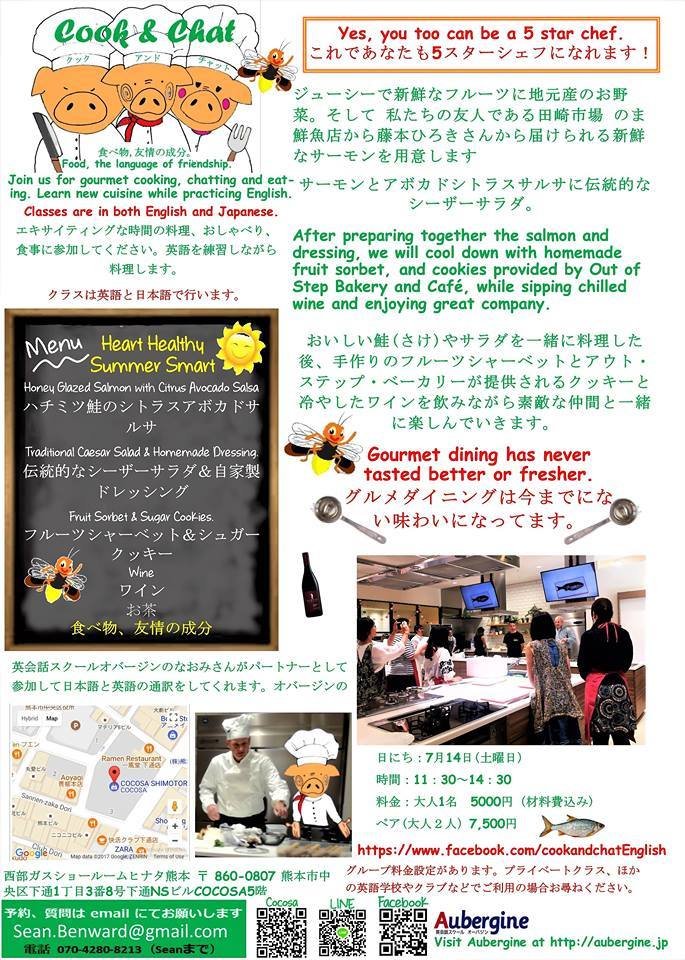
Sean Benward and his crew are preparing another English-language cooking session to be held at Cocosa on July 14 from 11:30 to 2:30. Whether you're a native speaker or not, the environment and culinary content make each of Sean's events quite worthwhile. Detailed information is at the flyer below. - William

2018-07-07 12:02 JST

I'd recently arrived in Japan when the sarin gas attacks on the Tokyo subway line perpetrated by Aum Shinrikyo occurred in 1995. I remember with shame now how I joked about the incident at the time, not realizing its significance (the cult was also responsible for the murder of a young lawyer, wife, and child in 1989.) Today, the leader of the cult, Asahara Shoko, was executed.
He was born and raised in Yatsushiro, Kumamoto. - William

Japan doomsday cult leader executed 23 years after Tokyo sarin attack
The leader of the Aum Shinrikyo cult, which carried out the deadly 1995 sarin gas attack on the Tokyo subway, has been executed, according to Japanese public broadcaster NHK.

2018-07-06 12:41 JST

Joe Tomei here, with a special introduction for our Funky Place Friday post, which will hopefully make up for me missing last week! Today, I want to introduce Chieko Noriyuki's blog Untapped Kumamoto (http://untappedkumamoto.com/)
She's just starting, but Kumamoto has more funky places than you can shake a stick at, so this shouldn't be a problem. The blog format also allows more pictures and a bit longer description, so please check it out!

Untapped Kumamoto - Let me help you to discover untapped experiences
Let me help you to discover untapped experiences

2018-07-06 09:00 JST

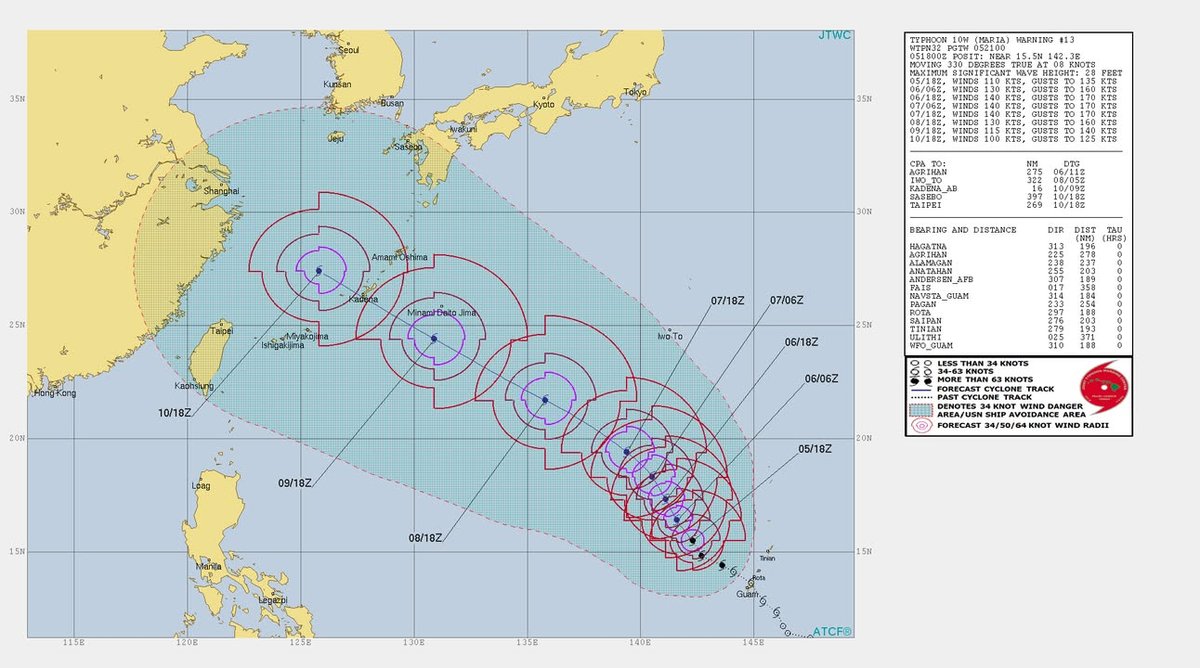
A note from the Kumamoto International Incessant Rain Desk: Forecast through the weekend is incessant rain, so take care of flooding and landslides. There's also Typhoon 10, a rather powerful guy, and while he's currently tracked to bisect Okinawa on Tuesday and then wham Shanghai, typhoons can turn on a dime, so it bears watching. - William

2018-07-06 08:42 JST

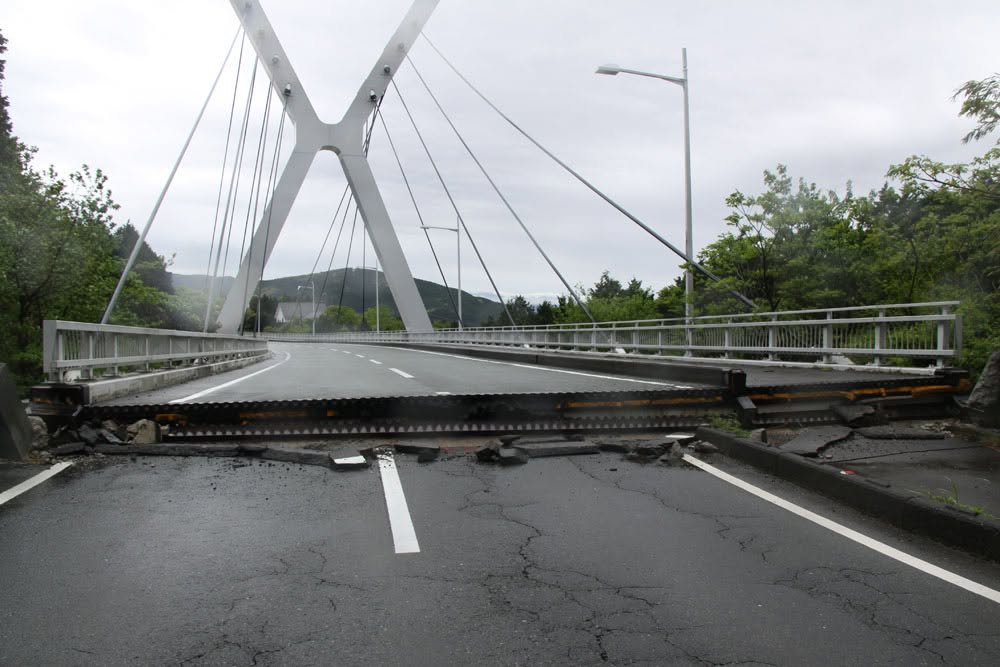
Kumanichi reports on another step in post-quake recovery (and, yes, I understand that phrase is illogical as it's impossible to recover from damage not yet incurred): Kuwatsuru Bridge (桑鶴大橋) in Nishihara Mura, which connects to the Tawarayama Tunnel still under reconstruction, has been reopened. The photo below shows the extent of movement both vertical (the bridge towers, being anchored deeply, did not move in relation to the leading road) and lateral (look at the center lines). The bridge's name is also quite beautiful: "kuwa" (桑) means mulberry, that plant that silkworms thrive on, and "tsuru" (鶴), of course, means crane - that of the bird variety. Apparently, construction on connecting roads will continue through late July, resulting in single-lane usage through that time. - William
https://this.kiji.is/387211454803133537?c=92619697908483575

2018-07-05 11:45 JST

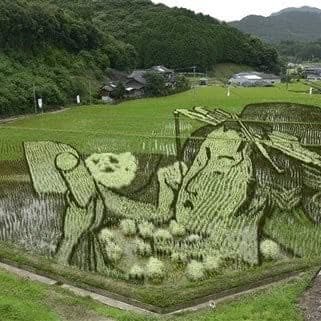
Even if you're unfamiliar with the name Kitagawa Utamaro (喜多川歌麿, 1753 - 1806), you're likely familiar with his work - his ukie woodblock prints became the standard for what ukie should be. You can read more about him here at Wikipedia: https://en.wikipedia.org/wiki/Utamaro
Kumanichi notes that some rice farmers in the Yamaura district of Kyouragi in Kamiamakusa's Matsushima Machi (Yeah, that's a mouthful: 上天草市松島町教良木の山浦地区 - just コピペ this if you head out there and show it to the locals for guidance) have reproduced a famous Kitagawa work using six strains of rice to create color variances. (Considering the large amount of Edo-era pornography Kitagawa produced [Google!], the choice was felicitous.)The location is close to a hill, allowing great photography. It will be on display until hunger overwhelms aesthetics. - William
https://this.kiji.is/386652775305741409?c=92619697908483575

山里に浮世絵 上天草市の農家らが「田んぼアート」 - 熊本日日新聞
水田に浮かび上がってきた美人画=上天草市 上天草市松島町教良木の山浦地区で、地元農家らが植えた「田んぼアート」の稲が成長し、緑深い山里に浮世絵の美人画が浮かび上がってきた。  天草四郎観光協会(同市).....

2018-07-03 13:47 JST

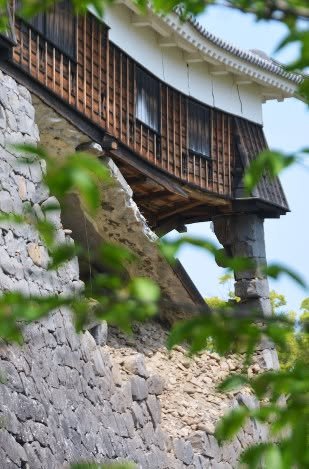
Many will remember Iidamaru Turret, that which the quakes left leaning precariously on a single column of corner stones - it was dubbed the "single-column turret" - while engineers frantically sought a solution before aftershocks or the advent of rainy season brought down the whole structure. They finally settled on an immense cantilever, which did the job. Bravo for these engineers' ingenuity.
The turret itself has been carefully dismantled and stored away, and Kumanichi reports that work to dismantle wall remnants for restoration, including that famous column, began today and is expected to conclude in March, with rock by rock to be carefully winched down to safety.
Also included below are photographs nabbed from the Net for a short trip down Iidamaru's memory road. - William
https://this.kiji.is/386365894543082593?c=92619697908483575

2018-07-02 17:46 JST

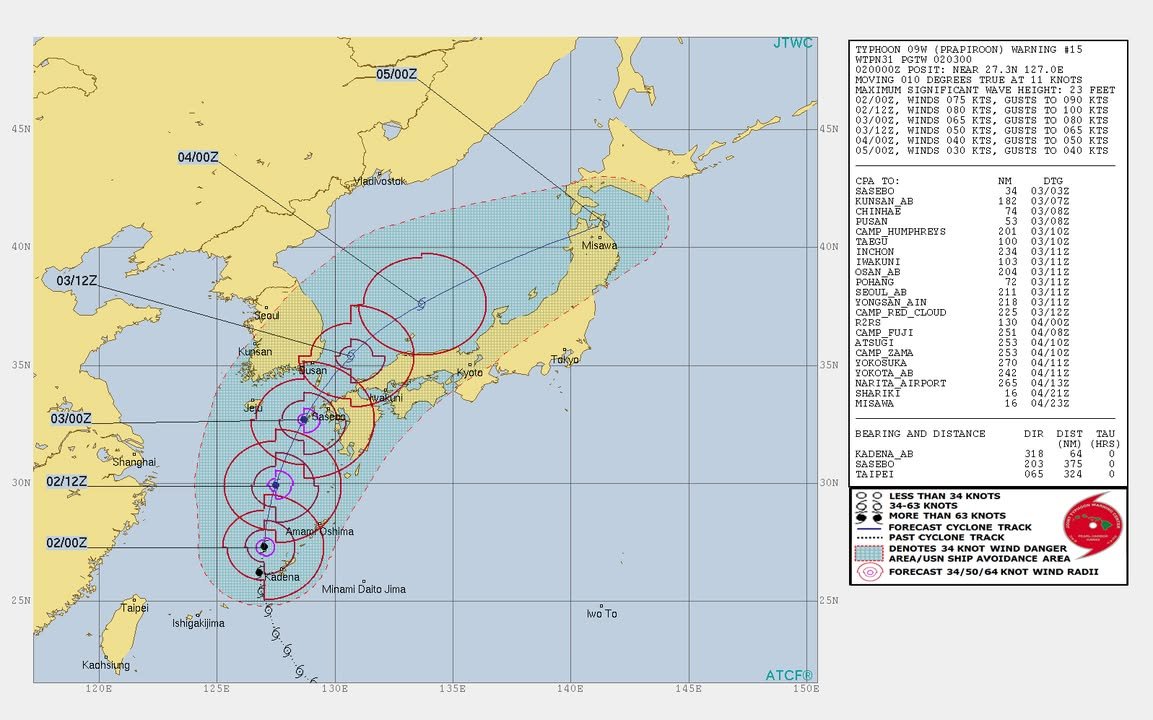
Quick update on the typhette. As I'd suspected, it is erroring east and is currently expected to pass over Nagasaki between midnight and noon of the 3rd. Again, it's small, so there's no need for alarm, but a bit of wind might be expected. - William

2018-07-02 12:19 JST

A note from the Kumamoto International desk of the Several Ways that Volcanoes can Kill You: We won't discuss the recent Hawaiian eruption, which resulted in magma flowing to the sea causing the sea salt to turn into a sodium chloride gas that will suffocate everything in its vicinity because those types of hot spot volcanoes do not occur in Japan and are anyway easily avoidable if you're not stupid. Or a bird.
Japanese eruptions, being subductive, don't present such danger; instead, there are two others: ejecta (rocks hurled up to kilometers from the site - ever notice really large rocks in Kumamoto whose existence is difficult to explain? -probably ejecta), and pyroclastic flow, which is a very hot mixture of ash and gasses that flows down from a volcano much faster than you can move away - basically, if you see pyroclastic flow within a kilometer from its origin, it's probably the last thing you'll ever see.
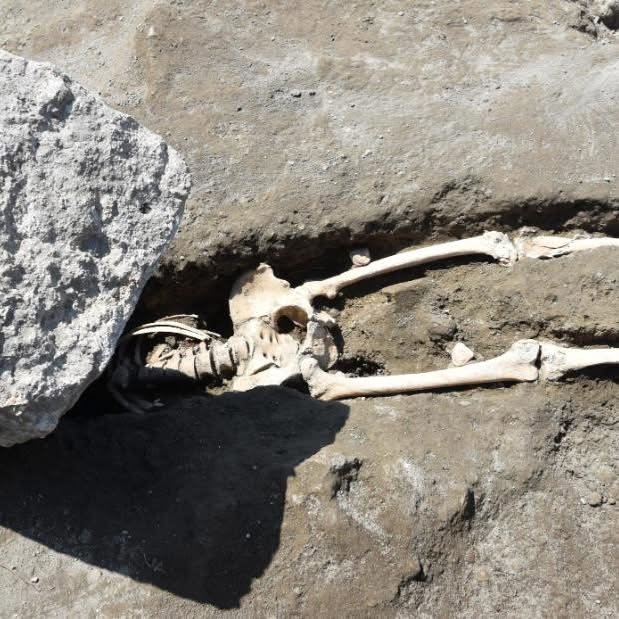
The reason I bring this up is that the guy who had died in the Mt. Vesuvius eruption of A.D. 79 and whose demise was assumed to have been due to a huge boulder landing on his face (ejecta - see photo) actually appears to have died from pyroclastic flow suffocation, with the boulder coming later as a cherry-on-cake kind of thing.
Mt. Pompei is very similar to Mt. Aso. Ejecta is cause for concern; pyroclastic flow leaves nothing alive in its wake. Then again, you might find yourself famous 2,000 years later. - William
https://edition.cnn.com/2018/06/30/europe/pompeii-victim-new-findings/index.html

Archaeologists uncover remains of man crushed while fleeing Pompeii
A man managed to escape the first eruptive fury of Vesuvius in A.D. 79, only to be crushed beneath a block of stone hurled by an explosive volcanic cloud, new excavations at the site suggest.

2018-07-01 15:31 JST