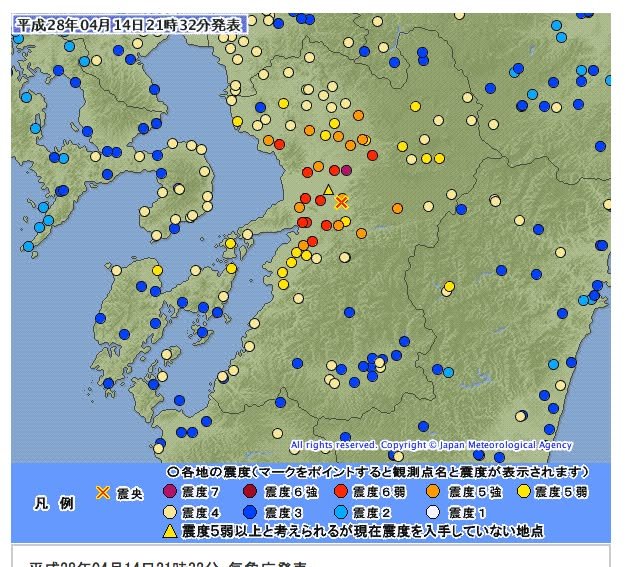
The epicenter was in Mashiki.
2016-04-14 21:38 JST 2016 The epicenter was in Mashiki. ↗ View original post on Facebook For a link to the original post on Facebook, open this page on a computer. ← 2016-04-14 21:35 JST 2016-04-14 21:44 JST → Around this time … 2016-04-14 22:08 JSTWilliam here:If you live in Kumamoto, you probably noticed an earthquake. In fact, you're probably aware of the aftershocks now. DO NOT BE ALARMED. Kumamoto's techtonics are dominated by the Futagawa fault, which has a theoretical maximum magnitide of 7 - which means it couldn't get much worse. We'll ride this out. There will be aftershocks, but it will not get worse. http://www.jishin.go.jp/main/yosokuchizu/katsudanso/f093_futagawa_hinagu.htm 2016-04-14 22:43 JSTHere's a page that should help you understand Japan's earthquake intensity rating scale (reported as "shindo"). Magnitude is a scientific measure of the amount of energy released whereas shindo tells you how bad the shaking was in each place. So, the two measure different things and you can't convert one into the other.https://en.wikipedia.org/wiki/Japan_Meteorological_Agency_seismic_intensity_scaleJapan Meteorological Agency seismic intensity scale - Wikipedia, the free encyclopedia 2016-04-14 23:00 JSTWilliam here - Introducing the Futagawa fault had occurred to me before, but this evening provides a good opportunity. The fault is a rift zone, meaning the land is spreading apart, which extends from Amakusa - creating the Uto peninsula - through Mt. Aso. In fact, the Tateno gap, through which Shirakawa flows out of the Aso caldera, is a result of the fault; without it, the Aso caldera would be a lake. It created the plain which currently hosts the airport, and the valley between the airport and the mountains to the south is the rift zone. Rift faults are not capable of such powerful earthquakes as other types such as subductive or thrust. What you have experienced is likely the largest quake this fault is capable of. 2016-04-14 22:48 JSTI was away from my computer for a while because I went to visit the dormitory that houses the exchange students at my university. Fortunately, they are all fine. The main thing I noticed is that many people are gathering in parks and other open spaces. I haven't heard the TV announcements but, apparently, people are being encouraged to leave buildings that might be vulnerable and to move to open spaces.-- Kirk (one of several editors of this page) 2016-04-14 21:44 JSTWe are continuing to experience aftershocks. Here's an image from RKK TV: 2016-04-14 21:38 JSTThe epicenter was in Mashiki. (this post) 2016-04-14 21:35 JSTThe magnitude is reported to be 6.4. We're still experiencing after shocks. 2016-04-14 21:32 JSTWe've just had a major earthquake focused on Kumamoto. Actually, we are still experiencing some tremors but the major jolt from the quake seems to be over. I was amazed to see that the shindo rating (Japan's rating scale) was 7 -- the highest level on the scale. I'lll follow up with more information as soon as I can.--- Kirk 2016-04-14 15:27 JSTThis is not a particularly interesting story save for a new piece of vocabulary for those who collect English loan words mashed into Japanese. A policeman was arrested in Kumamoto yesterday for riding a motorcycle without a helmet; as the headline notes, this was apparently a ノーヘル violation. The article also notes that we are in the midst of the spring traffic safety campaign, so keep your head about you, folks! http://www.sankei.com/region/news/160414/rgn1604140068-n1.html 2016-04-14 00:18 JSTWilliam here. It has been suggested that I introduce myself. I am an American expat who has lived in Kumamoto almost a quarter-century - long enough for "the pebbles to grow into boulders, lush with moss," to paraphrase the national anthem. My Japanese wife and I have raised two children here, who are now in American university limbo-land. Kumamoto is more my home than any place I have ever lived - yet I still have many things to learn, and as such, Kumamoto-I is a valuable source for me. I will try to summarize articles from the Japanese press related to Kumamoto so that you don't have to dig through them yourselves. Yoroshikuonegaiitashimasu. 2016-04-12 17:56 JSTThe Meiji restoration was a revolution that was largely bloodless. After the the revolution's initial success, however, disgruntled samurai waged a major revolt here in Kumamoto. It was the last series of battles of comparable scale in Japanese history. This was when Kumamoto Castle was burned down. (The current edifice was rebuilt in 1960.)-- KirkP.S. The article is by Mandy Bartok, who has published many articles about Kumamoto in the Japan Times.http://www.japantimes.co.jp/life/2016/04/09/travel/exploring-tabaruzakas-idyllic-forgotten-samurai-battleground/Exploring Tabaruzaka's idyllic but forgotten samurai battleground | The Japan Times