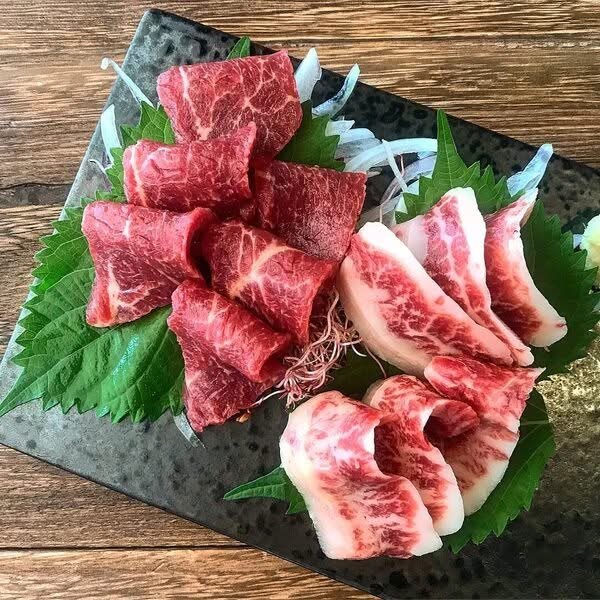
This is a basic introduction to basashi. The article includes the following factoids:
"Consuming meat, equine or otherwise, is a fairly recent acceptable practice in Japan. For more than 1,000 years, eating meat was punishable by law. On January 24, 1872, however, Emperor Meiji led by carnivorous example and publicly announced that he ate meat. He saw animal protein as a means of modernizing and enhancing the population’s health and strength, particularly with regards to the army."
This is a very rough simplification of a rather complex history. I took a look at the following Japanese Wikipedia article to try to improve my understanding of the prohibitions and taboos against eating meat:
https://ja.wikipedia.org/wiki/日本の獣肉食の歴史
One of the points made in the article is that, although there have been taboos and prohibitions against all forms of meat at various times, meat has been consumed to some extent throughout Japanese history. Also, the strongest taboos have been against raising animals for slaughter and that consuming the meat from wild animals (deer, boars, etc.) was relatively more acceptable. Another point made is that animals with more legs were considered to be worse. Fish --> no legs so no problem. Birds --> two legs, not as good as fish but not terrible. Four-legged mammals --> least acceptable. These taboos had to do, in part at least, with Buddhist thought.
This got me thinking about about the raising of horses and cattle in Aso:
https://www.aso-sougen.com/now/01/keep_02.html
I took a look at the short article above and got the impression (though I couldn't find a complete explanation) that the area was famous for raising working animals: horses for military use and oxen for other kinds of labor. So, while the practice of burning the fields in the Aso area to provide fodder for horses and cattle seems to have a very long history, the reasons for raising those animals seem to have changed in the last 100 years or so.
All this makes the bashi tradition that much more interesting to me. As I understand it, it has roots in the the Siege of Ulsan, which Wikipedia says started on December 22, 1597 and lasted until November 23, 1598:
https://en.wikipedia.org/wiki/Katō_Kiyomasa
In that siege, Kato Kiyomasa and his soldiers are said to have slaughtered and ate their horses to survive. It is my understanding that this led to the practice of consuming horse meat in Kumamoto. I'm not sure, though, how the local traditions was or was not affected by prohibitions against the consumption of animal flesh, particularly in regard to domesticated animals.
-- Kirk