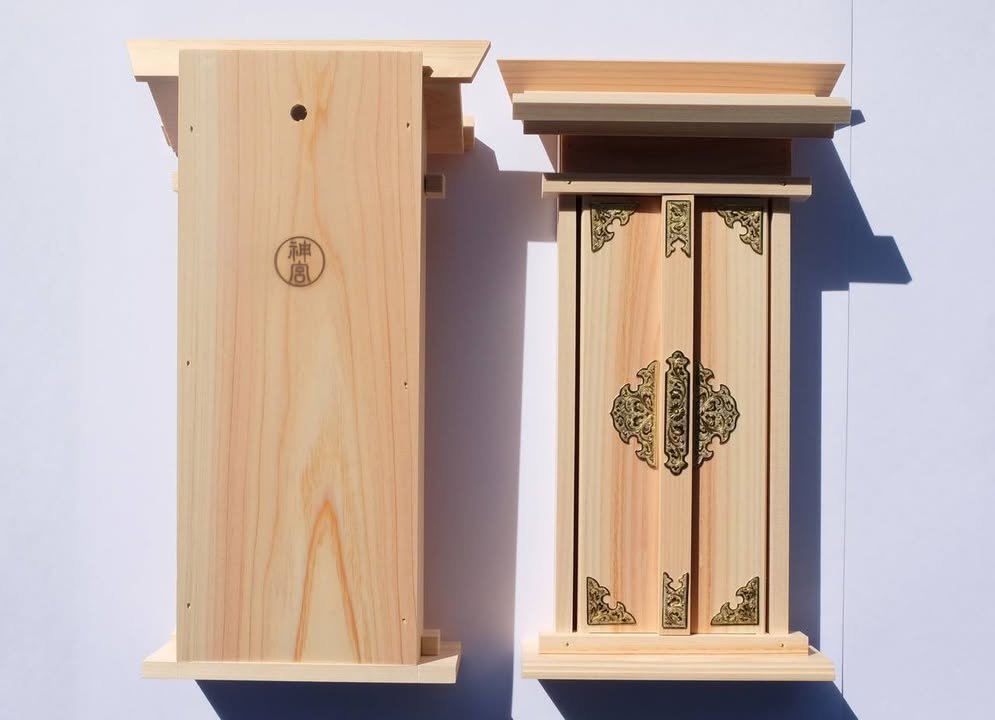
One has to be careful to distinguish between a butsudan (仏壇), generally an elaborate cabinet related to Buddhism used to pay respects to family members who have passed away; and a kamidana (神棚), spice rack-sized household altars related to Shinto used to enshrine a Shinto kami (god). Most every family - meaning extended - has the former, which is usually found at the house of its leading member, and when extended family member return "home," first is to pay respects there (even if you're not a family member, if you're close, it is considered polite); the latter is a bit more unusual and, in typical Shinto aesthetics, is very simple and hung high on a wall. Wikipedia has English-language articles on both for those interested. They're quite fascinating.
The reason I mention this is that the Kumamoto Prefecture Shinto Bureau (熊本県神社庁熊本) will be distributing free of charge 500 kamidana on a first-come, first-serve basis on December 2nd between 3:00 and 5:00 pm. The location is the former Mr. Donuts on Kamitori.
You may not need a kamidana and may want to spare them for those who do, but in addition, there will be a performance of gagaku (雅楽, traditional court music), a display of kamidana styles, and a DVD movie of Isejingu (伊勢神宮), the most sacred Shinto shrine, located in Mie Prefecture.
On a personal note, I'm not a big fan of Shintoism, finding it retaining much of the nationalism it acquired between the Meiji era through the end of the Pacific War - that is, it is tolerant of non-Japanese but not exactly welcoming. Below is a photo of the kamidana to be distributed (warning: to receive one, you'll have to fill out a "simple"questionnaire in Japanese), and more info can be found at the link. - William