Before expressway existence, the only way to travel between Kumamoto and Kagoshima was Route 3, an arduous journey in those days, and the small towns that dot that route - Ashikita, Minamata, Izumi, Akune, Sendai, Kushino - profited from the weary travelers. Of course, those days are long gone, and their other staples, farming and fishing, aren't doing much better. Except for a white elephant here and there, they're frozen in time - and losing their young rapidly.
Akune (阿久根) is particularly interesting. According to Wikipedia, the 「阿久」refers to the fisheries and the 「根」to the reefs. It was a popular way-stop, half-way between the cities, and with its onsen and beaches, often a destination in of itself. I recommend a visit; it is accessible by the JR Orange line. It was also important for the "hidden Christian" population in the Edo era. It's population, like other towns in the region, is plummeting.
I attend the Oe Lutheran church whose pastor, Tateno Sensei, is also responsible for the Akune church. Due to physical constraints limiting one to a single existential location, he's set up streaming video so that the handful of (mostly elderly) Lutherans remaining in Akune may join their Kumamoto brethren in worship on Sundays. This morning, he proudly announced an upgrade.
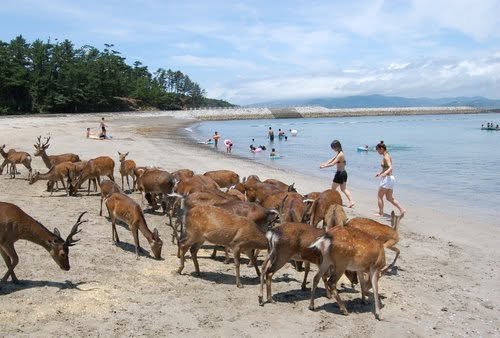
Technology will grow increasingly important in linking the elderly remaining in Japan's depopulated hinterland to its burgeoning cities. Below: Deer on a beach in Akune (obviously). - William