Kirk here with a post about a new, easier to understand, 5-level warning system that has been put into effect.
When the weather's nice, as it is today, those of use who edit Kumamoto International post about whatever happens to interest us or seem important at the time. When there's some kind of natural disaster, or the threat of one, however, we try to do what we can to provide practical information about how to weather the storm. That was particularly true in April of 2016, after the quakes hit, but we've also posted a lot about approaching typhoons, landslides, floods, volcanic eruptions, and other worrisome natural events. At such times, since there is often not enough good information available in English, we need to rely of warnings issued in Japanese and try to summarize the information in English. And, at such times, I have frequently found myself feeling irritated by cryptic, ambiguous Japanese-language warnings.
Apparently, I wasn't alone in feeling that more clarity was needed. Here's a link to an article about a new 5-level warning system that was put into effect because, in regard to last year's system, "complaints were raised that there were too many difficult-to-understand warning and evacuation advisories released":
http://www.asahi.com/ajw/articles/AJ201905270039.html
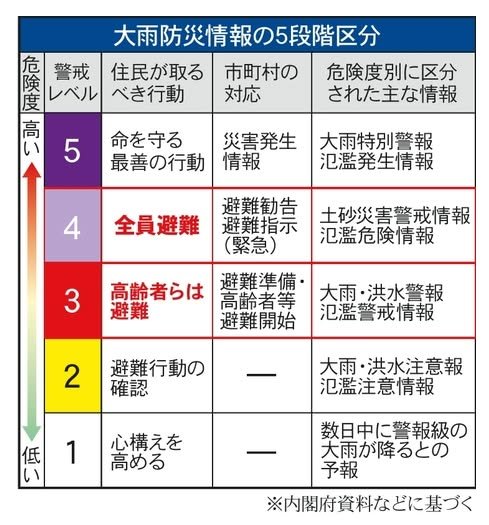
Clarity in Japanese makes the job of translating and/or summarizing the same information in English that much easier so I'm very glad to see this improvement. I wonder, however, why no one seems to have bothered to translate the reasonably simple and clear Japanese table (see attached image) into English. The Asahi article describes the five levels in text but in an emergency we'll need to refer to this color-coded chart. I'll make a few notes about it in this post in preparation for rainy days when I might need to quickly put out some information about warnings that have been issued.
First, one really nice feature is the clarity of the 5-level scale itself. Level 1 is the lowest level ("be on the look up for bad weather in the next few days") and Level 5 the highest. One important point is that Level 5 advises NOT to evacuate. By the time you get to Level 5, it's too late to try to go to an evacuation center because of the risk involved in moving to one. At Level 5, you need to do what you can within your house or apartment to weather the storm: move to a higher floor in case of flooding, move to a part of the building farthest from a possible landslide, etc. Level 4 is "everyone should evacuate" and level 3 is "the elderly and others who cannot evacuate quickly should begin evacuating now."
If anyone happens to see a clear graphic in English that explains this, please post a note about it to this page. In an actual emergency, I would like to have such a graphic available.
Ideally, I think the color-coded warning levels should be displayed on a map but, as far as I know, that is part of the plan at this point. "To evacuate or not to evacuate" is a very site specific decision. For now, however, I guess I just need to put such a map on my wish list.
Finally, here are some musings about confusing warnings issued in Japanese by the prefecture. I am posting them mostly for my own reference (I'm planning to write about this for a different forum later and would like to be able to find the links quickly) but, if you're interested, have a look.
https://www.facebook.com/Kumamotoi/posts/667596949980407
https://www.facebook.com/Kumamotoi/posts/667492209990881
https://www.facebook.com/Kumamotoi/photos/a.129499733790134/667780409962061/?type=3&theater
Thanks for reading and stay safe! :)