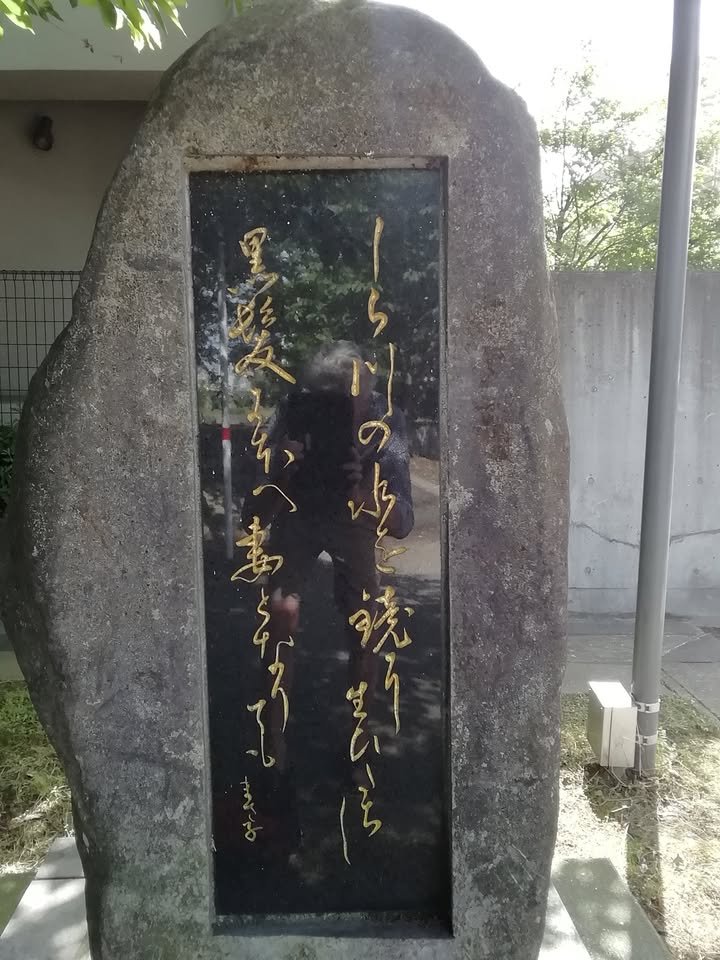
A walk my dog particularly enjoys (not that he disenjoys any walk, but he enjoys some more than others) traverses Meigo and Taiko bridges (the former was used by the Hosokawa clan when they visited Suizenji; the latter hosts the streetcar and was the official route through Kyushu - hence, Kokubu). Being off-lead, my dog requres more attention than this stele between the bridges that had long begged for attention deserved, so I photographed it for later consideraton. Here the mystery begins with two steps: deciphering the calligraphy and considering its meaning.
The stele's caligraphy is quite so stylistic (apperantly, it's a rubbbing of the originale stele that had deteriorateed) that even my Japanese friends could't read it, but a sufficient amount of fragments and Mr. Google resulted in this:
しら川の水を鏡に生ひたちし
黒髪にほへ妻となりても まさ子
So the content was solved, but then we get down to the meaning. A few eldely gents, bereft of family but blessed with knowledge, visit most mornings for breakfast, and their take was startling. (Sorry - this is kind of long.)
Good poetry is purposely ambiguous. Here, obviously, 黒髪 could mean actual hair but could also indicate the direction in which she was gazing - which is also the direction of her college. More interestingly is that 鏡 - mirror - is also the name of Natsume Souseki's wife, 鏡子 (Kyouko), herself also an accomplished author. Apparently, Souseki was too rather violent for Kyouko-san to put up with, and she tried to drown herself at this spot.
My take: The author, Yasuda Masuko (安田昌子), was an early graduate of Kumamoto Women's College, and this poem is an example of Japanese proto-feminism. Here is one way it can be translated. If you have other ideas, please let us know. - William
Shiraka is born a mirror
And though betrothed, my hair retains the river's fragrance
Which perhaps means
My past and present are here visable
As is my future.