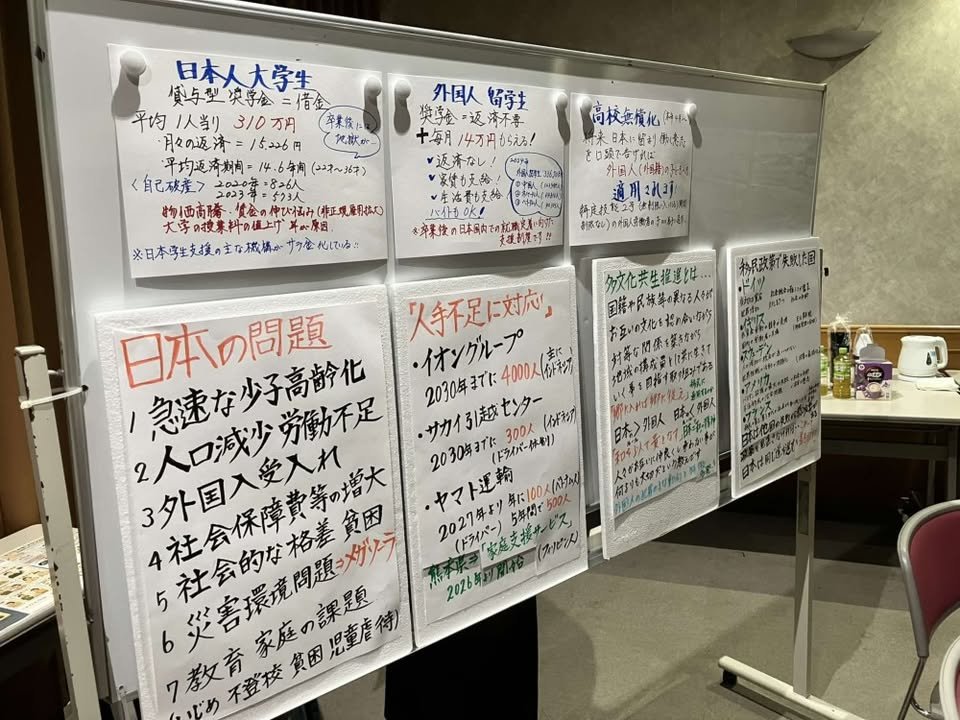
Kirk here. In this post I'd like to report on an anti-immigration "symposium" that was held at the Kumamoto International Center on Wednesday. First, as the International Center is by no means "anti-immigration" or "anti-foreigner" I should explain how it is that such an event came to be held there. I called the International Center and learned that the sponsoring group, Kumamoto Wasamonkai, must have applied to use a conference room and that in such cases, requests are routinely approved unless there's some very clear problem that they know about in advance. Citizens have a right to use public facilities so I can't blame the Center for granting permission. What bothered me a bit more was the Kumamoto Keizai's uncritical publication of the views expressed in the symposium (Kumamoto Keizai is an organization that publishes a reputable magazine and also runs an online news site). I'll report on my phone call with Kumamoto Keizai at the end of this article.
First, here's the content I was able to glean from the Kumamoto Keizai article:
1. Panel about immigration: "Countries That Failed at Immigration"
A list of countries described as having "failed" at immigration, including Germany and the United States. Each country is dismissed in roughly one line, with no nuance, no acknowledgment of the benefits of immigration in those societies.
2. Panel about student scholarships: "Japanese Students Get Loans, Foreign Students Get Free Money"
A panel juxtaposes Japanese students with average debt of 310 man-yen and 14.6 years of repayment with foreign students supposedly receiving 140,000 yen per month with no repayment requirement. The figures contain real elements but are presented misleadingly (for example, the "8,108" bankruptcy figure appears to be a 5-year cumulative total presented as an annual figure). The juxtaposition is rhetorical: the panel does NOT advocate for expanded grants for Japanese students, but instead frames the issue as foreigners being unfairly privileged. The recently expanded grant-type scholarships for Japanese students (since 2017 and 2020) are not mentioned.
3. Panel about free high-school tuition: Foreigners may get free tuition too!!
Japan's high school tuition-free program has been expanded in recent years, and the question of whether it applies to children of foreign residents has become a flashpoint in some political circles. Under current policy, the program does apply to foreign residents who meet the criteria, consistent with international human rights norms regarding children's right to education.
The panel frames tuition waivers for foreign residents as problematic. The implied position is that public education subsidies should be reserved for Japanese citizens, or at least that extending them to foreign families is inappropriate. The panel does not engage with the fact that these are typically children of tax-paying long-term residents, nor with international norms on children's education rights.
4. Symposium topic: Aso megasolar
The proliferation of megasolar plants in and near the Aso region is a genuine environmental and policy concern. Issues include grassland destruction, groundwater impact, landslide risk, panel disposal and toxic contamination, and the structure of FIT contracts. Local governments including Aso City have taken positions opposing large-scale installations that damage scenery. The Ministry of Environment expanded the Aso-Kuju National Park boundaries in part to restrict megasolar development.
The framing of this as a "foreigner problem" is probably connected to concern about foreign capital and Chinese involvement. In reality, most major Aso-area megasolar operators are Japanese companies or Japanese subsidiaries (JRE is now an ENEOS subsidiary; BCPG Japan is Thai-owned but operates through a Japanese SPC). Chinese-manufactured panels are common in Japan generally (over 80% of panels), but this reflects global market reality rather than foreign ownership of Aso-area plants. Aso City itself has explicitly pushed back against viral SNS framings, noting that some content causes fuhyo higai (reputational damage) to local tourism. The panel takes a real environmental concern and overlays it with a foreign-threat framing that misidentifies the actual policy and economic causes.
5. Symposium topic: Multiculturalism and religion
On June 7, 2025, approximately 700 Muslims gathered at Kumamoto Castle's Ninomaru Plaza for Eid al-Adha (犠牲祭) prayers, with permission from Kumamoto City. This was the first time the festival was held outdoors in Kumamoto, due to the indoor mosque space being insufficient as the local Muslim community has grown (driven largely by international students and technical interns from countries like Pakistan and Malaysia). The event generated significant online reaction, with some commentators framing it as "silent invasion" or cultural threat. Kumamoto Prefecture has about 4,533 Muslims as of end of 2023 (roughly 0.27% of the population). Other related topics in current debate include halal food in schools, mosque construction, and Islamic burial practices.
I do not know what was actually said at the meeting on this topic. However, given the framing of the other panels and the overall stance of the display, it is reasonable to suspect that the discussion treated religious differences as problems requiring management or restriction, rather than as ordinary features of a pluralistic society. The Kumamoto Castle event is a likely focal point, given its prominence in local discourse, but other topics (halal accommodation, burial practices, mosque construction) could also have been addressed.
6. Symposium topic: Foreign domestic support worker program
Kumamoto Prefecture announced plans to launch the foreign domestic support worker program (家事支援外国人受入事業) in 2026 under the National Strategic Special Zone framework, in connection with its special zone designation tied to TSMC's arrival. The program was originally launched under the Abe administration in 2017 and has been operating in six other jurisdictions (Tokyo, Kanagawa, Osaka, Hyogo, Aichi, and Chiba City). Workers come exclusively from the Philippines, are employed by approved companies, work on 5-year visas, and are subject to government oversight. The Kumamoto announcement generated 413 public comments raising safety concerns, prompting Governor Kimura to hold a press conference on October 29, 2025 explaining the program. Legitimate debate exists around worker protection, the feminist policy question of importing care labor versus restructuring Japanese workplaces, and the program's primary benefit to wealthy households.
Though I don't know what was actually said at the meeting, given the broader stance of the display, it is reasonable to suspect the discussion focused on opposition to the program — likely emphasizing crime and safety concerns, characterizing it as "immigration coming to Kumamoto," and treating it as a threat to local society. However, this is inference.
I called Kumamoto Keizai. I was not able to speak with the gentleman who put the article together but I was able to express my concern to another journalist who was kind enough to take my call. The thrust of what I said was that the combination of the venue and the uncritical publication may have given the content a certain "seal of approval" in the eyes of readers. I think Kumamoto Keizai should have done some fact checking or provided context or alternative views. Or, if they were not prepared to do that, I think they should have, at the very least, omitted the photo of the clearly anti-immigration and highly problematic panels.
Finally, here's the URL of the Kumamoto Keizai article: