I posted about a rather problematic portrayal of foreigners in Kumamoto a few minutes ago. Here's a much more positive article. -- Kirk
--- start Claude translation ---
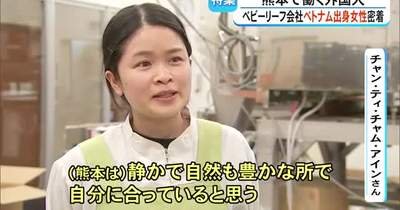
'Foreign Workers in Kumamoto' — A Close Look at a Vietnamese Woman Who Leads the Processing Floor at a Baby Leaf Company in Mashiki Town
April 30, 2026
This is a look at trends in what is called the "working-age population" — people aged 15 to 64 — in Kumamoto Prefecture. The number has fallen by over 100,000 in ten years and continues to decline, and the labor shortage in Kumamoto is becoming increasingly serious. At the same time, the number of foreign workers in the prefecture is on the rise, surpassing 24,000 as of last October — a new record high. In TKU Live News, we shine a spotlight on foreign workers living and working in Kumamoto.
For our first installment, we visit a company in Mashiki Town that grows and sells baby leaf vegetables. We spoke with a Vietnamese woman who serves as leader of the company's processing floor.
[Tran Thi Cham Anh]
"Good morning."
Meet Tran Thi Cham Anh, a Vietnamese woman living in Mashiki Town. She left her home country eight years ago and has been working in Kumamoto ever since. Before heading to work in the morning, she prepares her bento box at home. On this day, she makes a tamagoyaki packed with vegetables.
[Anh]
"Oh, it burned a little."
(Are you good at cooking?)
"Not really..."
Every morning she rides her bicycle about three kilometers from her apartment to the company.
This is Mitchan Kobo, where Anh works. The company cultivates baby leaf vegetables on approximately five hectares of farmland and handles everything from shipping to sales.
[Anh]
"Thanks everyone, let's have a good day today."
Anh is responsible for packaging and boxing the harvested baby leaves, as well as quality control, on the processing floor.
Mitchan Kobo began accepting foreign technical intern trainees ten years ago.
[Mitchan Kobo President, Hikari Kaori]
"Even when we put out job listings and spent money on recruitment, we just couldn't get people to come. We were in a truly desperate labor shortage. I had a real sense of crisis — if this kept up, the company wouldn't be able to function. I thought we might go under."
Mitchan Kobo currently employs six foreign workers, including Anh. President Hikari says that when they first accepted foreign workers, they ran straight into the language barrier.
[President Hikari Kaori]
"Not being able to communicate in Japanese was extremely difficult. After work, I taught Japanese every day. Just a textbook wasn't enough for them to understand, so I drew pictures in a sketchbook and we studied from those together. We also went to karaoke — I said 'let's learn Japanese songs' and we all sang whatever was popular at the time."
About a month after they started, the Kumamoto Earthquake struck. The company building itself sustained no major damage, but the interns' apartments were half-destroyed.
[President Hikari Kaori]
"We all lived together in the factory for about a month. After living together for a month, they naturally started picking up the language."
Anh came to Kumamoto in 2018, two years after the earthquake, at the age of 20, as a technical intern trainee. She says there were times back then when she thought about going back to Vietnam because she couldn't get used to life in Japan.
[Anh]
"At first, it was hard because it's a different country — everything is different, the culture, the language. I didn't even know how to read the garbage sorting guide."
Through the support of company staff and others around her, she gradually adjusted to life and work in Kumamoto and improved her Japanese. Three years ago she became leader of the processing floor, and she now serves as a unifying presence for both Japanese and foreign staff.
President Hikari places great trust in Anh.
[President Hikari Kaori]
"Anh is truly dedicated. The reason I made her leader is that she has excellent quality control instincts, she hates to lose, and she works with complete sincerity. She's also deeply trusted by the Japanese staff."
At lunchtime, Anh takes her break. She enjoys her homemade bento with a colleague.
[Anh]
"It's delicious. I made it myself, so it's delicious."
Anh finds real meaning in her work in Kumamoto.
[Anh]
"It's quiet here, with rich nature, and I think it suits me. When I help the people around me, they always smile back at me — that's what makes the work worthwhile. I'm still getting used to being a leader, so I want to keep learning and improving."
Last August, Anh obtained Specified Skilled Worker Type 2 status, which effectively allows permanent residence. She will continue to support the floor as a trusted processing leader going forward.
As for the receiving side, President Hikari of Mitchan Kobo had this message for local government: she would like to see municipalities proactively organize exchange events between Japanese and foreign residents, and create forums where foreign residents can discuss their difficulties — such as garbage disposal rules.
© Television Kumamoto
--- end Claude translation ---