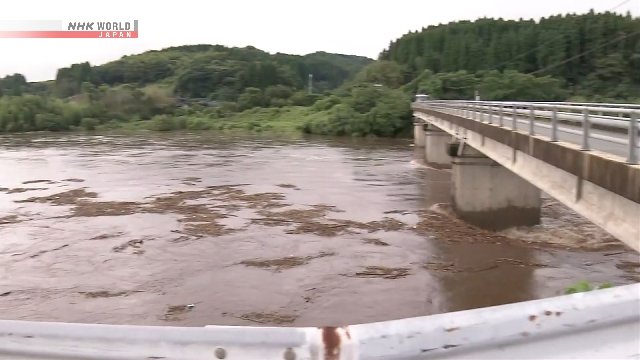
This video from NHK (in English) contains footage of flooding in Oguni-machi and Nagomi-machi --Kirk
2026-07-02 21:52 JST 2026 This video from NHK (in English) contains footage of flooding in Oguni-machi and Nagomi-machi --Kirk Japan's northern Kyushu region hit by landslides, flooding caused by downpours | NHK WORLD-JAPAN NewsHeavy downpours triggered flooding and landslides in the northern Kyushu region of southwestern Japan early on Thursday morning. https://www3.nhk.or.jp/nhkworld/en/news/20260702_12/ ↗ View original post on Facebook For a link to the original post on Facebook, open this page on a computer. Reactions: 5 ← 2026-06-28 13:30 JST 2026-07-04 09:37 JST → Around this time … 2026-07-06 19:23 JSTHere's a short little video of a surprised Kumamoto Mayor Onishi having a close encounter with an American alligator in Rome, Georgia (a sister-city of Kumamoto). It's true that alligators are native to southern Georgia, but I think Rome is a bit beyond the range of their natural habitat. -- KirkKumamoto Mayor Kazufumi Onishi and a native Georgia species 2026-07-05 18:06 JSTSorry to keep harping on rain-related topics but it's what I'm finding in my news feed. -- KirkMemorial held for 2020 rain disaster in Kumamoto 2026-07-05 11:43 JSTAs this video explains, both Kumamoto and Rome, Georgia (in the US) were involved in civil wars. In Kumamoto, it was the Seinan Senso or Satsuma Rebellion and Kumamoto Castle was where government forces faced SAIGO Takamori's rebels. -- Kirk[VIDEO] Delegation from Kumamoto Visits Rome Area History Center 2026-07-05 09:59 JSTKirk here. I just took this screenshot from the following web site:https://www.river.go.jp/kawabou/pc/ov?zm=8&area=89&clat=32.4723&clon=130.443&mapType=0&viewGrpStg=0&viewRd=1&viewRW=1&viewRl=1&viewRn=1&viewPoint=1Rainfall is heavy here in Kumamoto now but, due to previous rainfall, rivers in northern Kyushu are nearer flood levels. If you live near a river, the link I've pasted above may be somewhat helpful in keeping an eye on things. However, sadly, regardless of whether or not you read Japanese, there's no "one stop shopping" for river levels in a particular area. The following page has links to several different websites, each of which presents only a slice of the kinds of information someone wondering about whether or not they need to take evasive action might need. Ah . . . :(https://www.city.kumamoto.jp.e.fm.hp.transer.com/bousai/list00904.html 2026-07-04 09:37 JSTKirk here with a historical item from NHK World. Click on the link, not the image, to see the video.https://www3.nhk.or.jp/nhkworld/en/news/20260704_01/ 2026-07-02 21:52 JSTThis video from NHK (in English) contains footage of …Japan's northern Kyushu region hit by landslides, flooding caused by downpours | NHK WORLD-JAPAN News (this post) 2026-06-28 13:30 JSTThe AI "photo" you see is pretty darn cringeworthy. But, the story of a father and son who got inappropriately rambunctious in a Yamaga Onsen may very well be true. As portrayed in the article, there's a moderately happy ending; the idea that an onsen isn't a pool got through and all was well after that. Still, the main adjective that comes to mind is "cringe" both regarding the inappropriate behavior that stemmed out of ignorance (I've been there, done that, if not exactly the sort of thing described here) and the AI-laden way in which it's presented in SPA!, a fairly popular magazine. -- Kirk --- ChatGPT translation starts ---“They Don’t Understand Hot Springs”: The One Line from an Elderly Regular That Silenced a Foreign Tourist Parent and Child Swimming in the Bath / In 2025, Visitors to Japan Hit a Record 42.68 Million, and “Cultural Differences” Spread Even to Famous Local Hot SpringsNikkan SPA!June 27, 2026, 8:44 a.m.A moment on a trip when you slowly soak in a bath. Your body gradually warms up, and before you know it, a sigh slips out: “Ahh…” What if, in the middle of that quiet moment, you suddenly heard someone shout “Jump!” followed by a huge splash?Foreign tourist parent and child swimming in the bath 1Image is an AI-generated illustration.According to an announcement by the Japan National Tourism Organization, the number of foreign visitors to Japan in 2025 reached 42.68 million, setting a new record. At hot spring resorts, it is becoming increasingly common to soak in the bath alongside guests from overseas.This time, we introduce a true episode that drew a strong response in the past: the story of “a certain parent and child” at Yamaga Onsen in Kumamoto Prefecture. A foreign tourist father and child began using the bath like a swimming pool. What was the simple English phrase that a local elderly regular said to them, and what were his honest feelings afterward in the lobby?In the latter half of the article, as inbound tourism continues to increase, we would also like to think a little about how we ourselves should behave at hot springs and other travel destinations.* * *Japan is booming with inbound demand. But now, in many places, “bad manners” by foreign tourists have become a problem. Some aspects of Japanese culture can be difficult for them to understand in all their subtlety, and even when there is no ill intent, there are cases where people around them feel annoyed or inconvenienced.Yamaga Onsen is located in northern Kumamoto Prefecture. Its water is known for being somewhat lukewarm, allowing visitors to soak slowly and for a long time. What unfortunate incident did Yuki Yoshida, a pseudonym, experience there?Although It Was a Hot Spring, It Was “Just Like a Pool”Mr. Yoshida visited Yamaga Onsen on a day off at around 3 p.m.“It wasn’t a crowded time of day. There were only a few elderly customers in the bath, along with some people who seemed to be local regulars, quietly enjoying themselves. Then some white foreign tourists came in, and the whole atmosphere completely changed.”They were a father, probably in his thirties, and a child who seemed to be in the early years of elementary school. The parent and child appeared to rinse themselves off lightly, but it was clearly only a formality.“Jump!”Amazingly, the father picked up the child and dove straight into the bath. With a loud “splash!” the water surged, and some of it even hit elderly customers nearby.The father then laughed and shouted “Yeah!” while splashing around, and began swimming and playing together with the child.“They were using it exactly like a pool. Everyone who happened to be there was frowning.”“No Swimming! No Pool!”Foreign tourist parent and child swimming in the bath 2Image is an AI-generated illustration.Finally, an elderly man who seemed to be a regular, perhaps in his seventies, stood up beside Mr. Yoshida. Although his English was not fluent, he repeatedly said in simple English, “No swimming! No pool!” while making a hand gesture telling them to stop.The father looked somewhat embarrassed and said, “Oh, sorry, sorry,” but he did not seem to really understand what he had done wrong.Perhaps sensing the tense atmosphere around them, the parent and child quietly stayed in a corner of the bath after that. But Mr. Yoshida had become fed up and decided to get out a little earlier than planned.As he was resting in the lobby, the elderly man who had warned the foreign tourists earlier came over to him.“We’re glad they came all this way, but they really don’t understand hot springs…”Hearing the man mutter this, Mr. Yoshida could only give a wry smile and say, “I guess it’s a cultural difference.”A hot spring is something to be enjoyed quietly. It is unfortunate when that kind of unspoken understanding breaks down because of a language barrier or lack of knowledge.“It was an incident that made me think about the ‘small gap’ between the ever-increasing number of foreign tourists and Japanese culture.”Text by Mutsuki FujiyamaAre They Really the Only Ones Who “Don’t Understand Hot Springs”?In this episode, a foreign tourist parent and child jumped into the bath and began splashing around. After warning them, the elderly regular muttered in the lobby, “They really don’t understand hot springs…” His words seemed to contain not so much anger as a touch of sadness.Incidentally, according to the Japan National Tourism Organization, the number of foreign visitors to Japan in 2025 was 42.68 million, a record high. That was more than 5.8 million higher than the previous year, when the figure was about 36.87 million. This also means that visitors from overseas have begun making their way even to famous regional hot springs such as Yamaga Onsen.But what we should pause to consider here is this: practices such as “you soak quietly in the bath” and “you rinse your body properly before entering” may come naturally to people born and raised in Japan, but they are not necessarily “common sense” for people from other countries. If someone grew up in a culture of swimming pools and jacuzzis, it may not be unreasonable for them to look at a large bath and think of it as “a place to jump in and play.”Still, Beyond the SteamOf course, that does not mean that “anything goes.” In this case, after the father was warned by the elderly regular, he and the child did quietly spend their time in a corner of the bath. Even with brief English mixed with gestures, if you communicate something, it can get across. I feel that the elderly man quietly taught us that.When you think about it, when we ourselves travel overseas, can we really say we understand all the local manners perfectly? Probably not. If someone calmly teaches us about something we did unknowingly, the rest of our trip will surely become just a little richer. When the positions are reversed, what kind of words can we offer?Lowering your body slowly into the bath, relaxing your shoulders, and letting out a long breath. The next time someone is flustered on the other side of the steam, I hope I can be the kind of person who adds just one gentle word. I say that also as a reminder to myself.Foreign tourist parent and child swimming in the bath 3Image is an AI-generated illustration.Reconstructed by the Nikkan SPA! editorial departmentMutsuki FujiyamaEditor, writer, and travel writer. A super “jack-of-all-trades” around media work, from reporting and writing to manuscript editing, convenience-store runs, and even ghostwriting for celebrities. Books include Overseas Underground Travel, True Stories! I Tried All Kinds of Dubious Experiences, and The Ten-Dollar Night View. Has also contributed to many works, including the Ultimate Overseas Travel Guide Created by Travel Experts series. X, formerly Twitter: @gold_gogogo.--- translation ends ---「温泉をわかってない」湯船で泳ぐ外国人観光客の親子を黙らせた“常連のおじいさんの一言”/2025年は訪日客“4268万人”と過去最高、地方の名湯にも広がる「文化の違い」 | 日刊SPA! 2026-06-27 06:59 JSTKirk here with a blurb about heavy rain that fell in the Aso area. Fortunately, the sun is out today.--- from the article ---The seasonal rain front stalled across mainland Japan on Friday, with the city of Aso in Kumamoto Prefecture being heaviest hit after seeing a total of 167.5 millimeters of rain over the course of 12 hours up to around 11 a.m.--- end quote ---Heavy rain continues across country with two approaching tropical storms 2026-06-26 22:16 JSTKirk here. I reported (that is, presented a translation of someone else's report) about on-the-job injuries experienced by foreigners in Kumamoto some time ago. The report is basically the same, as I recall, with some added details.--- start ChatGPT translation ---Foreign workers’ occupational accidents: 40% involved workers with less than one year of experience — Insufficient safety training at hiring may be a factor, Kumamoto Labour BureauJune 26, 2026 — Safety Staff NewsThe Kumamoto Labour Bureau has compiled data on occupational accidents involving foreign workers that occurred within its jurisdiction in 2025. The number of workers killed or injured in accidents requiring at least four days off work was 60, an increase of 11 from the 49 recorded in 2024.About 40 percent of the victims had less than one year of work experience. The bureau analyzed the situation as suggesting that “safety and health education at the time of hiring and other training may not be sufficiently provided.”By status of residence, technical interns accounted for the largest number, at 27 people, or 45 percent, followed by specified skilled workers, at 19 people, or 32 percent. By industry, manufacturing had the highest number, with 22 people, followed by construction with 17, and agriculture and forestry with eight.Occupational accidents involving foreign workers within the bureau’s jurisdiction have tripled compared with five years ago and are on an upward trend. The Labour Bureau plans to urge employers to provide safety and health education that is easy to understand, including by making use of multilingual warning materials and illustrated teaching materials on hazardous work that have been released by the Ministry of Health, Labour and Welfare.--- end ChatGPT translation ---外国人労災 経験1年未満が4割 背景に雇入れ時の教育不足も 熊本労働局|安全スタッフ ニュース|労働新聞社 2026-06-26 08:00 JSTKirk here with an English translation of an article about foreign workers. The "specified skilled worker" moniker is an awkward (but, according to the government, officially correct) translation of 特定技能 [tokutei gino], which is a step above the "technical intern" (技能実習 [gino jisshu]) status. The article says that Kumamoto has a low retention rate for such higher level workers; they tend to go to other parts of Japan. --- start ChatGPT translation ---Kumamoto Aims to Help “Specified Skilled Worker No. 1” Foreign Workers Settle in the PrefectureJune 25, 2026, 7:15 p.m.Foreign worker numbers reach a new record highA meeting was held to consider coexistence with foreign human resources. It was reported that the number of foreign workers employed in Kumamoto Prefecture has exceeded 24,000, setting a new record high.Many workers are also moving to other prefecturesAt the same time, among foreign workers who transitioned from the Technical Intern Training Program to “Specified Skilled Worker No. 1,” a status for workers who can immediately contribute in specific fields, 32.8% moved from Kumamoto to other prefectures. This was the fifth-worst rate in Japan.With the aim of encouraging workers to settle in the prefecture, Governor Kimura said, “We would like to promote mutual cooperation in developing both the regions these workers come from and Kumamoto, as well as in human resource development.”Last updated: June 25, 2026, 7:15 p.m.--- end translation ---熊本の外国人労働者「特定技能1号」県内への定着目指す(2026年6月25日掲載)|KKT NEWS NNN 2026-06-24 21:00 JSTKirk here. Classes at my university have been cancelled tomorrow due to projections of heavy rain. It may be worst, according to this report, during the early morning hours. The lower row, obscured by the gentleman's arm, is about the danger of landslides. If you live in a low level area or near a steep slope that may become the site of a landslide you may need to evacuate. https://www.youtube.com/watch?v=cqEqYol2DyM&t=2s