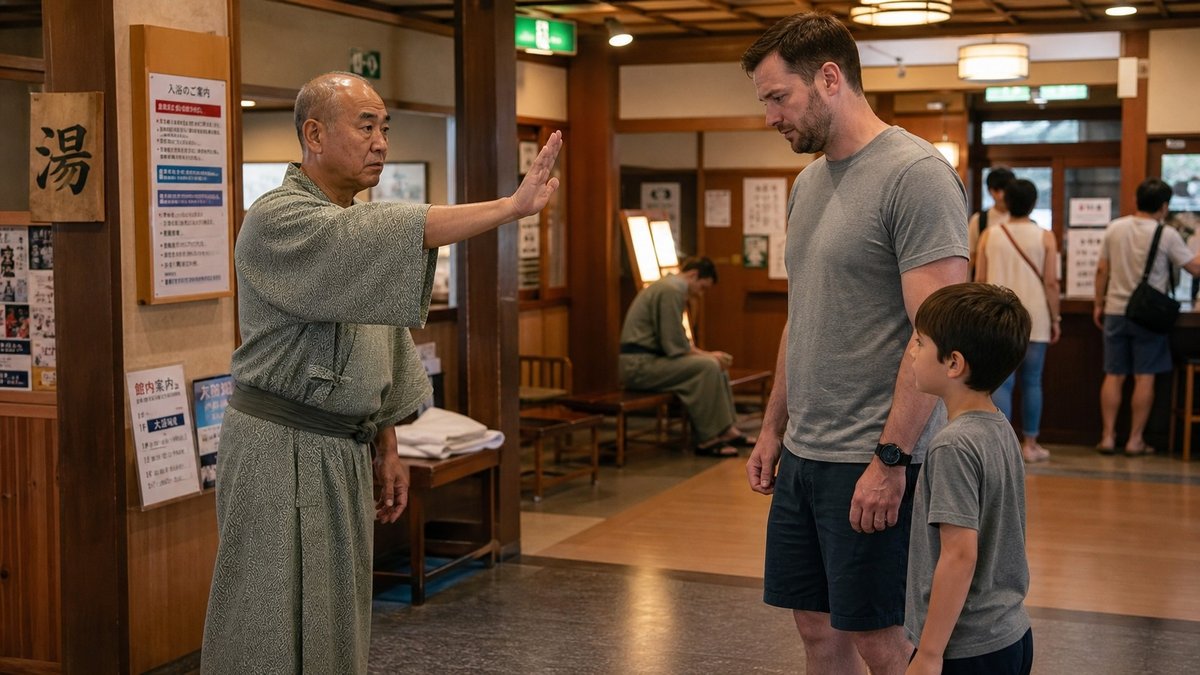
The AI "photo" you see is pretty darn cringeworthy. But, the story of a father and son who got inappropriately rambunctious in a Yamaga Onsen may very well be true. As portrayed in the article, there's a moderately happy ending; the idea that an onsen isn't a pool got through and all was well after that. Still, the main adjective that comes to mind is "cringe" both regarding the inappropriate behavior that stemmed out of ignorance (I've been there, done that, if not exactly the sort of thing described here) and the AI-laden way in which it's presented in SPA!, a fairly popular magazine. -- Kirk
--- ChatGPT translation starts ---
“They Don’t Understand Hot Springs”: The One Line from an Elderly Regular That Silenced a Foreign Tourist Parent and Child Swimming in the Bath / In 2025, Visitors to Japan Hit a Record 42.68 Million, and “Cultural Differences” Spread Even to Famous Local Hot Springs
Nikkan SPA!
June 27, 2026, 8:44 a.m.
A moment on a trip when you slowly soak in a bath. Your body gradually warms up, and before you know it, a sigh slips out: “Ahh…” What if, in the middle of that quiet moment, you suddenly heard someone shout “Jump!” followed by a huge splash?
Foreign tourist parent and child swimming in the bath 1
Image is an AI-generated illustration.
According to an announcement by the Japan National Tourism Organization, the number of foreign visitors to Japan in 2025 reached 42.68 million, setting a new record. At hot spring resorts, it is becoming increasingly common to soak in the bath alongside guests from overseas.
This time, we introduce a true episode that drew a strong response in the past: the story of “a certain parent and child” at Yamaga Onsen in Kumamoto Prefecture. A foreign tourist father and child began using the bath like a swimming pool. What was the simple English phrase that a local elderly regular said to them, and what were his honest feelings afterward in the lobby?
In the latter half of the article, as inbound tourism continues to increase, we would also like to think a little about how we ourselves should behave at hot springs and other travel destinations.
* * *
Japan is booming with inbound demand. But now, in many places, “bad manners” by foreign tourists have become a problem. Some aspects of Japanese culture can be difficult for them to understand in all their subtlety, and even when there is no ill intent, there are cases where people around them feel annoyed or inconvenienced.
Yamaga Onsen is located in northern Kumamoto Prefecture. Its water is known for being somewhat lukewarm, allowing visitors to soak slowly and for a long time. What unfortunate incident did Yuki Yoshida, a pseudonym, experience there?
Although It Was a Hot Spring, It Was “Just Like a Pool”
Mr. Yoshida visited Yamaga Onsen on a day off at around 3 p.m.
“It wasn’t a crowded time of day. There were only a few elderly customers in the bath, along with some people who seemed to be local regulars, quietly enjoying themselves. Then some white foreign tourists came in, and the whole atmosphere completely changed.”
They were a father, probably in his thirties, and a child who seemed to be in the early years of elementary school. The parent and child appeared to rinse themselves off lightly, but it was clearly only a formality.
“Jump!”
Amazingly, the father picked up the child and dove straight into the bath. With a loud “splash!” the water surged, and some of it even hit elderly customers nearby.
The father then laughed and shouted “Yeah!” while splashing around, and began swimming and playing together with the child.
“They were using it exactly like a pool. Everyone who happened to be there was frowning.”
“No Swimming! No Pool!”
Foreign tourist parent and child swimming in the bath 2
Image is an AI-generated illustration.
Finally, an elderly man who seemed to be a regular, perhaps in his seventies, stood up beside Mr. Yoshida. Although his English was not fluent, he repeatedly said in simple English, “No swimming! No pool!” while making a hand gesture telling them to stop.
The father looked somewhat embarrassed and said, “Oh, sorry, sorry,” but he did not seem to really understand what he had done wrong.
Perhaps sensing the tense atmosphere around them, the parent and child quietly stayed in a corner of the bath after that. But Mr. Yoshida had become fed up and decided to get out a little earlier than planned.
As he was resting in the lobby, the elderly man who had warned the foreign tourists earlier came over to him.
“We’re glad they came all this way, but they really don’t understand hot springs…”
Hearing the man mutter this, Mr. Yoshida could only give a wry smile and say, “I guess it’s a cultural difference.”
A hot spring is something to be enjoyed quietly. It is unfortunate when that kind of unspoken understanding breaks down because of a language barrier or lack of knowledge.
“It was an incident that made me think about the ‘small gap’ between the ever-increasing number of foreign tourists and Japanese culture.”
Text by Mutsuki Fujiyama
Are They Really the Only Ones Who “Don’t Understand Hot Springs”?
In this episode, a foreign tourist parent and child jumped into the bath and began splashing around. After warning them, the elderly regular muttered in the lobby, “They really don’t understand hot springs…” His words seemed to contain not so much anger as a touch of sadness.
Incidentally, according to the Japan National Tourism Organization, the number of foreign visitors to Japan in 2025 was 42.68 million, a record high. That was more than 5.8 million higher than the previous year, when the figure was about 36.87 million. This also means that visitors from overseas have begun making their way even to famous regional hot springs such as Yamaga Onsen.
But what we should pause to consider here is this: practices such as “you soak quietly in the bath” and “you rinse your body properly before entering” may come naturally to people born and raised in Japan, but they are not necessarily “common sense” for people from other countries. If someone grew up in a culture of swimming pools and jacuzzis, it may not be unreasonable for them to look at a large bath and think of it as “a place to jump in and play.”
Still, Beyond the Steam
Of course, that does not mean that “anything goes.” In this case, after the father was warned by the elderly regular, he and the child did quietly spend their time in a corner of the bath. Even with brief English mixed with gestures, if you communicate something, it can get across. I feel that the elderly man quietly taught us that.
When you think about it, when we ourselves travel overseas, can we really say we understand all the local manners perfectly? Probably not. If someone calmly teaches us about something we did unknowingly, the rest of our trip will surely become just a little richer. When the positions are reversed, what kind of words can we offer?
Lowering your body slowly into the bath, relaxing your shoulders, and letting out a long breath. The next time someone is flustered on the other side of the steam, I hope I can be the kind of person who adds just one gentle word. I say that also as a reminder to myself.
Foreign tourist parent and child swimming in the bath 3
Image is an AI-generated illustration.
Reconstructed by the Nikkan SPA! editorial department
Mutsuki Fujiyama
Editor, writer, and travel writer. A super “jack-of-all-trades” around media work, from reporting and writing to manuscript editing, convenience-store runs, and even ghostwriting for celebrities. Books include Overseas Underground Travel, True Stories! I Tried All Kinds of Dubious Experiences, and The Ten-Dollar Night View. Has also contributed to many works, including the Ultimate Overseas Travel Guide Created by Travel Experts series. X, formerly Twitter: @gold_gogogo.
--- translation ends ---