According to the article, most trainees who came from Vietnam to work in Kumamoto didn't expect to be able to go to a public shelter after a disaster. -- Kirk
--- Start ChatGPT translation except ---
Foreign Residents Isolated in Disaster Areas Turn to One Another for Help; Cultural Barriers Cause Hesitation About Using Evacuation Shelters — Kumamoto Earthquake
Jiji Press Social Affairs Department
August 14, 2026, 7:03 a.m.
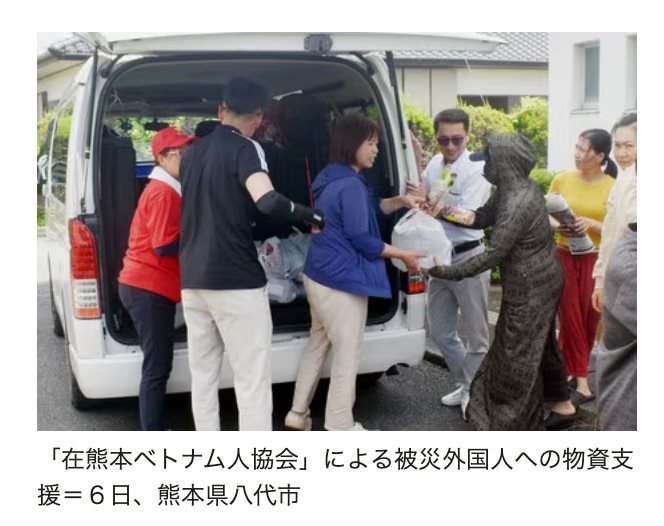
[Relief supplies being provided to foreign residents affected by the disaster by the Association of Vietnamese Residents in Kumamoto (在熊本ベトナム人協会) in Yatsushiro City, Kumamoto Prefecture, on August 6]
Many foreign residents of Japan who had never experienced a major earthquake were also affected by the earthquake in Kumamoto Prefecture, which registered a maximum seismic intensity of 7 on the Japanese scale. Language barriers and cultural differences have made many hesitant to use evacuation shelters or left them unsure where they can obtain relief supplies, revealing situations in which foreign residents have had little choice but to rely on mutual assistance among themselves.
In Yatsushiro City, which was struck by shaking of upper 6 on the Japanese seismic intensity scale, a vehicle loaded with emergency food, drinking water, and other relief supplies arrived in front of an apartment building on August 6. Cheers went up from the approximately 30 foreign residents affected by the disaster who had gathered there. Many of the residents had come to Japan as technical intern trainees. A 22-year-old Indonesian technical intern trainee smiled and said, “We were running short of food, so I’m very happy.”
The supplies were delivered by the Association of Vietnamese Residents in Kumamoto (在熊本ベトナム人協会), which provides consultations and other assistance to Vietnamese people living in the prefecture. Its chair, Le Thi Cham, 48, said, “Unlike in Japan, there is not much of an established practice in Vietnam of going to evacuation shelters. There is also the language barrier, so many people are reluctant to go to shelters or do not know where they are.” After the earthquake, many Vietnamese residents were afraid to remain in their homes because of the danger of buildings collapsing and reportedly slept outdoors on blue sheets.
The association was established in 2022 and is connected through Facebook with approximately 3,000 Vietnamese residents of the prefecture, about half of the Vietnamese population living there. After the earthquake, it began receiving messages asking for help, such as “We have no water,” and started delivering food and other supplies. On August 6, association members traveled around Yatsushiro and Uki cities, delivering supplies to approximately 200 foreign residents affected by the disaster.
Cham and the other members provide relief supplies to foreign disaster victims who are liable to be left out of public assistance, regardless of whether they are Vietnamese nationals. “This earthquake has revealed a variety of problems,” Cham said. “Through our regular activities, we would like to start by explaining what evacuation involves and how it works.”
--- end translation ---