Posts
This is a lengthy discussion of how to rebuild Kumamoto with many comparisons to the recovery effort still in progress in the Tohoko region.
http://www.the-japan-news.com/news/article/0003015150
Rebuilding homes after the Kumamoto Earthquake
Two months have passed since a major earthquake struck Kumamoto Prefecture. More than 80,000 buildings have been damaged or destroyed there. Some 10,000 people are still living in evacuation shelters. Now, governments face the urgent task of reconstructing houses to allow victims to restore their da...

Here's another article on the attempt to save the Iida-maru Gokai Yagura.
http://www.asahi.com/ajw/articles/AJ201606170052.html
Workers rush to save Kumamoto castle’s stone support wall:The Asahi Shimbun
KUMAMOTO--Emergency work to shore up a corner of Kumamoto Castle’s Iida-maru five-story turret, whic

Residents in quake-hit city of Kumamoto irked over having to foot bill to dispose of appliances...
As quake-hit areas in Kumamoto Prefecture work to dispose of debris, residents in the city of Kumamoto are complaining that the costs of discarding electri

William wrote today about plans to fix the Iidamaru Yagura. William explained that repairs would be accomplished "by wrapping the entire turret in a steel frame to allow three cantilever beams to be inserted into the foundation of the turret, relieving the weight from the stone walls."
This video report from NHK includes an image of how that steel frame with wrap around the turret.
-- Kirk
http://www3.nhk.or.jp/news/html/20160616/k10010558851000.html
熊本城 崩れそうなやぐらの倒壊防止工事を公開 | NHKニュース
一連の地震で下の石垣が大きく崩れ、残った石でかろうじて支えられている熊本城の「飯田丸五階櫓」の倒壊を防ぐための工事が16日、報道各社に公開さ…

Joe Tomei here. The brass band of the high school affiliated with KGU (Gakufu) had their concert cancelled because of the earthquake, and it has been rescheduled for tomorrow (Sat) at the Morio Takahashi Hall in building 14 at Kumamoto Gakuen University. Doors open at 1:30 and the concert begins at 2.
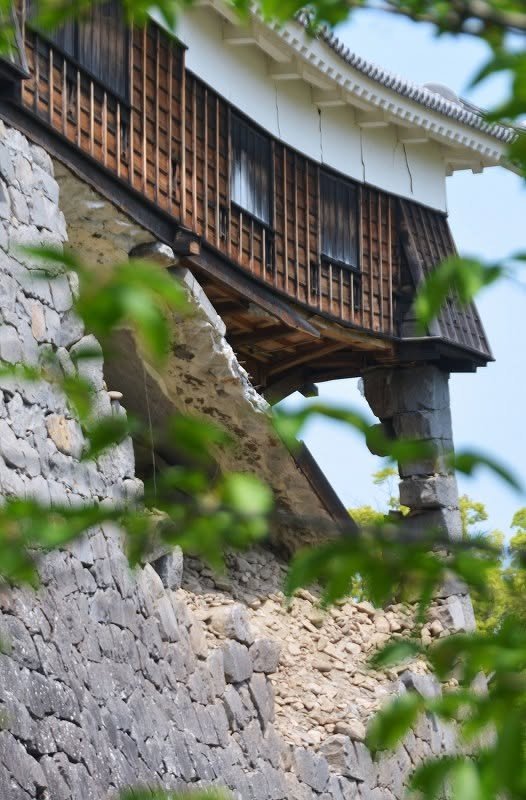
Iida yagura, shown in the photo below, is that five-story turret resting precariously on a single column of cornerstones which has come to symbolize the resilience of Kumamoto following the quakes. The entire structure weighs 35 tons, with that single column bearing the weight of 17 tons. This is clearly untenable, and concerns over continued aftershocks and weather-related effects have added urgency to stabilize the turret.
The Kumanichi reports that engineers have devised a plan to stabilize the structure to allow rebuilding of the walls. This will be done by wrapping the entire turret in a steel frame to allow three cantilever beams to be inserted into the foundation of the turret, relieving the weight from the stone walls. Work began on June 10, is expected to finish in July, and will cost about 8 million yen. Upon completion of this work to prevent total collapse, methods for full-scale restoration will be considered.
The video at the link shows construction of the foundation for the frame as well as tumbled rocks which have been carefully numbered to allow their proper replacement.
http://kumanichi.com/news/local/main/20160616006.xhtml
William wrote about this last night. Here's an article about Kumamon's new flag from the Asahi Shimbun:
http://www.asahi.com/ajw/articles/AJ201606160058.html
Flag-toting mascot bear symbol of hope in Kumamoto:The Asahi Shimbun
KUMAMOTO--In a time of crisis, Kumamoto Prefecture is enlisting the help of its well-known and popul

Kato Kiyomasa, considered the founding father of Kumamoto, had a crest called "eye of the snake" ("eye of the tiger" had apparently already been copyrighted by the band Survivor in the 16th C.) http://www.manyou-kumamoto.jp/contents.cfm?id=449 After Tokugawa Ieyasu decided that they were no longer BFF and had Kato mysteriously die, Ieyasu installed Hosokawa Tadatoshi with the promise that he and his successors would play nice (which they did); the Hosokawa crest is similar to the Kato crest, only with more circles. http://www.manyou-kumamoto.jp/contents.cfm?id=457 This is why you will often see black circles as symbols of Kumamoto.
This leads us to Kumamon. His creator, Mizuno Manubu, and producer, Oyama Kundo, have collaborated to produce a new image to aid in the reconstruction of Kumamoto. The image shows Kumamon holding a flag with markings that resemble both his face and the crests of Kato and Hosokawa and the phrases "Ganbaruken! Kumamoto Ken!" - a play on words, with the first "ken" a Higo dialect exclamatory term and the second referring to Kumamoto Prefecture (ha ha! clever!). Its use for commercial activities can be licensed from the city government. - William
http://kumanichi.com/news/local/main/20160615007.xhtml
復興へ旗振るくまモン 県がシンボルマーク作成-熊本のニュース│ くまにちコム
熊本日日新聞社が取材した熊本のニュース。新聞紙面に掲載前の記事もお伝えします。

Lessons in managing disasters from Kumamoto
Author: Hitomi Nakanishi, UC On the night of 14 April 2016, five years after the devastating 3/11 triple disaster, a magnitude 6.5 earthquake struck the

Evacuees move to relief housing in hard-hit town in Kumamoto:The Asahi Shimbun
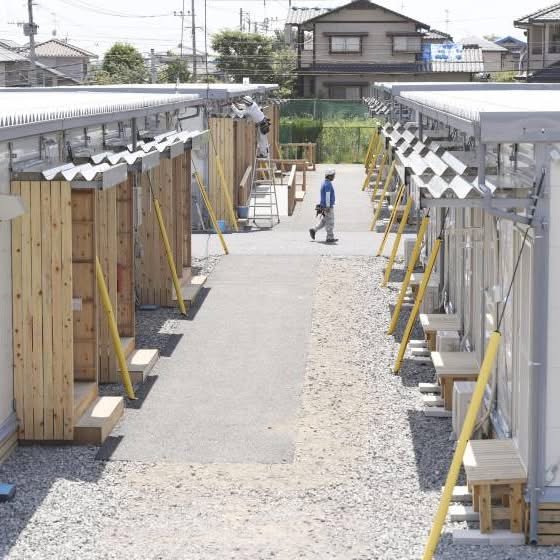
KUMAMOTO--In a welcome respite, evacuees in quake-damaged Mashiki began moving into temporary housin

What to do about Route 57 through the Tateno Gap? The road has been closed since massive landslides did what they do, and the guys in charge seem to have determined that recreating a four-lane road in that area would be inviting more disaster, given the propensity of the slope to slough off into the river below.
Instead, as the Kumanich reports, a proposal has been floated to create a new road originating near the Milk Road entrance that would bypass the gap altogether. This would require creating several kilometers of tunnels, so it is not going to happen soon. However, various entities have come together to investigate possibilities. A map is at the link. - William
http://kumanichi.com/news/local/main/20160614008.xhtml
国道57号迂回ルート整備へ 大津町から阿蘇市-熊本のニュース│ くまにちコム
熊本日日新聞社が取材した熊本のニュース。新聞紙面に掲載前の記事もお伝えします。
Temporary housing units opening for Mashiki's quake-displaced residents | The Japan Times
Procedures to move to temporary housing units are set to begin Tuesday for evacuees in Mashiki, a village in Kumamoto Prefecture where a major earthquake s
Tonight, on the two-month anniversary of the 4/14 foreshock, I thought I would repost what I had written immediately after, sitting on my sofa with my life rattling around me and my dog in a panic. I have seldom been so wrong (hey - 猿も木から落ちる, as they say). Otsukaresama to all who have ridden out these tough two months. - William
If you live in Kumamoto, you probably noticed an earthquake. In fact, you're probably aware of the aftershocks now. DO NOT BE ALARMED. Kumamoto's techtonics are dominated by the Futagawa fault, which has a theoretical maximum magnitide of 7 - which means it couldn't get much worse. We'll ride this out. There will be aftershocks, but it will not get worse. http://www.jishin.go.jp/…/katsudan…/f093_futagawa_hinagu.htm
ページが見つかりませんでした | 地震本部
パンフレットやこども向けのキッズページなど、防災・減災に広く活用いただくための資料を集めています
Sakura Machi - the area encompassing Kotsu Center - is under massive redevelopment, and apparently some are not enamored with how the project is proceeding. Kumanichi reports that workers found seven gun shell casings within the grounds of their two-story prefabricated headquarters at 8:00 AM on 6/14 and sensibly called police, who subsequently determined from holes in walls and broken windows in the prefab itself that they were not dropped there by accident (six hits were found vs. seven shell casings, leading to the question: how do you miss a two-story prefab?!). The prefab was unoccupied during the incident, so no one was injured, and the dismantling of Kotsu Center and the attached department store is expected to proceed as planned.
It's a shame the yaks would assault Kumamoto companies at any time, but particularly now, on the second-month anniversary of the foreshock.
http://kumanichi.com/news/local/main/20160614005.xhtml
桜町のビル解体現場に銃弾6発 熊本市-熊本のニュース│ くまにちコム
熊本日日新聞社が取材した熊本のニュース。新聞紙面に掲載前の記事もお伝えします。
Like Kumamoto Castle, the Shirakawa Komine Castle of Fukushima suffered serious damage to its stone walls after the 2011 quake.
"Shirakawa Komine Castle suffered serious damage in the 2011 Tohoku Earthquake and for a long while it was closed to the public due to restoration efforts, but from 2015, it was reopened. However, as of July 2015, it was still undergoing partial construction."
http://planetyze.com/en/japan/fukushima/shirakawa-komine-castle
Recently, on a local news show, I saw a report about the mayor of Shirakawa City visiting Kumamoto to offer support and advice. On the TV show I heard that the visiting mayor had recommended that the restoration process be made open to the public to the extent possible. This struck me as a great idea because the restoration process seems likely to take a very long time. Making the restoration itself something that visitors (and residents) can learn about and observe may give people a new reason to visit the castle area until the work is done.
Unfortunately, though, I couldn't find an article documenting this, even in Japanese. I did, however, find this Japanese article about a group of experts recommending an open restoration process:
http://www.yomiuri.co.jp/kyushu/news/20160606-OYS1T50026.html
The article says that the experts pointed to the example of the construction of Gaudí's Sagrada Família in Spain. Though the project is yet to be concluded tourists can observe and learn about the construction process when they visit.
One more Japanese article I found is about how the mayor of Shirakawa promised to send restoration experts (with experience working on Shirakawa Komine Castle) if requested:
http://headlines.yahoo.co.jp/hl?a=20160610-00000032-fminpo-l07
My impression was that Kumamoto's Mayor Onishi was in favor of the idea of a restoration process that is open to the public, at least partially. I hope it gets underway soon.
-- Kirk
Shirakawa Komine Castle - Fukushima Travel Guide | Planetyze
A stone wall castle, unusual for the Tohoku region, that is famous for its three-story keep

Quake-hit Kumamoto struggling to provide places, staff for July election voting | The Japan Times
Earthquake-hit municipalities in Kumamoto Prefecture are striving to secure replacement facilities and staff for polling stations for the July 10 House of
This article from the Asahi Shimbun provides a bit more information on last-night's quake. Here's a quote:
"The 10:08 p.m. earthquake is the first since April 19 to register an intensity of lower 5 in the prefecture. It is believed to be an aftershock of the series of earthquakes that started in mid-April in and around Kumamoto Prefecture, the agency said."
The article also says that operation of the nuclear reactors just south of Kumamoto was not affected.
http://www.asahi.com/ajw/articles/AJ201606130012.html
Fairly strong quake hits Kumamoto; no injuries reported:The Asahi Shimbun
A relatively strong earthquake hit Kumamoto Prefecture on the night on June 12, but there were no re
This is basically the same as the information I posted last night.
-- Kirk
http://www.tokyoreporter.com/2016/06/13/japan-meteorological-agency-4-3-m-earthquake-rocks-kumamoto-no-injuries/
Japan Meteorological Agency: 4.3-m earthquake rocks Kumamoto; no injuries | The Tokyo Reporter
An earthquake measuring lower 5 on Japan’s 7-point seismic intensity scale struck at around 10 p.m. on Sunday with no reports of tsunami or injuries

As an addendum to my below post, here is a link to a page with a map of inner-city routes and photographs of the old steam trains. Those times must have been smelly, noisy, and inconvenient; I remember reading memories of a woman who lived before the invention of automobiles and her reaction to the loss of those bygone days, and she remarked, "Frankly, the world smelt of horses." Also, notice the kanji for "Kenchomae" - 縣廳前! Be thankful for simplified kanji. http://tram.2-d.jp/kt/history/h0/sogyomae.htm