Archive of the Kumamoto International Facebook group, 2011–present.
A whole lot of rainfall drops in the Aso region. Some of it flows out in rivers, while much percolates into a huge aquifer which eventually surfaces where the crust thins in the Suizenji-Ezuko area.
Lake Ezu is a Kumamoto treasure, yet its clear, shallow water leads to explosions of vegetative growth which must be periodically removed for ecosystem health. Our friend Sean Benward noted a drive to remove this vegetation, scheduled to be held Tuesday, November 20, from 10 AM to 12 PM. Wear shorts. - William
William posted about the recent hate speech incident:
https://www.facebook.com/Kumamotoi/posts/2208507395889347
I was a bit surprised to read that this was the first confirmed instance of hate speech in Kumamoto. Perhaps it's the first instance of a public demonstration by a political group that was stopped because it was deemed to constitute hate speech. It was certainly not the first instance of a word or phrase being uttered in Kumamoto that could reasonably be thought to constitute hate speech.
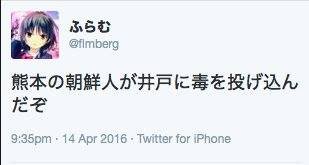
I was interested in previous examples of hate speech so I did a little Google search. That search led me to reports of comments like the one in the attached image, which reads "Koreans in Kumamoto have poisoned the wells." This is a particularly vile tweet because the accusation of well poisoning was one of several false claims that led to the massacre of an estimated 6,000 Koreans after the 1923 Kanto earthquake:
Regarding the Kanto Massacre
https://en.wikipedia.org/wiki/Kantō_Massacre
https://harvard-yenching.org/the-great-kanto-earthquake
Source of hateful tweets after 2016 Kumamoto quake:
https://togetter.com/li/962668
Now, before I go on, I'd like to point out that my own personal experience and all indications I've received on this page are that, after the earthquake, hate of any kind was definitely NOT the norm in Kumamoto -- the people of Kumamoto (Japanese and non-Japanese) came together to help each other. Still, I think it's worth noting that there were some people outside of Kumamoto who tried to use the disaster to foment hate.
Also, recent events in the States have caused me to recall an instance of hateful speech I heard while in the Shiyakusho (city office building) several years ago. I was there to renew my foreign registration card when a women came in to complain about how Japanese people were being discriminated against because foreigners (for her, Koreans seemed to be of particular concern) were "unfairly" receiving the benefits of the national healthcare system. I just happened to be sitting next to her so I was forced to listen to her rant. I never learned where she had gotten her information but, at the time (2012 or so), Katayama Satsuki was making such arguments in the Diet, so she might have been picking up on that. (By the way, Katayama is now the only female member of the Abe cabinet and is facing corruption charges -- poetic justice?)
The notion that providing basic social services to "foreigners" (the so-called "Zainichi Koreans" -- who were considered to be Japanese citizens and even able to vote until their citizenship was revoked after Japan's defeat in WWII) constitutes "discrimination" toward Japanese is very similar to accusations of "discrimination" toward Japanese made by the Zaitokukai (在日特権を許さない市民の会). See,for example, the Zaitokukai flier "日本人差別をなくそう" (Let's stop discrimination against Japanese) on the following page:
https://column.tokyo/sakurai-hatespeech/
I was reminded of this incident by recent events in the U.S. because I perceived a similarity in the thought process. The motivation behind the slaughter of 11 Jewish worshipers seems to have been that Jews are helping "inferior races" come to US and that this constitutes "White genocide." In both cases the language of victimization is reversed such that the dominant majority becomes the "victim" of the demonized other. See "Eli Saslow Traces 'Straight Line' From White Nationalism To Alleged Synagogue Shooter" for an explication of the phenomenon I've just referred to:
https://www.npr.org/2018/10/28/661633763/eli-saslow-traces-a-straight-line-from-white-nationalism-to-the-synagogue-shoote
Again, I find hateful speech to be quite rare in Kumamoto. Still, since recent events had reminded me of my first direct exposure to the hate speech akin to that of the Zaitokukai in Kumamoto, and since the incident near Kumamoto station was described as the "first" such instance, I thought I put this little essay together. Thanks for reading.
-- Kirk
I'm reposting this because I've realized (thanks to an astute friend's comments) that I had jumped to a conclusion that was clearly mistaken: the password leak I experienced was almost certainly not the result of a Facebook issue. I posted a mea culpa on the original post but, since a good deal of time has passed, I thought I should repost so that more of the people who had seen my originally post would see this correction. I'll try to be more careful in the future.
One point that was not mistaken: It's a good idea to have different passwords for different sites and to change them from time to time.
Apologetically yours,
Kirk
The Facebook hack explained: Who's affected, what happens next, and how the company will fare
Facebook said on Friday that a security vulnerability could have allowed attackers to take over about 50 million accounts and use them as if they were the account holders. But further details have been scarce. Here's what we know so far.

A long time ago, the Mongols invented stirrups, which turned out to be really useful in their invasion of most of the known world. At the tip of the Korean peninsula, however, they were stymied by water, but they persevered, built boats, and invaded Japan twice, not having learned from their first failed attempt (a typhoon disrupted their second, larger attempt, leading to the term "kamikaze"). Between the two invasions, walls were built along the Fukuoka coast, some of which still exist, and Higo (as Kumamoto was then known) forces were also involved.
It was kind of a big thing at the time, and an artist, Takesaki Suenaga (竹崎季長) was commissioned by the powers that be - who were, at that time, in Kikuchi - to depict it, so he came up with two scrolls around 1280 (dates vary). known as 「蒙古[もうこ]襲来絵[え]詞[ことば]」- "Images of the Mongol Invasion." They are seldom displayed, but Kumanichi reports that for the first time in 17 years, both, one measuring 24 meters and the other 21 meters in length, are on display until mid-December at the Museum of Science (in the prefectural library). One sample of a scroll is shown below; links are to the Kumanichi article and the Wikipedia page regarding the scrolls. Admission is free. - William
https://this.kiji.is/430864124722300001?c=92619697908483575
https://ja.wikipedia.org/wiki/%E7%AB%B9%E5%B4%8E%E5%AD%A3%E9%95%B7
Note: Apologies for the misdirection regarding the location of the museum - it's located within the prefectural library near Ezuko: https://www2.library.pref.kumamoto.jp/?page_id=476

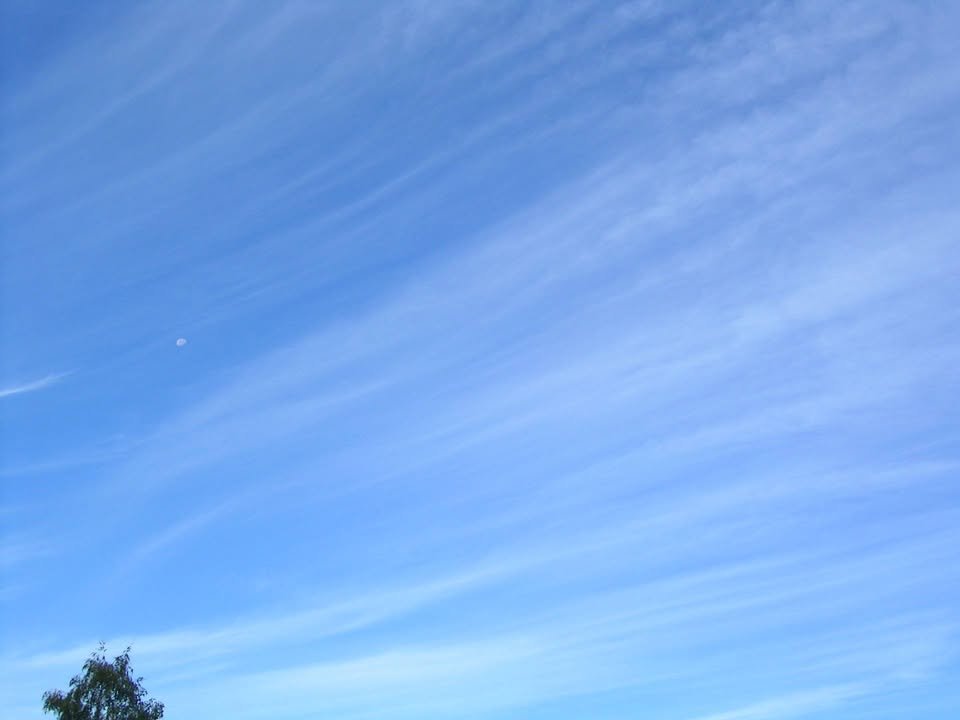
If you're reading this now, look up at the sky to enjoy rare and beautiful cirrus clouds. They form very high in the atmosphere, often at the edge of typhoons; today's are likely the last breath of typhoon Yutu, currently just south of Taiwan. The extent of meteorological effects is astounding. - William
Amakusa Report by Leanne
Sorry for the late notice, but for those interested in pottery, don't miss the Amakusa Pottery Festival held from tomorrow Friday, November 2nd to November 5th. This year there will be over 100 pottery studios displaying and selling their products. I think it is a great place to pick up holiday gifts; not only are they handmade and supporting the local industry, but they are also beautiful and practical! For those not so interested in pottery, there are also lectures, workshops and delicious locally produced food.
The Amakusa Ceramics and Porcelain Festival Kumamoto Nagomi Tourism Site
Why not take it easy in the breathtaking nature of Kumamoto, the “Land of Fire”? Nagomi Travel Journal, the sightseeing website of Kumamoto Prefecture, features a wealth of information on Kumamoto, including diverse sightseeing areas, delicious local specialty products, traditional handicrafts, ...

Our friend Mykca is a former Arizonian, which is the best type of Arizonian to be (disclaimer: I'm from California so may retain bias). She has organized a Christmas toy drive over many years, and has shared information at the below post. Contributions are welcomed, whether in cash or kind. - William
Japanese can be a bit weird as it often adopts foreign terms when adequate Japanese terms exist. For example, this Kumanichi article uses the katakana ヘイトスピーチ (hate speech) but then must restate it with kanji, which is zōo hyōgen (憎悪表現) - note that zōo is not pronounced as the Engish "zoo," though perhaps those who engage in it belong in one.
A new law exists criminalizing hate speech, and its first application in Kumamoto was announced on 10/30 against a right-wing "party" (the "Japan First Party") who were blaring from one of those black trucks in front of Kumamoto Station on 10/14. The article does not clarify whether the statute is being brought against the ten members who participated or the party itself.
Kumanichi writes: "The Prefectural Human Rights Policy Division stated, 'It is the first time that a hate speech was confirmed in the prefecture, and the appearance of citizens who engage in hate speech is regrettable.' Meanwhile, the Japan First Party states that it is only discussing problems regarding immigration policy and thus does not consider it as hate." Full article at the link. - William
「ヘイトスピーチ」県内初確認 熊本駅前で政治団体党員 | 熊本日日新聞 - This kiji is
「ヘイトスピーチ」(憎悪表現)と思われる差別的な街宣活動が、今月中旬に熊本市で実施されていたことを、30日に同市であった「県人権施策・啓発推進委員会」で、県が報告した。 県とJR九州などによると、.....

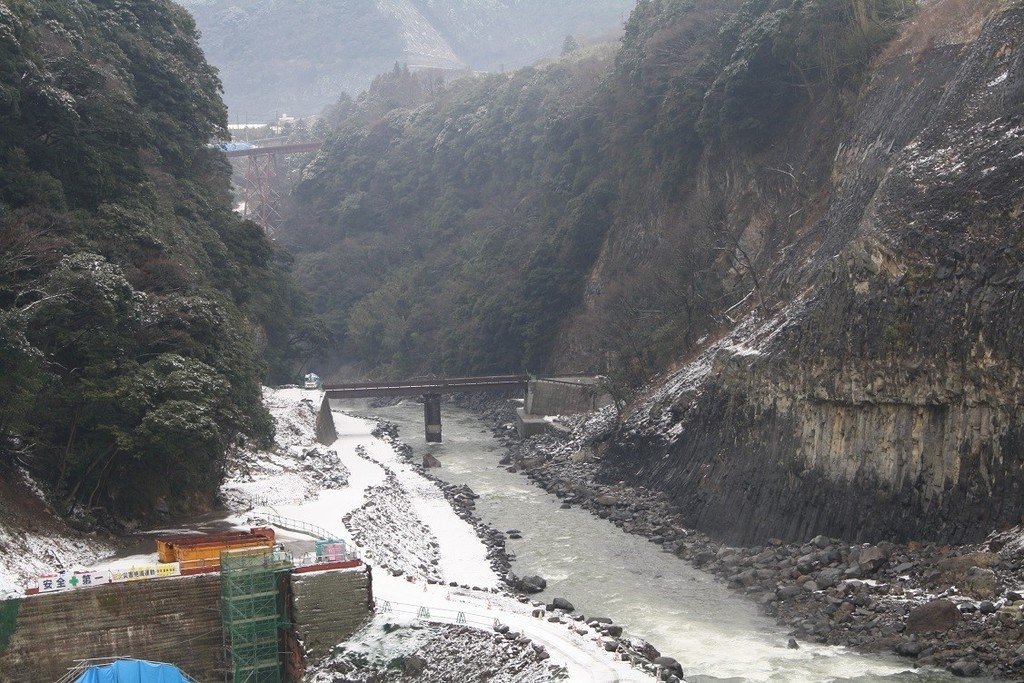
The Futagawa fault runs from Shimabara in Nagasaki up to Aso. Its northern section is divergent - pushing apart - and this explains the Tateno Gap, through which Shirakawa flows (see photo below). Without this gap, the Aso caldera would be a lake.
Hydrologists had created a hydroelectic power plant which jammed up during the quakes, causing pent-up water to flood the lower valley. This destroyed all transportation links and many houses (photo below).
Recovery of the area is proceeding at a snail's pace, Kumanichi reports. Only 30% of its former residents (about 100 of some 350 households) have returned, with the remainder still in temporary housing or having abandoned the area completely. Concerns regarding safety were most cited. Full restoration is not expected until 2020. Kumanichi: https://this.kiji.is/429776937625551969?c=92619697908483575 - William
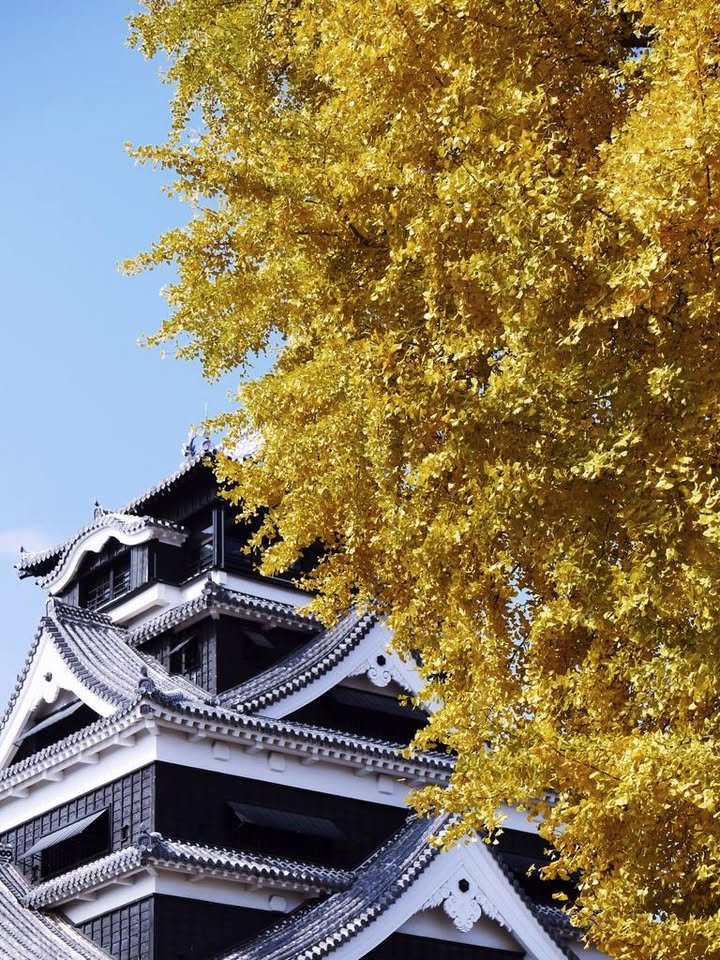
The Ginkgo biloba, known in Japanese as the 「銀杏」- pronounced as either "ginnan" or "ginkyou" (the latter from which its English name is derived and known scientifically as the イチョウ - ichyuu) deserves some attention. It's one of the oldest tree species, dating back to the dinosaur days (funny to think that dinosaurs grazed on their leaves), and dominated until more efficient breeds evolved. Its name comes from its native China via Japanese and means "silver nuts" (which, coincidentally, is my wife's nickname for me). At this time of year, you might see locals foraging for the nuts, which they steam before consuming.
The tree is a symbol of Kumamoto. Our castle was known as "Ginkyou Jyo" 「銀杏城」due to the large number of trees planted there both as horse fodder and firewood. Many remain; a particularly famous example is one in Ichi-no-Maru, just next to the main keep (see below), which remains inaccessible during reconstruction. Another splendid spot to view their leaves is in front of Prefectural Hall in Kengun (also pictured below). Or you can just walk down the street and remember what you're seeing is what the dinosaurs saw (except more traffic). - William
Editor's note: Our friend Jordan Tanaka had written an engaging reaction to the recent post on Minamata Byo, and, encouraged to expand on it, provided us with this beautiful piece. I urge all to read it. Thank you, Jordan-san. - William
(main post)
Self-intro: I’ve lived in Minamata for the past 11 years. My husband and I met when he said he wanted to study English... 11 years and 4 kids later, he still can’t speak English.
I`ve had the chance to talk to several people, my in laws and neighbors included, who remember being told about that time and many who lived through it. The area right outside my house used to be a large marina and beach, where big ships would port on one end, and on the other where kids could swim. One day, as they recall, the water turned this strange but pretty color. They all wanted to swim in it. But since so many people were getting sick the swimming areas were soon closed off. That area is now covered over with rocks and dirt, with old apartments and empty parking lots on top. The main area that was poisoned was covered over and turned into a park, the Eco Park. There are memorials and a museum dedicated to those who died and to telling the stories about Minamata disease. I really recommend the trip down to Minamata to go through the museum and walk along the seaside path towards the large bell memorial.
My husband is a care worker at Meisuien, a hospital/care center/old folks home all rolled in to one. It’s where those affected by Minamata disease were placed for most of their lives. One gentleman, Onitsuka Yuji, who had his photograph taken by Mr. Smith, the photographer mentioned earlier, has stayed in Meisuien since that time. My husband spoke with him this morning and Onitsuka-san said that while he hadn’t heard that they were making it into a movie, he’s glad to hear that their stories will be told. He also said he remembers Mr. Smith and his wife, and that they were very nice.
The following is about Ueno Eiko-san.
After getting married, she and her husband tried for three years to get pregnant. They were both so excited when it finally happened, after all that time spent dreaming together of their future family. They did the best they could with what they had, but unfortunately ate much of the infected fish that was so easily found. Of course, at the time, no one knew there was anything wrong with the fish, only the cats, birds, and other animals around seemed to be going crazy.
One night, her husband suddenly fell ill. He was in great pain, writhing about on the floor, muscles contracting and spasms going throughout his whole body. 13 says later, in a final painful fit, he repeatedly hit the walls of their home so violently that his hands were covered in blood. He then collapsed on the floor, dead. Six days later, their beautiful baby girl was born, Ueno Ryoko-san. As the days went by, Eiko-san noticed something wasn’t right with her daughter. Her leg and arm muscles remained straight, she couldn’t see, she couldn’t hear, she couldn’t talk, she couldn’t even lift her head. Eiko-san took Ryoko-san to see the doctor as soon as she could. The doctor dismissed the child easily, saying it was clearly a case of infantile paralysis. Afterwards, upon arriving home at her mother`s house, her mother refused to let her in, saying there was something wrong with that child, and that they were no longer welcome there. Eiko-san then moved into a hut, and again, did the very best she could to take care of her baby girl. But soon, people around them started to gossip. Whispers of what she must have done to cause her husband to die and her daughter to be so cursed soon grew louder. Cashiers began to refuse to take her money for fear of catching the disease that her daughter had.
By and by the effects of the disease had taken its toll on little Ryoko-san, and she passed away. At the time, this was the very first child born with this disease. No one had seen anything like it. But soon, others began to fall ill and die. Other children were brought into this world with their precious little bodies as full of the poison as little Ryoko-san was. The doctor who had seen Ryoko-san pass, wanted claim on her body. He pressured Eiko-san to give her daughter`s body to him, so that he could find out what the problem really was. She finally relented. But later, she went back to the hospital to ask for her daughter back and walked in on a horror scene: her sweet little two year old girl, on top of a cutting board, in pieces. Her eyes were taken out and placed on the counter. Her limbs in pieces. She screamed, これ何ですか先生!and then while gathering up her daughter as best she could in her arms, cried, my daughter was a person... you are not!! She carefully carried her daughter on her back and tried to make her way home but was later overtaken. Word soon spread about what she had done, and she was labeled as the crazy woman. Later, she said she would always remember how much lighter her daughter was that day, and even now, just thinking about it brings immediate tears. She said that she wonders if people really understand the true horror of that time, if people could even begin to understand the heavy grief of losing your husband and only child in that way.
They recently found something she wrote over 50 years ago. A letter telling about how she felt after discovering that the company Chisso had been dumping chemicals into the ocean. Eiki-san was furious. Overwhelmed with a desire to get revenge for her husband, (at the time, she still believed that her daughter had died from infantile paralysis) she fought for the truth. She swore she would always tell others about it, so we could all learn and make sure it never happened again. Though the local doctors called it the strange disease it was later named Minamata disease. In her letter it says that now she understood that both her husband and her daughter were murdered by Chisso. But even though she found out and was able to prove that it was Chisso, she said it never brought her peace because her family was gone, so her heart would never heal.
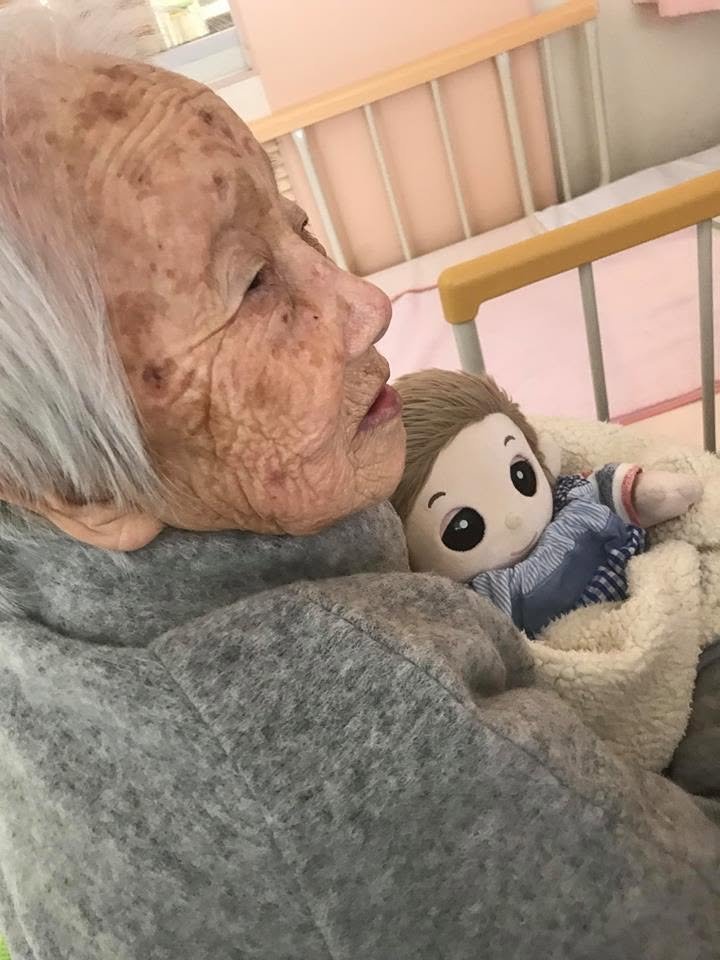
Now, she is a baachan at Meisuien. She saw another baachan with a doll and was quickly drawn to it. She was then given a similar one by a nurse, and has since not left it’s side. She brings it everywhere with her, sits it up and has conversations with it, has made a makeshift bed next to hers, sings it lullabies while rubbing the doll`s back. When other baachans comment on how cute it is, Eiko-san will pat the doll`s head and say, よかったね!She refuses any nurse that tries to take it away.
Since her daughter and husband died, she spent her whole life fighting for their story to be heard. Fighting for what Chisso did, lied about and then tried to cover up, to be brought to light. I really recommend a trip to the Minamata disease museum for those who are interested. Here is their site in English: http://www.minamata195651.jp/list_en.html
If driving, follow san go sen all the way down until you come to the end of Minamata, Hirai bento on the left, Minamata Eco Park on the right. Turn right and follow the signs. Walking from the train station will take maybe 20-30 minutes.
Below is a photograph of Eiko-san.
Postscript mea culpa: After posting this, I have been informed (see comments below) that the Facebook issue did not involve password leaks. This was clearly indicated in the article: "Personally identifiable information, like social security numbers, passwords or credit cards, weren’t stolen." I should have studied the issue more carefully before jumping to the conclusion that the password leak I experienced came from Facebook. One point in my original post that is correct is that it's a good idea not to use the same password over and over (as I had done to some extent) and to change passwords from time to time. Sorry for the error.
--------------------------------
Kirk here, and I think my Facebook account was one of the millions that was hacked.
I got this message in Japanese from a hacker who claimed to have hacked my yahoo.co.jp e-mail account (associated with Facebook) and demanded that I pay a ransom in bitcoin:
こんにちは!
私は数ヶ月前にあなたの電子メールとデバイスをクラックしたハッカーです。
あなたが訪問したサイトの1つにパスワードを入力君た。それを傍受しました。
これは、ハッキングの瞬間に[email protected]からのあなたのパスワードです: actually Facebook password was here
もちろん、それを変更したり、すでに変更したりすることができます。
しかし、それは問題ではありません、私のマルウェアは毎回それを更新しました。
The e-mail goes on to tell me the unpleasant things they have planned for me and why I need to pay. Of course, I'm not paying. They hadn't really gotten my yahoo.co.jp password as they claimed -- it was the Facebook password -- but a person using the same password on e-mail as on Facebook wouldn't know that. Nasty.
Add this to the "hate" side of my "love-hate" relationship with Facebook.
Also, as is often recommended, don't use the same password on multiple accounts.
The Facebook hack explained: Who's affected, what happens next, and how the company will fare
Facebook said on Friday that a security vulnerability could have allowed attackers to take over about 50 million accounts and use them as if they were the account holders. But further details have been scarce. Here's what we know so far.

The forestless slopes of Aso remind me of my home state, California - but my home state is forestless due to lack of water, whereas Aso is so due to their autumn burns. These kill off any tree saplings yet leave other plant root systems active, and these plants return quickly.
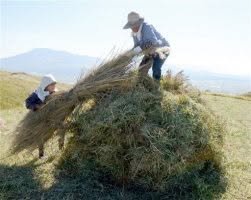
After the autumn burns, the ranchers harvest the fresh brush for winter forage. Kumanichi reports that this has been completed. We're halfway through fall, and winter is bearing down. That the cows will be well-fed is comforting. - William
https://kumanichi.com/news/685975/
God clearly wasn't paying attention when He (She?) created the whippet, my dog breed (Google it!): it has a bulging chest behind which is situated a very large penis, resembling a lower gun turret on one of those WWII planes, so every time he pees, his urine hits his chest. Design flaw. I often meet people who ask me if he's male or female, and I respond, "Have you ever studied physiology? Look!"
The question of Kumamon's sex remains - Male? Female? Kumanichi has displayed a photo of Kumamon wearing a Women's Handball T-shirt, which only deepens the mystery. The Women's World Handball Tournament will be held in Kumamoto 400 days from now. Perhaps then we'll know. - William
世界女子ハンド、PRするモン 実行委がスポーツ庁訪問 | 熊本日日新聞 - This kiji is
2019年女子ハンドボール世界選手権をPRするため、スポーツ庁の鈴木長官に記念品を贈呈するくまモン=25日、東京都千代田区 2019年に県内で開催される女子ハンドボール世界選手権の開幕まで26日であと...

"Minamata byo" (more accurately, mercury poisoning, though the nuance is that it is acquired through food due to environmental contamination) is normally Kirk's purview. However, this is a bit of big news.
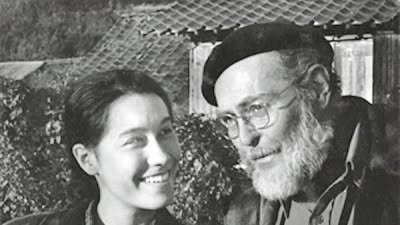
Eugene Smith was an American photographer with much experience in photography of the Pacific War so was no shrinking violet - he left the war with injuries and shellshock. His wife was of Japanese origin with roots in Minamata, and the couple lived there between 1971 - 73, when effects of the mercury poisoning were becoming apparent. His photographs both publicized the tragedy and helped lead to stricter environmental regulations worldwide. Below, he is portrayed with his wife, Aileen Mioko. Wikipedia provides a brief biography here: https://en.wikipedia.org/wiki/W._Eugene_Smith
and a selection of his photos is here:
https://pro.magnumphotos.com/C.aspx?VP3=SearchResult&ALID=2TYRYDDWZXTR
This is mentioned as Johnny Depp has been chosen to portray Smith in a production slated to begin filming in Minamata in January and released in October. So if you see a guy in Kumamoto who looks like Johnny Depp, it's likely Johnny Depp. More info at Variety: https://variety.com/2018/film/markets-festivals/johnny-depp-photographer-minamata-1202989438/ - William
Note: It has been brought to my attention that Smith's heartbreaking photo, "Tomoko Uemura in Her Bath," is discouraged from being published by the victim's family, so it has been replaced and the post edited. It is viewable at the above Wikipedia link.
A Tokyo-based publishing company has recently produced a book entitled "Kumamon's Rules for Success" (「くまモンの成功法則」), subtitled "Being Loved and Making Money." We could all aspire to that. The book apparently focuses on the work of Kumamoto Prefecture officials and others who have led to his (her?) phenomenon.
Kumamon fans can find info at this Kumanichi link. - William
新刊「くまモンの成功法則」 活躍ぶりを紹介 | 熊本日日新聞 - This kiji is
幻冬舎から出版された「くまモンの成功法則 愛され、稼ぎ続ける秘密」 くまモンの活躍ぶりをまとめた「くまモンの成功法則 愛され、稼ぎ続ける秘密」が、幻冬舎(東京)から出版された。熊本県職員などくまモンに...

This event will be held on Sunday morning, November 4th at Parea. The level of Japanese required to understand all of the discussion will undoubtably be quite high but I hope some of you will be intrigued enough to attend. Ms. Yuka Ogata, the famous member of the Kumamoto City Council whose activities we have followed so closely on this page, will be one of several panelists talking about local government.
I've learned a little more about local government, specifically the Kumamoto City Council, through my association with Ms. Ogata over the past year. I've been particularly interested to learn about the deeper issues that have influenced flaps about babies and lozenges: (1) extreme conservatism (don't change anything -- especially the rules that govern us), (2) an apparent expectation that younger politicians should be docile followers and learn the importance of going along to get along, and, of course, (3) talk about opening politics to women is mostly just that -- talk. I think there will be a lively discussion of these sorts of issues. I'm not sure but I think it will probably also be possible for attendees to have a few words with Ms. Ogata after the formal discussion concludes. Of course, she is able to speak English very well so a one-to-one conversation could take place in English.
-- Kirk
P.S. The final image is the one with the information about the event in which Ms. Ogata will appear.
Damage to facilities at the Kumamoto zoo led to evacuation of its animals to other facilities (note: not to my house - below is a snow leopard; if I'd taken him in, not only would I now be dogless, I'd likely be too dead to write this), but Kumanichi reports that, with zoo restoration complete, the animals are being returned. The article contains a cute expression: 「2年半ぶりにわが家に帰ってきた」- "after two and a half years, they have finally come home." I have kids in college so can empathize.
Zoo workers applauded as each tranche of animals arrived, and the animals are apparently adjusting well to sitting around and doing nothing but plot how to kill their keepers. - William
猛獣たち元気に帰還 熊本市動植物園 | 熊本日日新聞 - This kiji is
寝室を動き回るユキヒョウのスピカ=22日午後、熊本市東区の市動植物園(池田祐介)寝室でくつろぐウンピョウのイーナ(池田祐介) 熊本地震で獣舎が壊れ、九州各地の動物園に預けられていた熊本市動植物園(東区...

Most know of the "Kakure Kirishitan" ( 隠れキリシタン, "hidden Christian"), those members of the Catholic Church during the Edo period, mostly scattered amongst the Shimambara-Amakusa archipelago, who went underground after the Shimabara Rebellion in the 1630s when being known as a Christian became a death sentence. The area recently became a World Heritage Site.
In 1974, locals in Kawaura Machi built a large statue of St. Mary both as a warning of the inlet where it stands and as prayers of safety for their fishermen. Kumanichi reports that, a bit like Stonehenge, between late October and late November, the setting sun completely silhouettes the statue. Our photography friends with cars, be aware. More info is at the link. - William
マリア像、夕日に神々しく 天草市の崎津集落 | 熊本日日新聞 - This kiji is
夕日に浮かぶマリア像=20日午後5時40分ごろ、天草市河浦町 世界文化遺産に登録された熊本県天草市河浦町の崎津集落で、岬に立つ「海上マリア像」と夕日が重なる好機を迎えている。オレンジ色の太陽に祈りをさ...
