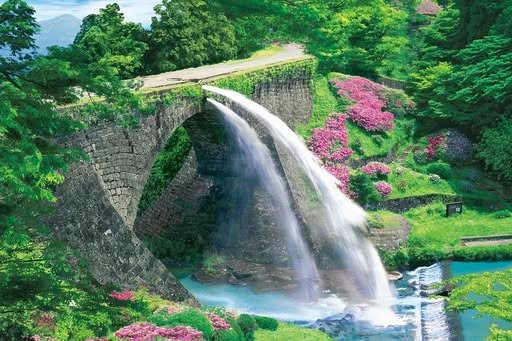
William Tsujunkyo (通潤橋, literally "moisture passage bridge"), a symbol of Kumamoto located in the town of Yabe, was completed in 1854 and, at 84m in length with an arch spanning 27m, is the largest stone aqueduct in Japan, built to irrigate an otherwise arid plateau to its south. The bridge was designed to sag in the center, with openings created to allow flushing of sediment. Removing the stump-sized wooden plugs to do so results in cascades of water, and this has become a major tourist attraction.
Kumanichi notes that access to the bridge, previously free, will now cost Y500 for adults and Y300 for children through HS age. My wife suggested that, as a rapidly depopulating town whose remaining residents are mainly elderly, Yabe simply needs the money.
https://kumanichi.com/articles/602968