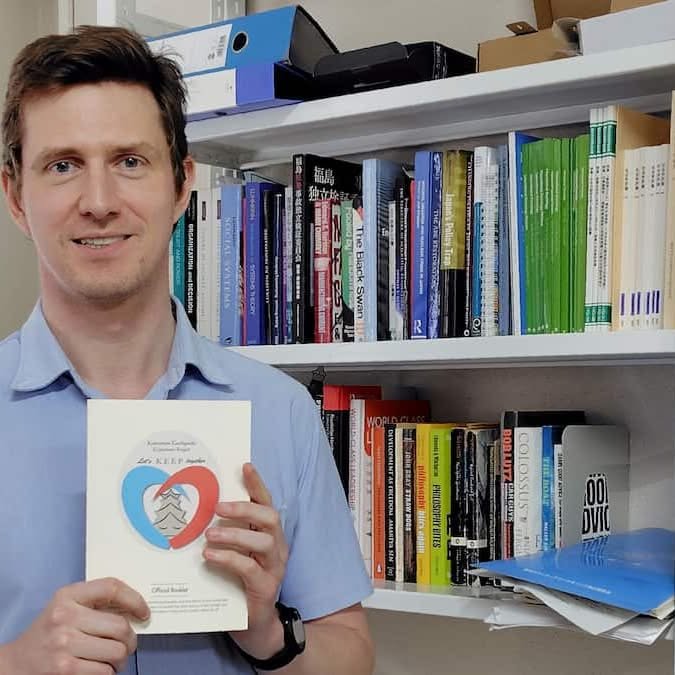
Kirk here with another news article about Andrew Mitchell.
--- start Claude translation ---
oreign Residents as Disaster Preparedness Contributors:
Shifting from "Vulnerable" to "Active Participants" Through Multiculturalism
— Local Government Support Has Its Limits —
(Sankei Shimbun, April 11, 2026)
As the number of foreign residents and inbound tourists in Japan continues to grow, questions are being raised about how to approach disaster preparedness given language barriers and cultural differences. Past disasters — including the 2016 Kumamoto earthquake — saw numerous cases of confusion among foreign nationals who could not understand disaster-related terminology. While local governments work to support affected foreign residents, smaller municipalities face limits in both staffing and budget. Experts are calling for a fundamental shift: rather than treating foreign residents as "disaster vulnerable," they should be recognized as active contributors to disaster preparedness, working together to get ready for the next crisis.
BACKGROUND
The 1995 Great Hanshin Earthquake claimed the lives of approximately 170 foreign nationals. Disaster relief information — including distribution of aid money and public housing applications — was released almost entirely in Japanese, leaving many evacuated foreign residents without adequate information. That experience spurred efforts to better support foreign nationals during disasters.
More than 30 years later, the situation for foreign residents has changed dramatically. While Japan is accepting more foreign workers in response to serious labor shortages, the conditions that leave foreign nationals vulnerable during disasters have not significantly improved.
LANGUAGE AND CULTURE: THE CORE CHALLENGE
Associate Professor Akiyoshi Kikuchi (disaster sociology) at Meisei University, who specializes in community disaster preparedness for foreign residents, points to language and cultural differences as root causes. "There are cases where someone knows the word 'tsunami' but doesn't truly understand how dangerous it is," he says. It's not uncommon for foreign nationals to be unfamiliar with disasters or to lack knowledge of evacuation procedures — and simply translating Japanese into other languages is sometimes not enough to ensure appropriate action.
When evacuation periods are prolonged, municipal involvement becomes critical — such as providing interpreters for administrative procedures — but the level of support varies significantly by region.
GAPS IN MUNICIPAL PREPAREDNESS
"Disaster Multilingual Support Centers" serve as hubs for assisting foreign nationals during large-scale disasters. These temporary organizations are established at the request of local governments during emergencies; they dispatch multilingual interpreters to evacuation shelters and provide translated disaster information as well as updates in plain Japanese.
However, a 2024 survey by the Ministry of Internal Affairs and Communications found that of Japan's 47 prefectures and 1,741 municipalities, fewer than 10% — just 163 local governments — reported having systems in place to smoothly activate such centers during a disaster. Smaller municipalities tend to lag further behind.
"In smaller municipalities, even when the need is understood, there are often limited human resources and no budget," Kikuchi observes. "National government support for personnel development and funding is essential."
"MULTICULTURAL DISASTER PREPAREDNESS": A NEW APPROACH
With the possibility of a massive Nankai Trough earthquake, a major Tokyo metropolitan earthquake, or other catastrophic events always looming, Kikuchi advocates for strengthening what he calls "multicultural disaster preparedness" (多文化防災). Rather than treating the growing foreign population as disaster-vulnerable, the idea is to position foreign residents as active contributors to community disaster preparedness and to build a genuinely inclusive society.
According to Kikuchi, the number of foreign nationals joining local fire brigades is increasing. Moreover, issues such as language and cultural differences and religious taboos are matters that foreign residents living in Japan are uniquely positioned to understand. "It's important to help foreign nationals during a disaster, but we must never lose sight of the question of how we can help each other," Kikuchi said. "The real question is whether we can build those relationships before disaster strikes."
A BRITISH SURVIVOR WHO FOUNDED AN ORGANIZATION
Andrew Mitchell (41), a British-born specially appointed assistant professor at Kumamoto University, experienced the 2016 Kumamoto earthquake as a student and went on to co-found KEEP with fellow international students — a group dedicated to disaster preparedness for foreign nationals. "Many foreign nationals have never received disaster training in their home countries and tend to think, 'This doesn't concern me,'" he says.
On the night of April 14, 2016, he was struck by violent shaking at his apartment in Kumamoto City. Terrified, he pulled a mattress over his head to protect himself. Two days later, during the "main quake," he evacuated to Kumamoto University with a Japanese student from the next room. The gymnasium was full, so they waited outside through the night.
The difficulty of receiving information as a foreign national hit him hard. While he could manage everyday Japanese conversation, he recalls, "I didn't know where to evacuate, and I didn't even know the word for 'evacuation shelter.'" Rumors circulated online — such as reports that a nearby bridge had collapsed — and he remembers the anxiety of not knowing how to find accurate information.
Nearly ten years after founding KEEP, Mitchell is active on social media and frequently serves as a lecturer at events hosted by municipalities and disaster preparedness organizations. He encourages international students and technical intern trainees to take everyday precautions — like carrying a mobile battery — and to participate in local disaster drills.
With Japan's foreign resident population now exceeding 4 million and growing more diverse, Mitchell underscored the importance of building relationships where people can help each other even across language barriers. "By being prepared, you can protect your own life, the lives of your family, friends, and colleagues, and contribute to your community," he said.
(Reported by Chika Yoshida and Akari Horiguchi)
--- end Claude translation ---