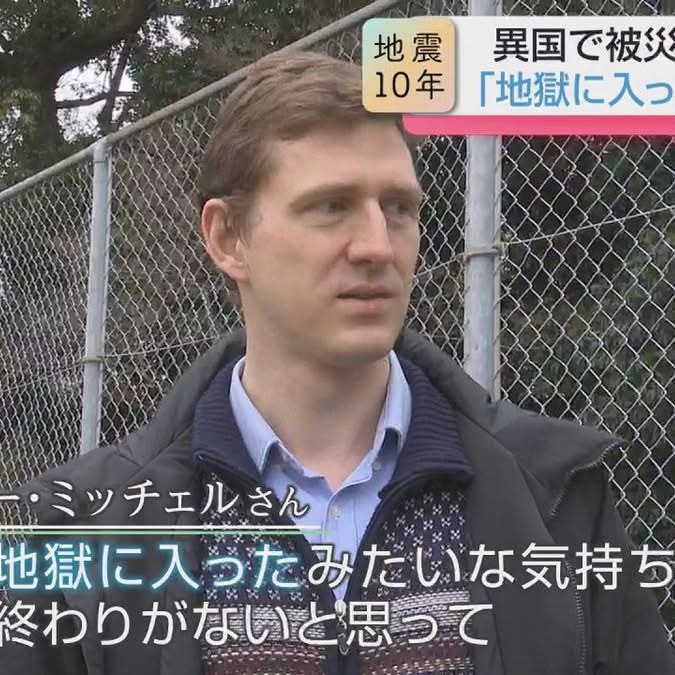
Kirk here with another news item (video) about Andrew Mitchell and how the earthquakes affect foreigners living in Kumamoto.
--- start Claude translation ---
"It Felt Like Entering Hell": What Do Foreign Residents Need During Disasters? Lessons from the Kumamoto Earthquake
April 14, 2026, 17:00
"It felt like entering hell"
One of the challenges that emerged when the Kumamoto Earthquake struck in 2016 was how to support foreign residents. Differences in language and culture made it difficult for assistance to reach them. We explore what will be needed when the next disaster strikes.
Andrew Mitchell:
"It's been ten years since I was last here. This is my first time back since the earthquake."
Andrew Mitchell (41), originally from the United Kingdom, returned for the first time in about ten years to the university grounds where he took shelter during the Kumamoto Earthquake.
Andrew Mitchell:
"I felt like I had entered hell. I thought it would never end."
How foreign disaster victims were treated
The Kumamoto Earthquake brought two tremors of the maximum seismic intensity of 7. Andrew, who was an international student at the time, lived in Kumamoto City, where the main shock registered a strong 6 on the Japanese seismic scale. In his home country of Britain, earthquakes only occasionally reach intensity 2 or 3, so he had no idea what to do during a quake. A Japanese neighbor called out to him, and together they evacuated.
Unable to sleep due to aftershocks
Andrew Mitchell:
"I would sit here, then lie down, but the aftershocks kept shaking us and I couldn't sleep at all. International students have no idea what to do when a disaster happens, and of course because our Japanese isn't very good, I was shocked at how hard it was to get information."
When he arrived at the evacuation shelter, the signs and notices were all in Japanese, full of kanji. He couldn't understand where to get food or what he was supposed to do next. The following day, he evacuated to Miyazaki City, where he had an acquaintance, and was finally able to eat a proper meal. But...
Andrew Mitchell:
"I immediately thought of my friends still back in Kumamoto and felt guilty. They might still have no food. It was really painful."
The gap between the situation of his friends still in Kumamoto and his own circumstances created a powerful sense of guilt. Even now, ten years later, he can't forget it.
Other foreign residents faced different difficulties during the Kumamoto Earthquake.
Marlo Suswahyu:
"You can't eat the food at the evacuation shelters. That was the first problem."
Near Kumamoto University is the Kumamoto Islamic Center. When prayer time comes, Muslims gather there. Marlo Suswahyu (50), who serves as the center's representative, sells halal ingredients and runs a restaurant. During the Kumamoto Earthquake, international students brought their troubles to him.
Marlo Suswahyu:
"On the first day, all we got was a 500-milliliter bottle of water and one biscuit shared between two people. But that biscuit contained pork, so Muslims couldn't eat it. So for about two days, none of us had any food."
The issue was food. Muslims are forbidden from consuming alcohol or anything derived from pork. A few days later, relief supplies arrived from sources including the Indonesian Embassy, and Marlo wanted to share them with others, so he called an evacuation shelter. But...
Marlo Suswahyu:
"They told me, 'We don't need it. We're fine.' I think they were probably afraid of Islam. It made me a little sad."
Still, as he continued his support efforts, people in the community gradually opened up to him.
Marlo Suswahyu:
"They were only afraid of me at first. Now there's no problem. We're all human beings, so I want to help together with them."
Marlo came to believe that the fear of Muslims arose from "not knowing each other's cultures." After the earthquake, he has been actively communicating not only about countries and religions but also about how foreign residents should learn Japan's rules.
Marlo Suswahyu:
"For example, the rules about garbage, and the rules for riding bicycles have gotten stricter, so we teach each other these things."
Foreign residents faced difficulties during the Kumamoto Earthquake when language and culture became barriers. Andrew, from the UK, has been sharing his own experiences through outreach activities since three months after the earthquake. What he has come to realize is that foreign residents can also help people in need. During the 2020 Kumamoto floods, he himself participated as a volunteer. He hopes for "mutual aid" that crosses national borders.
Andrew Mitchell:
"Don't just be a victim. Even if you don't understand Japanese, foreign residents can do many kinds of volunteer activities. Even without Japanese, gestures are something everyone understands. That's the message I want to share with both foreign residents and Japanese people."
Last updated: April 14, 2026, 17:00