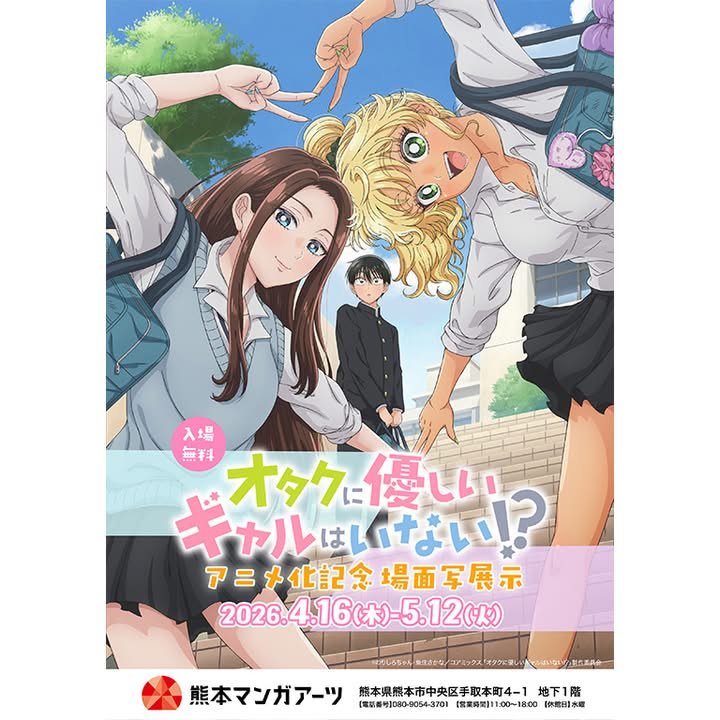
Kirk here. To be honest, not exactly my cup of tea, but for those of you who might be interested:
2026-04-14 16:40 JST 2026 Kirk here. To be honest, not exactly my cup of tea, but for those of you who might be interested: An exhibition of still images from the anime adaptation of "Are There No Girls Who Are Kind to Otaku!?" is being held in Kumamoto!To commemorate the anime "There Are No Girls Who Are Kind to Otaku!?" currently airing on TV Asahi a https://www.coamix.co.jp/en/topics/otagyal_260413 ↗ View original post on Facebook For a link to the original post on Facebook, open this page on a computer. Reactions: 1 ← 2026-04-14 08:33 JST 2026-04-14 21:27 JST → Around this time … 2026-04-16 12:28 JSTKirk here with a news item. We just observed a minute of silence for the victims at my university.Kumamoto Earthquake Victims Remembered 10 Years On; Survivor Stresses Importance of Disaster Preparedness 2026-04-16 08:56 JSTKirk here with some mascot news. There are quite a few articles having to do with the 10th anniversary of the Kumamoto earthquakes that I need to share. I'll try to do that soon.Pop-up store of Mexico's iconic character Dr. Simi opens in Japan - The Mainichi 2026-04-15 18:08 JSTKirk here. I've posted links to many articles about these statues over the years but this one taught me something about the connection to the quakes that I had either forgotten or missed entirely:--- start quote ----The fact that *One Piece* statues were erected only in disaster-affected areas added a deeper meaning: a “pilgrimage to wounded lands.” Taking commemorative photos in front of the statues and sharing their stories became a ritual that echoed the manga’s theme of camaraderie—“never leaving anyone behind.” --- end quote ---One Piece Statues Spur Kumamoto Tourism Revival 2026-04-15 08:55 JSTKirk here with another news item (video) about Andrew Mitchell and how the earthquakes affect foreigners living in Kumamoto.--- start Claude translation ---"It Felt Like Entering Hell": What Do Foreign Residents Need During Disasters? Lessons from the Kumamoto EarthquakeApril 14, 2026, 17:00"It felt like entering hell"One of the challenges that emerged when the Kumamoto Earthquake struck in 2016 was how to support foreign residents. Differences in language and culture made it difficult for assistance to reach them. We explore what will be needed when the next disaster strikes.Andrew Mitchell:"It's been ten years since I was last here. This is my first time back since the earthquake."Andrew Mitchell (41), originally from the United Kingdom, returned for the first time in about ten years to the university grounds where he took shelter during the Kumamoto Earthquake.Andrew Mitchell:"I felt like I had entered hell. I thought it would never end."How foreign disaster victims were treatedThe Kumamoto Earthquake brought two tremors of the maximum seismic intensity of 7. Andrew, who was an international student at the time, lived in Kumamoto City, where the main shock registered a strong 6 on the Japanese seismic scale. In his home country of Britain, earthquakes only occasionally reach intensity 2 or 3, so he had no idea what to do during a quake. A Japanese neighbor called out to him, and together they evacuated.Unable to sleep due to aftershocksAndrew Mitchell:"I would sit here, then lie down, but the aftershocks kept shaking us and I couldn't sleep at all. International students have no idea what to do when a disaster happens, and of course because our Japanese isn't very good, I was shocked at how hard it was to get information."When he arrived at the evacuation shelter, the signs and notices were all in Japanese, full of kanji. He couldn't understand where to get food or what he was supposed to do next. The following day, he evacuated to Miyazaki City, where he had an acquaintance, and was finally able to eat a proper meal. But...Andrew Mitchell:"I immediately thought of my friends still back in Kumamoto and felt guilty. They might still have no food. It was really painful."The gap between the situation of his friends still in Kumamoto and his own circumstances created a powerful sense of guilt. Even now, ten years later, he can't forget it.Other foreign residents faced different difficulties during the Kumamoto Earthquake.Marlo Suswahyu:"You can't eat the food at the evacuation shelters. That was the first problem."Near Kumamoto University is the Kumamoto Islamic Center. When prayer time comes, Muslims gather there. Marlo Suswahyu (50), who serves as the center's representative, sells halal ingredients and runs a restaurant. During the Kumamoto Earthquake, international students brought their troubles to him.Marlo Suswahyu:"On the first day, all we got was a 500-milliliter bottle of water and one biscuit shared between two people. But that biscuit contained pork, so Muslims couldn't eat it. So for about two days, none of us had any food."The issue was food. Muslims are forbidden from consuming alcohol or anything derived from pork. A few days later, relief supplies arrived from sources including the Indonesian Embassy, and Marlo wanted to share them with others, so he called an evacuation shelter. But...Marlo Suswahyu:"They told me, 'We don't need it. We're fine.' I think they were probably afraid of Islam. It made me a little sad."Still, as he continued his support efforts, people in the community gradually opened up to him.Marlo Suswahyu:"They were only afraid of me at first. Now there's no problem. We're all human beings, so I want to help together with them."Marlo came to believe that the fear of Muslims arose from "not knowing each other's cultures." After the earthquake, he has been actively communicating not only about countries and religions but also about how foreign residents should learn Japan's rules.Marlo Suswahyu:"For example, the rules about garbage, and the rules for riding bicycles have gotten stricter, so we teach each other these things."Foreign residents faced difficulties during the Kumamoto Earthquake when language and culture became barriers. Andrew, from the UK, has been sharing his own experiences through outreach activities since three months after the earthquake. What he has come to realize is that foreign residents can also help people in need. During the 2020 Kumamoto floods, he himself participated as a volunteer. He hopes for "mutual aid" that crosses national borders.Andrew Mitchell:"Don't just be a victim. Even if you don't understand Japanese, foreign residents can do many kinds of volunteer activities. Even without Japanese, gestures are something everyone understands. That's the message I want to share with both foreign residents and Japanese people."Last updated: April 14, 2026, 17:00「避難所でビスケットも食べられず」災害時の外国人へ何が必要?熊本地震の教訓(2026年4月14日掲載)|KKT NEWS NNN 2026-04-14 21:27 JSTKirk here with a Japan Times article about the restoration work on the castle.I think the article is basically fine but I'd like to add a footnote to this sentence: "The stone walls are expected to take longer to restore. Recognized as a national special historic site, they are characterized by mushagaeshi steep inclines at the top that make it difficult for enemies to climb over them."The word mushagaeshi (musha 武者 warrior; gaeshi [kaeshi] 返し causing to topple back) does imply that the walls were designed to be difficult to scale. However, as this quote from a very detailed webpage about the castle points out, the shape was primarily intended to make them more quake resistant.--- start quote ---This curved slope was designed by Kato Kiyomasa and, compared to vertical stone walls, has greater self-supporting strength and is also more resistant to earthquakes. In fact, during the 2016 Kumamoto earthquakes, while many stone walls collapsed, many of the stone walls dating from the Kato era remained intact. From atop the stone walls, visitors can overlook the entire castle, and the magnificent scenery captivates all who visit.--- end quote ---https://article.bespes-jt.com/en/article/kumamoto-castle/https://www.japantimes.co.jp/news/2026/04/14/japan/society/japan-kumamoto-castle-restoration/Kumamoto Castle restoration continues 10 years after quakes 2026-04-14 16:40 JSTKirk here. To be honest, not exactly my cup of tea, but for …An exhibition of still images from the anime adaptation of "Are There No Girls Who Are Kind to Otaku!?" is being held in Kumamoto! (this post) 2026-04-14 08:33 JSTKirk here. Today is the 10th anniversary of the first major earthquake of the series of quakes that hit Kumamoto in 2016. It registered 7, the highest level, on the Japanese seismic scale in Mashiki, Kumamoto. A symposium has been planned to discuss how those quakes impacted foreigners in Kumamoto and Kumamoto International's own Hari Devkota will be one of the speakers. The event will be in Japanese but here's an English translation of the webpage announcing it.P.S. Hi Hari! If you have time, please tell us a little about Kumamoto Kurasu. I found one web page but I still don't have a clear idea about the organization and how it works. I'm happy to see, though, that the organization's website links to this page. :)https://kumamotokurasu23.wixsite.com/kumamotokurasu/about-1--- start Claude translation --- On April 14 and 16, 2016, we were struck by violent tremors of seismic intensity 7. At that time, there were foreign residents who evacuated while facing barriers of language and culture. Ten years have now passed. This symposium will begin by welcoming as guests foreign residents who experienced the harsh conditions of those days, those who rushed to provide support on the front lines, and newspaper reporters who observed the disaster area both as victims themselves and from an objective perspective — all sharing their stories about that day. This will be followed by a keynote lecture by Taro Tamura, Representative Director of the Diversity Research Institute and Reconstruction Promotion Advisor to the Reconstruction Agency, who has been active on the front lines of supporting foreign residents at disaster sites across Japan. The event concludes with a panel discussion exploring mutual community support (kyōjo) between local residents and foreign residents — three parts in all. "What if a major earthquake struck again tomorrow?" Let's start building, here and now, the kind of relationships where we can reach out and take the hand of the foreign resident living next door.Event Overview (Three-Part Format)Date: Sunday, April 19, 2026 (Reiwa 8), 2:00 PM – 5:00 PMVenue: Kumamoto City International Exchange Center HallCapacity: 180 peopleAdmission: FreePart 1: Looking Back on the Kumamoto Earthquake — Experiences During the Kumamoto Earthquake(2:00 PM – 2:40 PM)Presenters:1. Naoki Watanabe, Head of Integrated Editorial Division, Kumamoto Nichinichi Shimbun2. Tsutomu Higuchi, Representative Director, Kumamoto Disaster Volunteer Network NPO3. Hari Devkota, Vice President, KUMAMOTO KURASU4. Hiromitsu Yagi, Managing Director, Kumamoto City International Exchange and Promotion FoundationPart 2: Keynote Lecture(2:50 PM – 4:00 PM)"Large-Scale Disasters and Foreign Residents: A Bird's-Eye View of Community-Based Disaster Response from the Great Hanshin-Awaji Earthquake to the Noto Peninsula Earthquake"Speaker: Taro Tamura (Representative Director, Diversity Research Institute)Born in Itami City, Hyogo Prefecture. In response to the need to provide information to foreign residents affected by the Great Hanshin-Awaji Earthquake, he established the "Multicultural Coexistence Center" in 1995. After serving as a councilor at the Council of Local Authorities for International Relations and other positions, he founded the Diversity Research Institute in 2007. As Representative Director, he works to promote "consideration for human diversity" in corporations and local governments. Following the establishment of the Reconstruction Agency, he served as Senior Policy Research Officer and has concurrently served as Reconstruction Promotion Advisor since 2014. His co-authored works include Creating Work in a Town You Love, Multicultural Coexistence Keyword Dictionary, Municipal Policy and Universal Design, and The Great Hanshin Earthquake and Foreign Residents.Part 3: Panel Discussion — Making Foreign Residents Partners in Community Mutual Support(4:10 PM – 5:00 PM)Panelists:1. Naoki Watanabe, Head of Integrated Editorial Division, Kumamoto Nichinichi Shimbun2. Tsutomu Higuchi, Representative Director, Kumamoto Disaster Volunteer Network NPO3. Hari Devkota, Vice President, KUMAMOTO KURASU4. Hiromitsu Yagi, Managing Director, Kumamoto City International Exchange and Promotion FoundationCoordinator: Taro Tamura, Representative Director, Diversity Research InstituteFor more details, please see the flyer below.Kumamoto Earthquake 10th Anniversary Symposium Flyer (PDF: 527.9 KB) — Opens in a new window--- end Claude translation ---熊本地震から10年シンポジウムを開催しますhttps://www.kumamoto-if.or.jp/kiji0033582/index.html 2026-04-13 18:33 JSTKirk here with another news article about Andrew Mitchell.--- start Claude translation ---oreign Residents as Disaster Preparedness Contributors:Shifting from "Vulnerable" to "Active Participants" Through Multiculturalism— Local Government Support Has Its Limits —(Sankei Shimbun, April 11, 2026)As the number of foreign residents and inbound tourists in Japan continues to grow, questions are being raised about how to approach disaster preparedness given language barriers and cultural differences. Past disasters — including the 2016 Kumamoto earthquake — saw numerous cases of confusion among foreign nationals who could not understand disaster-related terminology. While local governments work to support affected foreign residents, smaller municipalities face limits in both staffing and budget. Experts are calling for a fundamental shift: rather than treating foreign residents as "disaster vulnerable," they should be recognized as active contributors to disaster preparedness, working together to get ready for the next crisis.---BACKGROUNDThe 1995 Great Hanshin Earthquake claimed the lives of approximately 170 foreign nationals. Disaster relief information — including distribution of aid money and public housing applications — was released almost entirely in Japanese, leaving many evacuated foreign residents without adequate information. That experience spurred efforts to better support foreign nationals during disasters.More than 30 years later, the situation for foreign residents has changed dramatically. While Japan is accepting more foreign workers in response to serious labor shortages, the conditions that leave foreign nationals vulnerable during disasters have not significantly improved.---LANGUAGE AND CULTURE: THE CORE CHALLENGEAssociate Professor Akiyoshi Kikuchi (disaster sociology) at Meisei University, who specializes in community disaster preparedness for foreign residents, points to language and cultural differences as root causes. "There are cases where someone knows the word 'tsunami' but doesn't truly understand how dangerous it is," he says. It's not uncommon for foreign nationals to be unfamiliar with disasters or to lack knowledge of evacuation procedures — and simply translating Japanese into other languages is sometimes not enough to ensure appropriate action.When evacuation periods are prolonged, municipal involvement becomes critical — such as providing interpreters for administrative procedures — but the level of support varies significantly by region.---GAPS IN MUNICIPAL PREPAREDNESS"Disaster Multilingual Support Centers" serve as hubs for assisting foreign nationals during large-scale disasters. These temporary organizations are established at the request of local governments during emergencies; they dispatch multilingual interpreters to evacuation shelters and provide translated disaster information as well as updates in plain Japanese.However, a 2024 survey by the Ministry of Internal Affairs and Communications found that of Japan's 47 prefectures and 1,741 municipalities, fewer than 10% — just 163 local governments — reported having systems in place to smoothly activate such centers during a disaster. Smaller municipalities tend to lag further behind."In smaller municipalities, even when the need is understood, there are often limited human resources and no budget," Kikuchi observes. "National government support for personnel development and funding is essential."---"MULTICULTURAL DISASTER PREPAREDNESS": A NEW APPROACHWith the possibility of a massive Nankai Trough earthquake, a major Tokyo metropolitan earthquake, or other catastrophic events always looming, Kikuchi advocates for strengthening what he calls "multicultural disaster preparedness" (多文化防災). Rather than treating the growing foreign population as disaster-vulnerable, the idea is to position foreign residents as active contributors to community disaster preparedness and to build a genuinely inclusive society.According to Kikuchi, the number of foreign nationals joining local fire brigades is increasing. Moreover, issues such as language and cultural differences and religious taboos are matters that foreign residents living in Japan are uniquely positioned to understand. "It's important to help foreign nationals during a disaster, but we must never lose sight of the question of how we can help each other," Kikuchi said. "The real question is whether we can build those relationships before disaster strikes."---A BRITISH SURVIVOR WHO FOUNDED AN ORGANIZATIONAndrew Mitchell (41), a British-born specially appointed assistant professor at Kumamoto University, experienced the 2016 Kumamoto earthquake as a student and went on to co-found KEEP with fellow international students — a group dedicated to disaster preparedness for foreign nationals. "Many foreign nationals have never received disaster training in their home countries and tend to think, 'This doesn't concern me,'" he says.On the night of April 14, 2016, he was struck by violent shaking at his apartment in Kumamoto City. Terrified, he pulled a mattress over his head to protect himself. Two days later, during the "main quake," he evacuated to Kumamoto University with a Japanese student from the next room. The gymnasium was full, so they waited outside through the night.The difficulty of receiving information as a foreign national hit him hard. While he could manage everyday Japanese conversation, he recalls, "I didn't know where to evacuate, and I didn't even know the word for 'evacuation shelter.'" Rumors circulated online — such as reports that a nearby bridge had collapsed — and he remembers the anxiety of not knowing how to find accurate information.Nearly ten years after founding KEEP, Mitchell is active on social media and frequently serves as a lecturer at events hosted by municipalities and disaster preparedness organizations. He encourages international students and technical intern trainees to take everyday precautions — like carrying a mobile battery — and to participate in local disaster drills.With Japan's foreign resident population now exceeding 4 million and growing more diverse, Mitchell underscored the importance of building relationships where people can help each other even across language barriers. "By being prepared, you can protect your own life, the lives of your family, friends, and colleagues, and contribute to your community," he said.(Reported by Chika Yoshida and Akari Horiguchi)--- end Claude translation ---外国人を防災担い手に 「多文化」強化で弱者から転換 自治体支援に限界 2026-04-12 21:14 JSTAtsuko here,sharing my favorite Puppet theater in Kahoku town. ٩(ˊᗜˋ*)و♪ーーーーーーーーーーーーーーーーーーーーーーーPierrock Troupe 🎪 Puppet Theater & Toy Factory 🏭We are happy to announce that we will now be open every other weekend (Saturday & Sunday) each month ☺️❣️✨Our next performance & workshop will be:April 25 (Sat) & April 26 (Sun) ☺️✨Schedule:1:00 PM – Puppet Theater Performance (about 40 minutes)2:00 PM – Marionette-Making Workshop (about 2 hours)You are welcome to join either one or both!If you’re interested, please make a reservation via Facebook or Instagram message 🙇✨⭐️Admission:Adults: 1,300 yen ✨Children: 500 yen ✨Workshop Fee:One marionette: 3,300 yen ✨For those who want to fill their hearts with dreams, fantasy, and imagination 🌈✨we highly recommend the performance.For those who want to bring their imagination to life from the universe within themselves ✨we recommend the workshop ☺️❣️✨ーーーーーーーーーーーーーーーーーーーーーーWe aim to create a place where people from all over Japan 🗾 and the world 🌏,who carry a childlike spirit, can gather and connect ❣️✨🙇⭐️At Pierrot Troupe Puppet Theater 🎪 & Toy Factory 🏭,we will continue to create and share many wonderful fantasies ❣️We sincerely look forward to welcoming you ☺️ 2026-04-12 15:22 JSTA notable consequence of the quakes was that stores quickly ran out of food. With the roads and railroads damaged, it was up to the SDF to bring in food.Inspired by this, a man has developed an instant meal that requires neither water nor cooking and can be stored for up to three years. Read about it here: - WilliamFukuoka materials firm develops ready-to-eat risotto inspired by Kumamoto quake relief - The Mainichi 2026-04-12 12:33 JSTKirk here. Here's something related to the upcoming earthquake anniversary.Kumamoto Castle hosts panel exhibition marking 10 years since quakes