Kirk here.
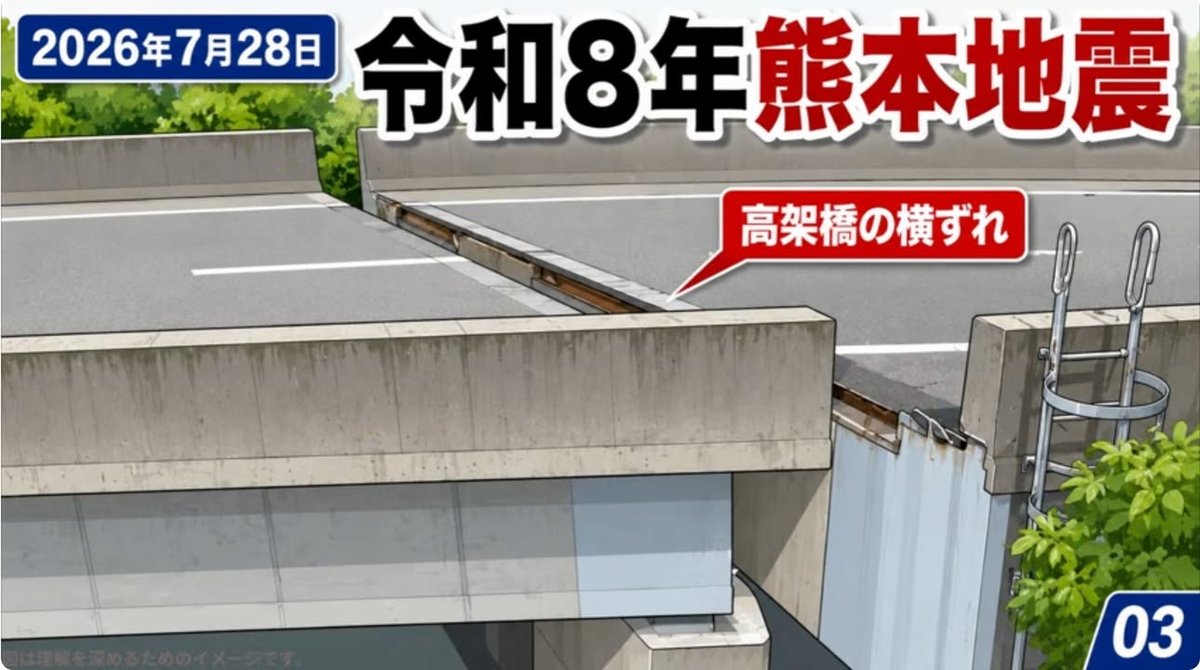
This image is from a new Japanese YouTube video by KENOVA研究所 (kenken), an independent YouTube explainer channel. The video explains the design features that helped prevent total bridge failure in Yatsushiro's Myoken No. 1 Bridge, which you see in the illustration.
In subsequent posts, I'll describe the following four safety features in bridge design:
1. Bearings between the bridge girders (large horizontal beams that support the bridge deck) and the piers (vertical columns that hold the bridge up) that permit controlled movement.
2. Devices that limit how far the bridge girders can move from side to side — perpendicular to the direction of traffic — during a major earthquake.
3. “Lifeline” devices intended to keep a girder from falling even after very large movement — a key feature that helped prevent the Myoken No. 1 Bridge from collapsing completely.
4. Extra supporting space on top of the pier that gives a displaced girder room to remain supported rather than immediately falling off (another feature that was particularly important in the Myoken No. 1 Bridge).
All four help explain modern bridge earthquake engineering, and all four are relevant to understanding what happened at Myoken. But the strongest direct evidence points to #2, #3, and #4 as the features that helped prevent complete collapse at Myoken. The bearings (#1) were themselves damaged, and the other systems were specifically there to keep that damage from turning into a complete fall of the bridge girders.
By the way, the kenken explainer channel also produces material about generative AI, including how to use ChatGPT to make explanatory images. I used ChatGPT to do a little research on the reliability of the video content. Here are the key results, with citations I have verified myself:
--- start ChatGPT text ---
After checking the main claims in the video against NEXCO West and Ministry of Land, Infrastructure, Transport and Tourism materials, I would describe its core engineering explanation as credible, although necessarily simplified for a general audience.
NEXCO West’s expert committee on the Myoken No. 1 Bridge reported that the bridge had been designed so that even if its bearings failed, several other features would make it difficult for the girders to fall: adequate width on top of the piers, connections between the girders, and protruding restraints intended to impede girder movement. The committee concluded that these measures appear to have had ‘a certain effect’ in preventing a complete collapse in this earthquake, while stressing that detailed investigation is still needed to determine exactly how the bridge behaved. [1]
NEXCO’s more detailed technical material also describes the fall-prevention system as a combination of sufficient girder support length, structures that prevent the girders from falling, and restraints on excessive sideways movement. The same material documents damage to the bearings themselves. This is important: the bridge did not survive because nothing failed. Some components failed or were severely damaged, while other layers of protection helped keep that damage from progressing to the complete fall of the girders. [2]
The video’s broader explanation of ‘damage-control design’ is also well grounded. An official Ministry of Land, Infrastructure, Transport and Tourism technical paper on the New Aso Bridge describes an unusually clear example. For movements exceeding the Level 2 earthquake design conditions, selected parts of the bearing system were deliberately designed to fail before damaging forces could be transmitted into the major structural components. The designers also widened the supporting area on top of the piers so that failure of the bearings would be less likely to result in the girders falling. [3]
So the central idea presented in the video — that earthquake-resistant bridge design is not simply a matter of making everything as rigid and unbreakable as possible, but can involve allowing movement, controlling where damage occurs, and providing multiple safeguards against catastrophic collapse — is supported by the engineering sources I checked.
As for the illustrations, I cannot determine from the images alone whether they were generated by AI. However, the same KENOVA研究所 | kenken channel publishes tutorials specifically about using ChatGPT to generate multiple explanatory images for YouTube videos, teaching materials, presentations and social media. That makes AI assistance quite plausible, but it does not establish how the images in this particular video were made. [4]
In short, I would treat the video as a useful and apparently well-researched popular explanation, not as an engineering source in itself. Its most important claims are consistent with the primary sources, and it is appropriately cautious about not attributing the survival of the Myoken bridge to any single device.
Sources:
[1] NEXCO West, “第1回 南九州自動車道妙見第一橋復旧に関する検討委員会の開催結果について,” August 7, 2026.
https://www.w-nexco.co.jp/emc/emcpdfs/20260807153611-01.pdf
[2] NEXCO West, “第1回 南九州自動車道妙見第一橋復旧に関する検討委員会の開催状況について,” committee materials, August 6, 2026.
https://www.w-nexco.co.jp/emc/emcpdfs/20260806163010-01.pdf
[3] Kyushu Regional Development Bureau, Ministry of Land, Infrastructure, Transport and Tourism, “推定活断層を踏まえた阿蘇大橋の橋梁設計について.”
https://www.qsr.mlit.go.jp/useful/n-shiryo/kikaku/kenkyu/h30/01/1_05%2829%29.pdf
[4] KENOVA研究所 | kenken, “【ChatGPT画像生成】1回の指示で複数枚の画像をまとめて作る方法.”
https://www.youtube.com/watch?v=kYBCiWbo3eQ
--- end ChatGPT text ---
I'll follow this up with more posts.