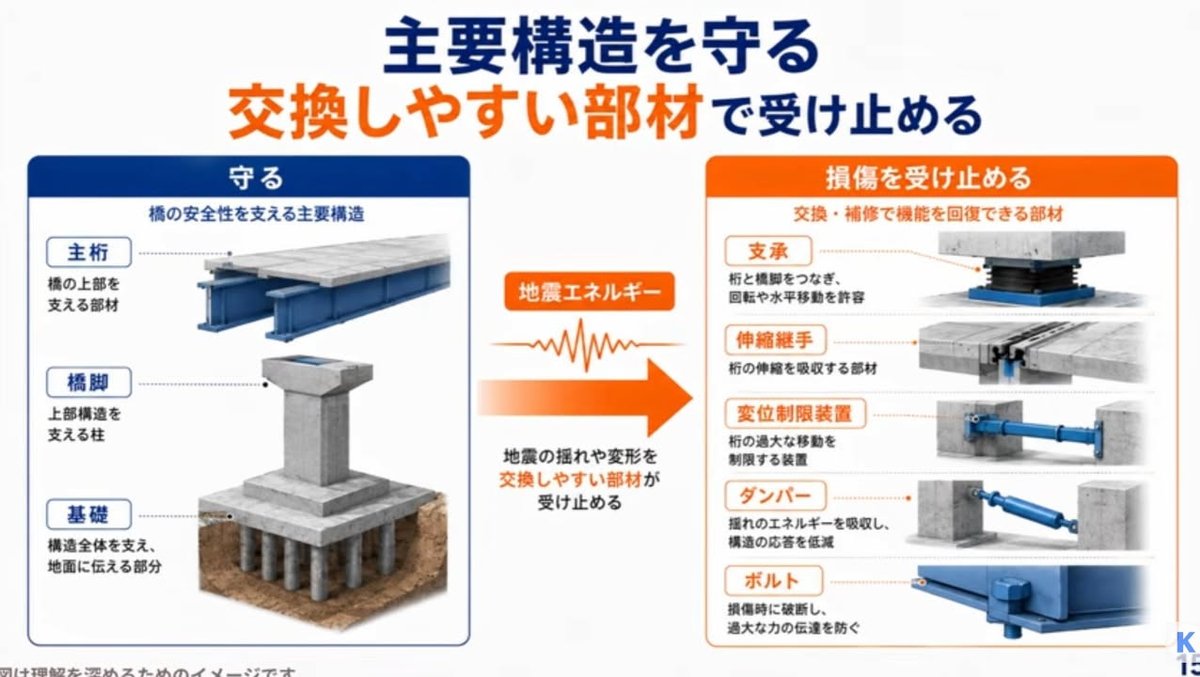
Kirk here with a follow-up to a post I made earlier (https://www.facebook.com/Kumamotoi/posts/pfbid02wX1tTtkt4Wx3UdTshdzuFKkj9CNgw9eBbG1LcqT2FWp6nkL9gS4zeDzaQEeS5wiHl) about how design measures helped the Myoken No. 1 Bridge in Yatsushiro avoid total collapse. In my introductory post I wrote about four safety features in bridge design. The image you see illustrates the first two:
1. Bearings between the bridge girders (large horizontal beams that support the bridge deck) and the piers (vertical columns that hold the bridge up) that permit controlled movement.
2. Devices that limit how far the bridge girders can move from side to side — perpendicular to the direction of traffic — during a major earthquake.
I'll let ChatGPT summarize these two features and how they relate to the Myoken bridge.
--- start ChatGPT explanation ---
The first feature is the bridge bearing, or 支承, shown at the upper right of the illustration.
A bridge bearing is the relatively small component located between a bridge girder and the top of a pier. The word “bearing” may bring to mind the round ball bearings found in things like bicycle wheels, but bridge bearings often look nothing like that. Many are rectangular blocks or assemblies. In the illustration, the bearing is the black, layered rectangular structure between the blue girder and the concrete pier, labeled 支承.
Despite its relatively small size, it performs an important job: it supports the enormous weight of the bridge while allowing the girder to move or rotate slightly rather than being rigidly fixed to the pier.
Some movement is necessary even in ordinary conditions. Bridges expand and contract as temperatures change, and the girders flex and rotate slightly under traffic. During an earthquake, allowing appropriately controlled movement can also reduce the forces that would otherwise be transmitted directly into the girders and piers. Depending on their design, bearings can accommodate movement, deform, and in some cases help absorb earthquake energy.
The second feature is the 変位制限装置, or displacement-restraint device, shown farther down on the right side of the illustration.
There is an apparent contradiction here that actually captures an important principle of earthquake-resistant design. The bearing allows the bridge girder to move, but the displacement-restraint device keeps that movement from becoming excessive. In other words: let the bridge move, but don't let it move too far.
Such restraints act rather like structural stoppers. During a powerful earthquake, the girder may move relative to the pier, but these devices are intended to prevent that displacement from becoming large enough to threaten the stability of the bridge.
This is part of a broader principle in earthquake-resistant engineering: making a structure completely rigid is not necessarily the safest approach. Allowing selected parts to move can reduce the forces imposed on the main structure, while additional devices control how far that movement can go.
The illustration puts both ideas into a larger “damage-control” system. On the left are the major parts engineers particularly want to protect: the main girders, piers and foundations. On the right are components that can accommodate movement, absorb energy, limit displacement, or be more readily repaired or replaced.
There is an important qualification when we apply this general explanation to the Myoken No. 1 Bridge. NEXCO West found that some of the bridge's bearings were themselves damaged. The bearings therefore should not be described as a feature that has specifically been shown to have “saved” the bridge. [1]
The second feature, however, has a more direct connection to what happened at Myoken. NEXCO reports that the bridge had protruding restraints intended to impede excessive movement of the girders. These were part of the bridge's fall-prevention system, and NEXCO's expert committee concluded that measures of this kind, together with other safeguards, had “a certain effect” in preventing complete collapse. [2]
This helps explain why earthquake protection is built in layers. The bearings normally provide the interface that supports the girders while permitting necessary movement. If an earthquake becomes severe enough to damage those bearings or produce very large displacement, other devices are there to limit that movement. And if those defenses are not enough, still more safeguards are intended to keep the girders from falling completely off their supports.
Those final layers — the “lifeline” connections and the extra supporting space on top of the piers — will be the subject of Kirk's next posts.
Sources:
[1] NEXCO West, committee materials on the Myoken No. 1 Bridge, August 6, 2026. The materials document damage to bearings and describe the bridge's fall-prevention system.
https://www.w-nexco.co.jp/emc/emcpdfs/20260806163010-01.pdf
[2] NEXCO West, results of the first expert committee meeting on restoration of the Myoken No. 1 Bridge, August 7, 2026.
https://www.w-nexco.co.jp/emc/emcpdfs/20260807153611-01.pdf
--- end ChatGPT explanation ---