Kirk here with another follow-up on how design measures helped the Myoken No. 1 Bridge in Yatsushiro avoid total collapse.
My introductory post and my post about the first two safety features can be viewed here:
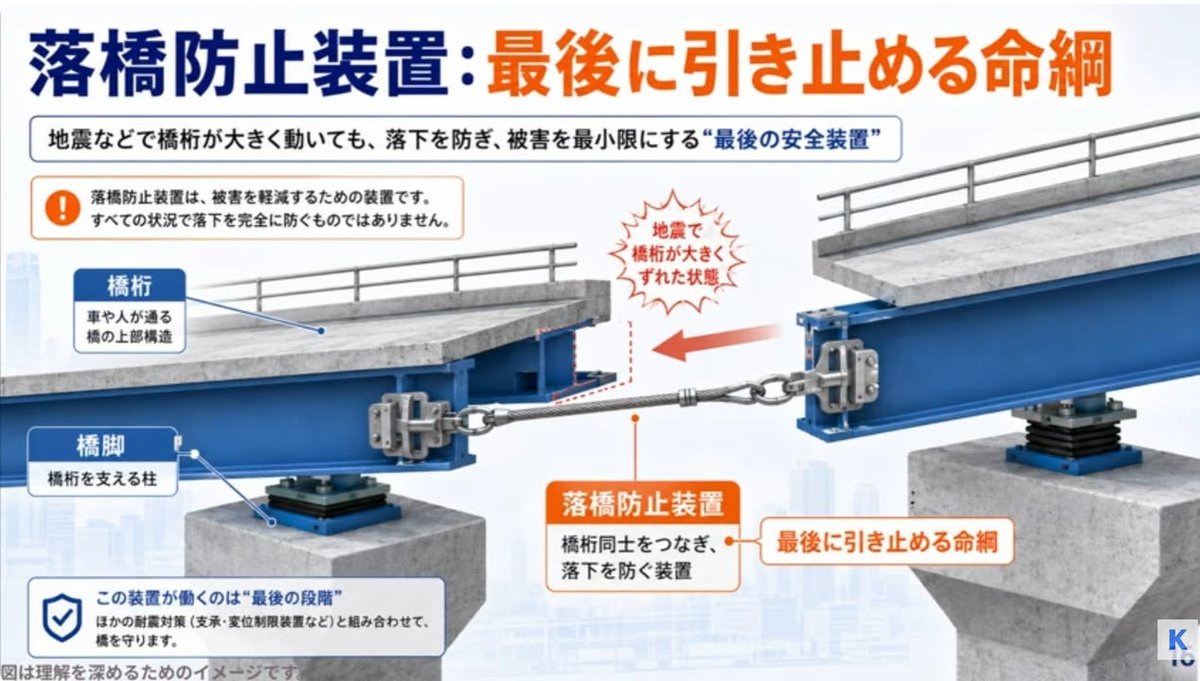
This post looks at the third safety feature: “lifeline” devices intended to keep a bridge girder from falling even after very large movement. The image from the kenken video illustrates the basic idea.
I'll let ChatGPT explain how this works and how it relates to the Myoken bridge.
--- start ChatGPT explanation ---
The Japanese term for the device illustrated here is 落橋防止装置 — a device intended to prevent a bridge girder from falling from its supports. The illustration describes it as a 命綱, or “lifeline.”
The cable-like connection shown between the two girders is not what normally holds the bridge up. The girders normally rest on supports above the piers. But during an extreme earthquake, those supports can be damaged and the girders can move much farther than intended.
The “lifeline” provides an additional layer of protection. If the bridge sections begin to move too far apart, the connection helps restrain that movement and reduces the danger that a girder will separate completely and fall.
This is directly relevant to the Myoken No. 1 Bridge. NEXCO West's technical records show that the bridge had seismic reinforcement that included connections between girders (桁連結), as well as protruding restraints intended to restrict excessive girder movement. After the earthquake, NEXCO's expert committee concluded that these and other fall-prevention measures had “a certain effect” in keeping the girders from falling, although further investigation is needed to determine exactly how each part of the system behaved.
The “lifeline” analogy should not be taken too literally, however. The badly displaced section of the Myoken bridge was not simply hanging from one of these connections. NEXCO reports that a displaced girder became caught on the top of the supporting structure. In other words, the connection helped keep the bridge sections from separating completely, while the structure below still provided physical support.
That leads directly to the fourth and final feature in this series: there was enough supporting space beneath the girder that, even after a very large displacement, it could still remain caught and supported rather than falling to the ground. That will be the subject of Kirk's next post.
Sources:
[1] NEXCO West, committee materials on the Myoken No. 1 Bridge, August 6, 2026.
https://www.w-nexco.co.jp/emc/emcpdfs/20260806163010-01.pdf
[2] NEXCO West, results of the first expert committee meeting on restoration of the Myoken No. 1 Bridge, August 7, 2026.
https://www.w-nexco.co.jp/emc/emcpdfs/20260807153611-01.pdf
--- end ChatGPT explanation ---