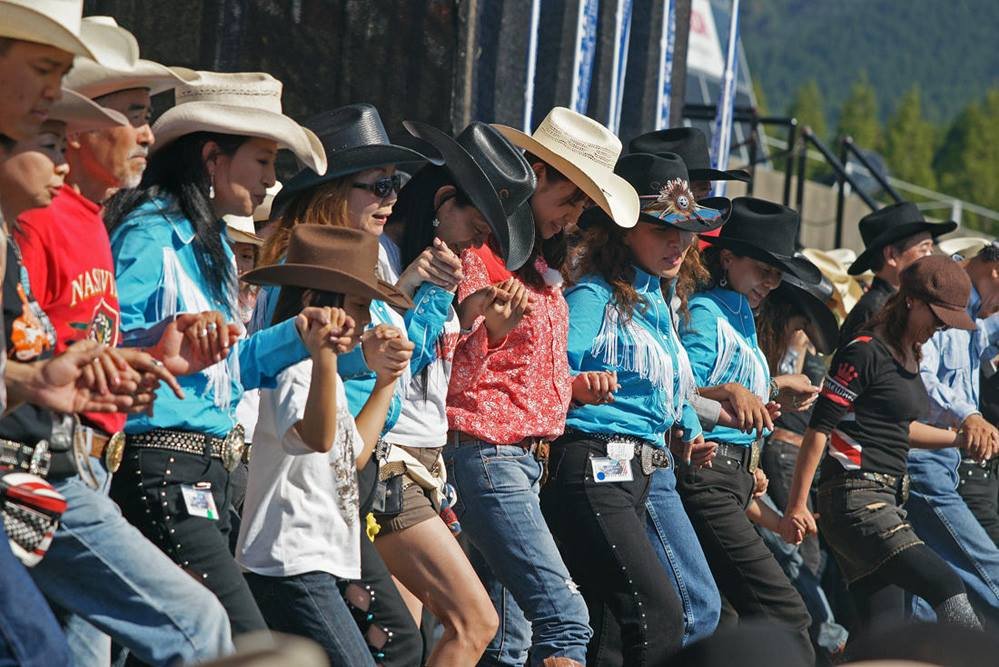
I had the pleasure of seeing a portion of this ensemble recently, and their beauty literally brought me to tears. A more expanded cast will perform on Mt. Kimpo on December 8. If you have a mode of transportation, you should be there. Info at the link. - William

2018-11-11 21:24 JST

Hi there! JHS Info Sessions/Entrance Advice - Do you have kids heading into Junior High School in the near future? If my memory serves me right, about this time last year people were asking about JHS Open Days and info seminars in Kumamoto. Well, the free-sheets we got this past week have had such adverts - see images attached. I don't know much about the schools in question, but hopefully this information can be useful to some of you with kids, especially those in upper primary - Ruth

2018-11-10 17:16 JST

The slopes of Kumamoto Castle are termed "mushagaeshi" 「武者返し」as they were designed to deter invaders, which is kind of the point of a castle. A mathematical analysis of the physics is shown below. I don't understand mathematics, but apparently it worked until someone (Satsuma!) discovered cannon.
Kumanichi reports that deconstruction of the current Shinkansen station has begun, with the new station slated to be complete next March featuring a mushagaeshi motif. The article notes that castle walls are visible in the background. - William
https://this.kiji.is/433823596219860065?c=92619697908483575

2018-11-10 12:54 JST

joe tomei here passing on a call for auditions. I recently met Takuma Matsuda and Mari Miyamoto, who are making a short film for the shotengai in Shinmachi, (renamed Shinborimachi in 2009) that will be entered in a short film festival and they are looking for people to fill several roles. Please check out their website at
https://dokkoishofilmcasting.weebly.com/

2018-11-10 09:57 JST

Just was informed about this workshop, entitled Perspectives on International Cooperation and Development: JICA, Palestine and Personal Experience: A discussion with Dr. Iyas Salim
Hosted by Dr. Joshua Rickard at Kumadai on 7 Dec. For more details, contact Joshua Rickard.

2018-11-09 15:05 JST

If one marries one with long Kumamoto history, one also marries the history. Tsunoda-san, our neighbor, had been friends with my wife's mother, who died before I met her. New to Kumamoto, I helped with the convalescence of Tsunoda-san's husband - I built them a wheelchair ramp to their genkan - and then watched over her after her husband's demise. She came over most daily with one request or another, and fulfilling them was good study for me.
She passed away recently, and her son demolished her ramshackle house, replacing it with an ill-advised, very cheap structure. (Our neighborhood sits on a fault, and I doubt it will survive the next quake.) This morning, the workers began installing roof tiles, and I had a chance to ask what one of those ladders which act as an elevator is called. Turns out it's "niageki" (荷揚げ機). So you can add that to your vocabulary. And take care of your elderly neighbors. - William

2018-11-09 11:43 JST

joe tomei here with a phunky phriday photo post here. Unfortunately, a need for a bit of dieting has reduced the food funkiness, but I recently needed some passport photos, and Liz Suenaga (who often provides the photos for William Baerg's) son has a phunky photo studio, located near Shinai, located in a sufficiently funky building, with 2 sweet cats (one pictured below). I had often driven by and wondered about the building and now I (and you!) know.
The location is on the FFP map at https://drive.google.com/open?id=1qUH94Bac7Hr939b7_8gtvebaJZffGRsX&usp=sharing
And some sad news, Sunny Place hamburgers in Kengun (NOT the place downtown) has closed. Tempus just keeps fugiting and fugiting...

2018-11-09 09:37 JST

November is here, and the orange season has slowly started. Japan guide gave better description for this fruit, and they are actually called “Mikan” (Mandarin Orange) in English.
I went to Mount Kinpo to freshly pick them. They were sweet and delicious.
The details of the Mikan farm is in my Facebook page below:
https://m.facebook.com/pages/category/Personal-Blog/Kumamoto-and-Beyond-699941546778813/
And the description of Mikan was taken from japan guide link below:
https://www.japan-guide.com/e/e2347.html
Mikan (Mandarin Orange)
Mikan are the most popular type of Japanese oranges, which are generally known as kan (some other orange varieties are iyokan, ponkan, etc.). Mikan peel easily and do not have seeds and are widely popular as a dessert or snack when they are in season in early winter.
-Olivia-

2018-11-08 09:55 JST

Our sister Facebook page Explore Kumamoto has recently posted some gorgeous photos of Kumamoto autumn (there's a pun in there). One article they recently reposted entitled "30 pictures that will make you want to visit Kumamoto" is useful not only for your own travel plans but to introduce Kumamoto to your friends and family. That post is at the link below. - William
https://itsyourjapan.com/kumamoto-travel/?fbclid=IwAR15ttFwH6qCDHO_MRmxsRTUc4ICD6wf7iY6_gj6Voj6aKXsrVLqMsJUE-U
https://www.facebook.com/explorekumamoto/
Explore Kumamoto

2018-11-07 08:39 JST

This, from Greg Lambert, may be of interest to folks here. -- Joe
======
Hello. There is a touch rugby day on November 25th if anyone wants to join our Kumamoto team. It’s non-contact and we have two co-ed teams with the majority of players being ALTs. It’s perfect for beginners who would like to have a run around with the rugby World Cup approaching
Just comment here if you would like more details.
Thanks.

2018-11-06 10:43 JST

Good morning! Here's a bit of news from the Japan Times. -- Kirk
Quake-hit Kumamoto looks to reopen access to tourist attractions in time for Rugby World Cup | The Japan Times
The city of Kumamoto plans to take advantage of next year's Rugby World Cup to revive its struggling tourism industry by offering visitors special access t

2018-11-06 10:08 JST

Kirk here. I was bundling up some old newspapers yesterday when I noticed that the cover story of the October 6th edition of "Living Kumamoto" was about foreign residents. I've attached some photos but they don't show all of the articles. If you'd like to have pdfs of the two pages that contain the relevant pictures and articles go to
http://www.livikuma.com/2018年10月6日号/
The first two pages of the publication are what you need to look at or download.
By the way, I have some misgivings about the use of the word "YOU" in the article. The word is used to mean "foreigner" and the usage follows the TV Tokyo program "YOUは何しに日本へ?":
http://www.tv-tokyo.co.jp/youhananishini/
At best, this program is a light, humorous approach to learning about people who come to Japan while, at worst, the "light humor" devolves into looking for opportunities to laugh at crazy foreigners.
The use of the word "YOU" on the program has its origins in a quirk of the famous talent producer, Johnny Kitagawa. Mr. Kitagawa is known for using the English "you" when speaking Japanese in order to avoid having to choose between the various second person pronouns that one finds in the Japanese language (あなた、君、お前、お宅など).
https://www.excite.co.jp/news/article/Real_Live_32492/
Regardless of the gag's origins, however, on the TV Tokyo program, "YOU" means "gaikokujin" and is used in a light, playful and/or comedic way.
Now, here's where I start to have a problem. Are there similarly light, comedic expressions that can be used to refer to other ethnic identities? Would "ANTA" or "ANATA" be acceptable ways to refer to Japanese people on an English-language TV program (e.g. "Look! I think I see an ANTA coming this way!")? That is exactly what is being done here. The second image asks "How many YOUs are there in Kumamoto?" and such usages are very common on the TV Tokyo show.
The articles themselves are very innocuous and I'm sure that no harm is meant. I just wish that they would not have followed in TV Tokyo's practice of using "YOU" as a "light" way to refer to foreigners. In my life in Japan, I have generally not enjoyed situations where people (usually young people or drunks) took my foreign identity as their cue to try to be funny and so I'd prefer that my identity as a foreigner not be tied to some low-level comedy show.
I suspect that my discomfort with this may not be shared by many others. I'll be curious to see what, if any, thoughts you have about this. Feel free to tell me if you think I'm making a mountain out of a mole hill, so to speak.
Thanks for reading. :)

2018-11-05 08:49 JST

Sometimes you see something flying that looks like a stick, and, not feeling particularly creative that day, call it a "flying stick." That is the etymology of "tonbo" (always katakana - トンボ, but which derives from 飛ぶ棒; I just looked it up), and what the English, who, when they invented English and were busy fighting dragons (double tasking!), termed "dragonfly."
They are a symbol of autumn in Japan and are quite carnivorous - if you were small and flying, you probably wouldn't be anymore by this time - but I had no idea of life cycle details until I watched this video. (Note: the creator, zefrank1, is famous for being risque but scientifically accurate and very funny. Do not show this to your children.) - William
True Facts : Dragonflies
What animal should we do next? Special thanks to the following: FOOTAGE: Andy Holt Shutterstock Linda Bower, Nature in Motion Getty Images Luca Sabatino Anth...

2018-11-04 19:46 JST

Hi! Kirk here. I'm sharing a message from Mr. Itoh at the International Center about beginning Japanese classes. An English summary follows the simple Japanese, so please scroll down if you would like to refer to the English.
--------------------
日本語(にほんご)を 勉強(べんきょう)しませんか?】
12月(がつ)から 初級日本語集中講座(しょきゅうにほんごしゅうちゅうこうざ)が はじまります!
日本語(にほんご)を 初(はじ)めて 勉強(べんきょう)する人(ひと)、初級(しょきゅう)の 文法(ぶんぽう)を 復習(ふくしゅう)したい人(ひと)、日本語(にほんご)の 先生(せんせい)が わかりやすく 教(おし)えて くれます。
参加(さんか)したい人(ひと)は、下(した)に 連絡(れんらく)してください。
[申(もう)し込(こ)み・問(と)い合(あ)わせ]
電話(でんわ)096-359-2121
メール [email protected]
【Seven days of basic Japanese lesson】
We are now offering an intensive 2 + 5 days Basic Japanese Class for people who want to study the fundamentals of Japanese grammar. The class is for 10 people.
First lesson will be 5th Dec.
Feel free to apply now at the International Center!
[Contact]
TEL: 096-359-2121
E-mail: [email protected]

2018-11-04 18:39 JST

We've discussed recently the pervasive creep of loan words in Japanese with the example of "inbound" being used as a noun. Kumanichi reports polling results on their usage in local government documents, noting that 83.5% of residents have trouble understanding such terms.
Some terms have clear Japanese translations, such as "redundancy," while others, such as "cloud computing," do not. In the former case, they're often followed with a parenthesized kanji term, leading one to wonder why the katakana was used to begin with. The article also notes that borrowed terms can carry different nuances depending on locale, and that, while many prefectures have guidelines regarding their usage, Kumamoto does not. The article also includes a rather amusing list of such commonly-used terms. - William
わかりにくい行政のカタカナ語 “役所では普通”…ずれ実感 | 熊本日日新聞 - This kiji is
カタカナ語について話す熊本大学の茂木俊伸准教授〈こちら編集局 増刊号〉  何でもカタカナで表現する風潮に物申したいです。例えば、テレビのニュースなどで「訪日外国人客」を「インバウンド」とカタカナで、よ.....

2018-11-04 15:15 JST

If you enjoy quizzes, come and test your knowledge this month. Saturday November 17th from 7:30pm. You don't need to make a team in advance, and the event is free of charge. Just bring some drinks/snacks to share. Hope to see you there!
Fiona

2018-11-03 18:25 JST

A whole lot of rainfall drops in the Aso region. Some of it flows out in rivers, while much percolates into a huge aquifer which eventually surfaces where the crust thins in the Suizenji-Ezuko area.
Lake Ezu is a Kumamoto treasure, yet its clear, shallow water leads to explosions of vegetative growth which must be periodically removed for ecosystem health. Our friend Sean Benward noted a drive to remove this vegetation, scheduled to be held Tuesday, November 20, from 10 AM to 12 PM. Wear shorts. - William

2018-11-03 17:21 JST

William posted about the recent hate speech incident:
https://www.facebook.com/Kumamotoi/posts/2208507395889347
I was a bit surprised to read that this was the first confirmed instance of hate speech in Kumamoto. Perhaps it's the first instance of a public demonstration by a political group that was stopped because it was deemed to constitute hate speech. It was certainly not the first instance of a word or phrase being uttered in Kumamoto that could reasonably be thought to constitute hate speech.
I was interested in previous examples of hate speech so I did a little Google search. That search led me to reports of comments like the one in the attached image, which reads "Koreans in Kumamoto have poisoned the wells." This is a particularly vile tweet because the accusation of well poisoning was one of several false claims that led to the massacre of an estimated 6,000 Koreans after the 1923 Kanto earthquake:
Regarding the Kanto Massacre
https://en.wikipedia.org/wiki/Kantō_Massacre
https://harvard-yenching.org/the-great-kanto-earthquake
Source of hateful tweets after 2016 Kumamoto quake:
https://togetter.com/li/962668
Now, before I go on, I'd like to point out that my own personal experience and all indications I've received on this page are that, after the earthquake, hate of any kind was definitely NOT the norm in Kumamoto -- the people of Kumamoto (Japanese and non-Japanese) came together to help each other. Still, I think it's worth noting that there were some people outside of Kumamoto who tried to use the disaster to foment hate.
Also, recent events in the States have caused me to recall an instance of hateful speech I heard while in the Shiyakusho (city office building) several years ago. I was there to renew my foreign registration card when a women came in to complain about how Japanese people were being discriminated against because foreigners (for her, Koreans seemed to be of particular concern) were "unfairly" receiving the benefits of the national healthcare system. I just happened to be sitting next to her so I was forced to listen to her rant. I never learned where she had gotten her information but, at the time (2012 or so), Katayama Satsuki was making such arguments in the Diet, so she might have been picking up on that. (By the way, Katayama is now the only female member of the Abe cabinet and is facing corruption charges -- poetic justice?)
The notion that providing basic social services to "foreigners" (the so-called "Zainichi Koreans" -- who were considered to be Japanese citizens and even able to vote until their citizenship was revoked after Japan's defeat in WWII) constitutes "discrimination" toward Japanese is very similar to accusations of "discrimination" toward Japanese made by the Zaitokukai (在日特権を許さない市民の会). See,for example, the Zaitokukai flier "日本人差別をなくそう" (Let's stop discrimination against Japanese) on the following page:
https://column.tokyo/sakurai-hatespeech/
I was reminded of this incident by recent events in the U.S. because I perceived a similarity in the thought process. The motivation behind the slaughter of 11 Jewish worshipers seems to have been that Jews are helping "inferior races" come to US and that this constitutes "White genocide." In both cases the language of victimization is reversed such that the dominant majority becomes the "victim" of the demonized other. See "Eli Saslow Traces 'Straight Line' From White Nationalism To Alleged Synagogue Shooter" for an explication of the phenomenon I've just referred to:
https://www.npr.org/2018/10/28/661633763/eli-saslow-traces-a-straight-line-from-white-nationalism-to-the-synagogue-shoote
Again, I find hateful speech to be quite rare in Kumamoto. Still, since recent events had reminded me of my first direct exposure to the hate speech akin to that of the Zaitokukai in Kumamoto, and since the incident near Kumamoto station was described as the "first" such instance, I thought I put this little essay together. Thanks for reading.
-- Kirk

2018-11-03 12:09 JST

I'm reposting this because I've realized (thanks to an astute friend's comments) that I had jumped to a conclusion that was clearly mistaken: the password leak I experienced was almost certainly not the result of a Facebook issue. I posted a mea culpa on the original post but, since a good deal of time has passed, I thought I should repost so that more of the people who had seen my originally post would see this correction. I'll try to be more careful in the future.
One point that was not mistaken: It's a good idea to have different passwords for different sites and to change them from time to time.
Apologetically yours,
Kirk
The Facebook hack explained: Who's affected, what happens next, and how the company will fare
Facebook said on Friday that a security vulnerability could have allowed attackers to take over about 50 million accounts and use them as if they were the account holders. But further details have been scarce. Here's what we know so far.

2018-11-03 11:14 JST

A long time ago, the Mongols invented stirrups, which turned out to be really useful in their invasion of most of the known world. At the tip of the Korean peninsula, however, they were stymied by water, but they persevered, built boats, and invaded Japan twice, not having learned from their first failed attempt (a typhoon disrupted their second, larger attempt, leading to the term "kamikaze"). Between the two invasions, walls were built along the Fukuoka coast, some of which still exist, and Higo (as Kumamoto was then known) forces were also involved.
It was kind of a big thing at the time, and an artist, Takesaki Suenaga (竹崎季長) was commissioned by the powers that be - who were, at that time, in Kikuchi - to depict it, so he came up with two scrolls around 1280 (dates vary). known as 「蒙古[もうこ]襲来絵[え]詞[ことば]」- "Images of the Mongol Invasion." They are seldom displayed, but Kumanichi reports that for the first time in 17 years, both, one measuring 24 meters and the other 21 meters in length, are on display until mid-December at the Museum of Science (in the prefectural library). One sample of a scroll is shown below; links are to the Kumanichi article and the Wikipedia page regarding the scrolls. Admission is free. - William
https://this.kiji.is/430864124722300001?c=92619697908483575
https://ja.wikipedia.org/wiki/%E7%AB%B9%E5%B4%8E%E5%AD%A3%E9%95%B7
Note: Apologies for the misdirection regarding the location of the museum - it's located within the prefectural library near Ezuko: https://www2.library.pref.kumamoto.jp/?page_id=476

2018-11-02 20:12 JST