Before expressway existence, the only way to travel between Kumamoto and Kagoshima was Route 3, an arduous journey in those days, and the small towns that dot that route - Ashikita, Minamata, Izumi, Akune, Sendai, Kushino - profited from the weary travelers. Of course, those days are long gone, and their other staples, farming and fishing, aren't doing much better. Except for a white elephant here and there, they're frozen in time - and losing their young rapidly.
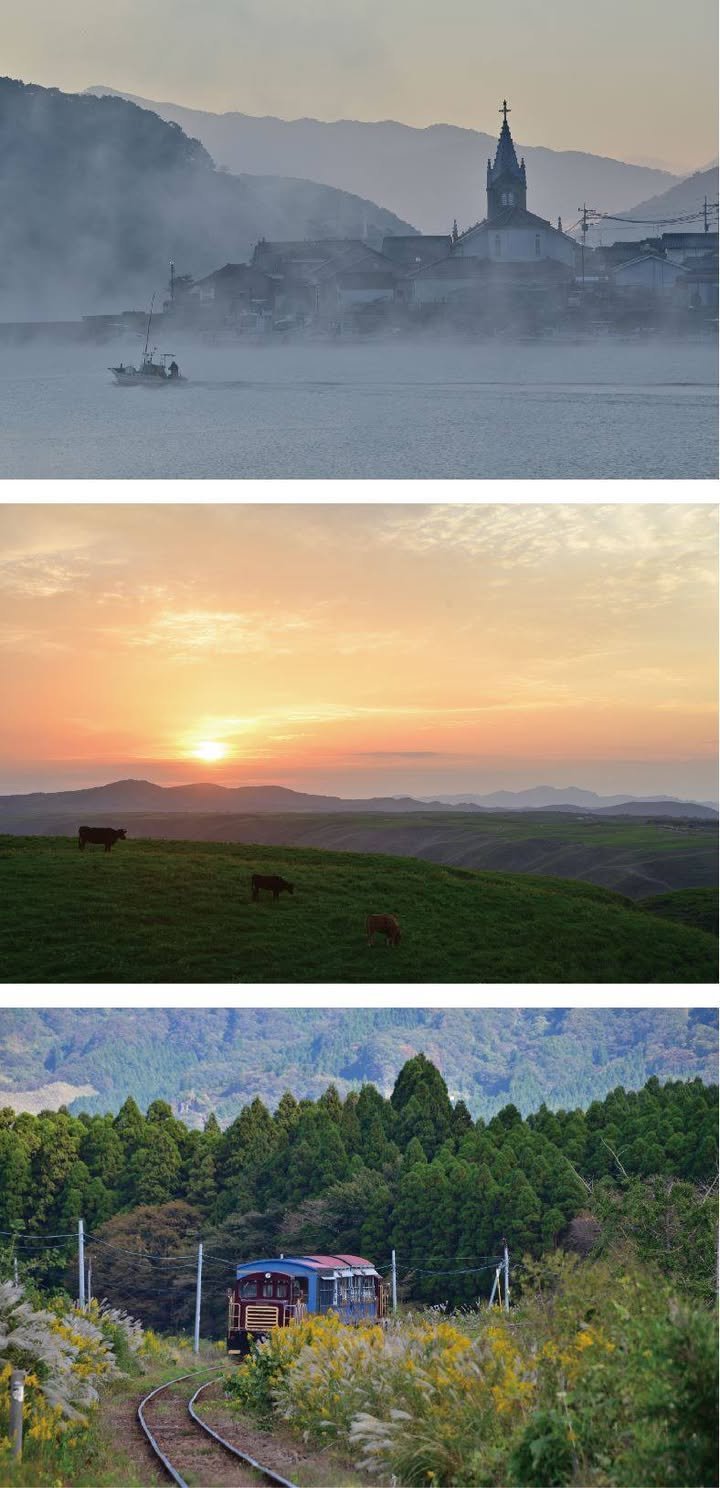
Akune (阿久根) is particularly interesting. According to Wikipedia, the 「阿久」refers to the fisheries and the 「根」to the reefs. It was a popular way-stop, half-way between the cities, and with its onsen and beaches, often a destination in of itself. I recommend a visit; it is accessible by the JR Orange line. It was also important for the "hidden Christian" population in the Edo era. It's population, like other towns in the region, is plummeting.
I attend the Oe Lutheran church whose pastor, Tateno Sensei, is also responsible for the Akune church. Due to physical constraints limiting one to a single existential location, he's set up streaming video so that the handful of (mostly elderly) Lutherans remaining in Akune may join their Kumamoto brethren in worship on Sundays. This morning, he proudly announced an upgrade.
Technology will grow increasingly important in linking the elderly remaining in Japan's depopulated hinterland to its burgeoning cities. Below: Deer on a beach in Akune (obviously). - William

2018-11-25 12:41 JST

One has to be careful to distinguish between a butsudan (仏壇), generally an elaborate cabinet related to Buddhism used to pay respects to family members who have passed away; and a kamidana (神棚), spice rack-sized household altars related to Shinto used to enshrine a Shinto kami (god). Most every family - meaning extended - has the former, which is usually found at the house of its leading member, and when extended family member return "home," first is to pay respects there (even if you're not a family member, if you're close, it is considered polite); the latter is a bit more unusual and, in typical Shinto aesthetics, is very simple and hung high on a wall. Wikipedia has English-language articles on both for those interested. They're quite fascinating.
The reason I mention this is that the Kumamoto Prefecture Shinto Bureau (熊本県神社庁熊本) will be distributing free of charge 500 kamidana on a first-come, first-serve basis on December 2nd between 3:00 and 5:00 pm. The location is the former Mr. Donuts on Kamitori.
You may not need a kamidana and may want to spare them for those who do, but in addition, there will be a performance of gagaku (雅楽, traditional court music), a display of kamidana styles, and a DVD movie of Isejingu (伊勢神宮), the most sacred Shinto shrine, located in Mie Prefecture.
On a personal note, I'm not a big fan of Shintoism, finding it retaining much of the nationalism it acquired between the Meiji era through the end of the Pacific War - that is, it is tolerant of non-Japanese but not exactly welcoming. Below is a photo of the kamidana to be distributed (warning: to receive one, you'll have to fill out a "simple"questionnaire in Japanese), and more info can be found at the link. - William
https://www.facebook.com/%E7%86%8A%E6%9C%AC%E7%9C%8C%E7%A5%9E%E7%A4%BE%E5%BA%81%E7%86%8A%E6%9C%AC%E4%B8%89%E6%94%AF%E9%83%A8-1145788322169459/?__xts__[0]=68.ARCdkXlOmV0MDnzW7UUfhhi6zHewidimxfqkMHQzMveZy7dyTHMLKTQy8pVGRyzyvce6pMDM-7JgV4e62QAAWvUOixKeMUuKsqP33MNN4y_F788JMKY3L2SDdhf08c7bAOWX8NBr9Ynp4ymJ32B0gOjuOS2Oz8Ts2Nk3kE9u6n5KwItVTqOvto8IoJWbIOtHnlDSnZHalanmPnxZr0APGF4NlBFIyrpNDg-Hhh57x9XPUaRLvO9TAcosXXlQodxkOMcYruA6HVQwXlhhd6hixE9FcXa9vHFhG2j86NJ2tcqKNFg99XmguQ3-Da8Q8gaJx3IOrDYWT3b5QwBgNpxm8weD3w&eid=ARAy49eqnmwWeDf1fSuqZs2nTITxQ1PBiPyG14c68341ml8w9oL7xDjnkVzfacaE89kw9S73B2obPBmv

2018-11-23 21:03 JST

I'm not sure if Kumamoto is unusual, but it seems to have at least its share of nuts and kooks. The most famous case is Asahara Shoko, whose cult committed Japan's most infamous domestic terrorism attacks. Then there was the case of the "13-year-old girl [who] was suffocated by her father and a monk who were trying to expel an 'evil spirit'":
https://www.tapatalk.com/groups/cultbustersgalactica/nakayamashingoshoshu-buddhist-cult-japan-deadly-ex-t983.html
That one struck quite close to home for me. The family's home was quite near ours and I had met the little girl in happier times.
Now this. :(
-- Kirk
------ Start quote ------
The LDP branch received the donation from a woman who heads a religious corporation based in Kumamoto Prefecture on Oct. 17, 2017, according to a 2017 political funding report of the LDP's branch in the Tokyo No. 11 constituency released by the metropolitan election administration commission on Nov. 21.
The Nagoya District Court ordered the religious body and its head in April 2012 to pay approximately 6.1 million yen in compensation to a woman for having the plaintiff pay a massive amount of money to the organization by telling her that she was possessed by the spirit of a miscarried or aborted fetus and fueling her concerns. The ruling pointed out that the practice was antisocial and illegal."
------ End quote ------
https://mainichi.jp/english/articles/20181122/p2a/00m/0na/011000c
LDP branch headed by ex-education minister received donation from 'psychic' - The Mainichi
TOKYO -- A ruling Liberal Democratic Party (LDP) branch here headed by former education minister Hakubun Shimomura accepted 100,000 yen in a political

2018-11-23 13:53 JST

Now that the dilapidated housing across the street has been cleared, construction has started on a mansion all the neighbors agree is far too ambitious for the lot. As it will require a strong foundation, deep holes are being dug using a collection of monstrous machines which I'd seen before but didn't know the name of in any language. So I ventured over to ask.
The young worker who kindly responded to my beckoning said 「チヤック」- "chuck" -and, noticing my confusion, gave me its more formal name: 「全周回転機」(ぜんしゅうかいてんき). A somewhat prolonged Google search provided it's English translation: "casing rotator." (It's also called a "chuck" in English.) Basically, a huge pipe with teeth is lowered into a gigantic rotator to dig, and an immense crane drops a weight with a device at the tip that looks like a stork beak that snaps shut when it hits the bottom and is raised to empty its contents, and the process repeats. The casing will be left in place, filled with concrete, and - voila!- a foundation.
The problem is that it creates localized tremors equivalent to maybe M2 repeatedly, all day. My dog loathes earthquakes, so he is not a happy pup. Below is a schematic of the apparatus and links to a Youtube video of how it works and an English-language explanation. And I learned some new words today in two languages. - William
https://www.youtube.com/watch?time_continue=87&v=6MY7XqvoNcs
http://www.n-sharyo.co.jp/business/kiden_e/topic20120709.html

2018-11-22 14:34 JST

My favorite bakery, a shop called Biggi, which is run by a lady who learned her craft in Germany, bakes bread for these hungry athletes when they are in Kumamoto.
For more about the bakery:
https://www.facebook.com/Kumamotoi/posts/1842977225775701
-- Kirk
German squad tests their 2020 pre-olympic training location in Japan
The 2020 Olympic Games in Tokyo are less than 630 days away and a German squad traveled to Japan to test their Olympic pre-camp-location in Kumamoto, Japan. Kumamoto is located less than a two-hour…

2018-11-21 15:34 JST

The Abe administration is moving to create new categories of foreign workers. Until Abe's most recent proposal, the "polite fiction" (tatemae) that Japan does not issue visas for low-skilled workers was maintained by carving out exceptions for people of Japanese ancestry and then by creating "training" or "intern" programs that are more about providing labor to certain industries than actually training people. Now, the government is poised to step farther away from the no-low-skilled-labor fiction by setting up new categories for foreign workers that are intended to satisfy the demand for manual labor in a number of industries. Unfortunately, the idea that foreigners are only temporary, disposable laborers is being maintained and Abe is asserting that this is NOT an "immigration" policy. To learn more the latest policy proposals, see the following article:
https://asia.nikkei.com/Spotlight/Japan-Immigration/Abe-bets-big-on-adding-foreign-workers
In regard to Kumamoto, the following article points to the heavy reliance on foreign labor in the agricultural sector here:
"Ikuo Kabashima, the 71-year-old governor of the southern prefecture of Kumamoto, agrees that the presence of foreigners is indispensable for the survival of the Japanese farming industry. 'Without foreign laborers, Japanese agriculture is unimaginable,' he said.
In October 2017, the Kumamoto Prefectural Government set a goal of establishing 'agriculture that links us with the world' and applied to be certified as a national strategic special zone. The concept entailed foreigners working at farms and fruit-sorting sites during the busy season, while gaining expert knowledge by studying Japanese language and agriculture at universities and other institutions."
-- Kirk
https://mainichi.jp/english/articles/20181116/p2a/00m/0na/002000c
Shrinking Japan: Asian interns carrying the weight of agriculture industry - The Mainichi
SHIBETSU, Hokkaido/ASO, Kumamoto/TOKYO -- Inside one of the many greenhouses lining the vast area of land under the autumn sky in Hokkaido is 22-year-

2018-11-20 09:47 JST

This is a basic introduction to basashi. The article includes the following factoids:
"Consuming meat, equine or otherwise, is a fairly recent acceptable practice in Japan. For more than 1,000 years, eating meat was punishable by law. On January 24, 1872, however, Emperor Meiji led by carnivorous example and publicly announced that he ate meat. He saw animal protein as a means of modernizing and enhancing the population’s health and strength, particularly with regards to the army."
This is a very rough simplification of a rather complex history. I took a look at the following Japanese Wikipedia article to try to improve my understanding of the prohibitions and taboos against eating meat:
https://ja.wikipedia.org/wiki/日本の獣肉食の歴史
One of the points made in the article is that, although there have been taboos and prohibitions against all forms of meat at various times, meat has been consumed to some extent throughout Japanese history. Also, the strongest taboos have been against raising animals for slaughter and that consuming the meat from wild animals (deer, boars, etc.) was relatively more acceptable. Another point made is that animals with more legs were considered to be worse. Fish --> no legs so no problem. Birds --> two legs, not as good as fish but not terrible. Four-legged mammals --> least acceptable. These taboos had to do, in part at least, with Buddhist thought.
This got me thinking about about the raising of horses and cattle in Aso:
https://www.aso-sougen.com/now/01/keep_02.html
I took a look at the short article above and got the impression (though I couldn't find a complete explanation) that the area was famous for raising working animals: horses for military use and oxen for other kinds of labor. So, while the practice of burning the fields in the Aso area to provide fodder for horses and cattle seems to have a very long history, the reasons for raising those animals seem to have changed in the last 100 years or so.
All this makes the bashi tradition that much more interesting to me. As I understand it, it has roots in the the Siege of Ulsan, which Wikipedia says started on December 22, 1597 and lasted until November 23, 1598:
https://en.wikipedia.org/wiki/Katō_Kiyomasa
In that siege, Kato Kiyomasa and his soldiers are said to have slaughtered and ate their horses to survive. It is my understanding that this led to the practice of consuming horse meat in Kumamoto. I'm not sure, though, how the local traditions was or was not affected by prohibitions against the consumption of animal flesh, particularly in regard to domesticated animals.
-- Kirk
https://www.atlasobscura.com/foods/basashi-horse-meat
Deeply red and tender, raw horse meat is a Japanese delicacy.

2018-11-19 09:40 JST

Communities all over Japan have a lot riding of the success of their yurukyara -- mascots with people inside. Today on NHK's evening news show, a good deal of time was spent discussing a kind of ballot stuffing that has been alleged in the election of this year's number one yurukyara. First, here's a link to the NHK video (in Japanese):
https://www3.nhk.or.jp/news/html/20181118/k10011715301000.html
The images you see are from that video. NHK focused on claims that Yokkaiichi got municipal employees to vote en masse for their character. Kumamon came up in the context of a discussion of the motivation for such cheating: money. Kumamon is known to have brought the prefecture lots of money in merchandise sales and to have been effective in promoting the prefecture. Kumamon's status in this regard was significantly enhanced by its (his?) victory in the first yurukyara contest, which was held in 2011. So, the idea is that Yokkaiichi has been willing to cheat in order to reap similar benefits. Here's an English article describing claims against Yokkaiichi:
https://mainichi.jp/english/articles/20181112/p2a/00m/0na/013000c
-- Kirk

2018-11-18 22:17 JST

A bit of information about how the castle structure is being reinforced.
-- Kirk
Shock absorbers make Kumamoto Castle a tower of strength:The Asahi Shimbun
KUMAMOTO--Quake-stricken Kumamoto Castle is turning into a tower of strength, as hefty reinforcement

2018-11-18 17:36 JST

Here's another rugby-related item.
-- Kirk
Kumamoto Castle Park to reopen for 2019 Rugby World Cup in Japan
The city of Kumamoto will take advantage of next year's Rugby World Cup in Japan to revive its flagging tourism industry by offering visitors special access to a famous castle which is undergoing repairs following a pair of powerful earthquakes in 2016.

2018-11-17 17:34 JST

Ummmm. Insecty . . .
An article in the Kumanichi says that the vending machine can be found on the Kokai Shopping Street (Kokai Shotengai) where it is a "mushi dekinai" item (a pun on the word "mushi" [insect] and the expression meaning "cannot be ignored").
https://kumanichi.com/news/705976/
The banner says "world's first edible insect vending machine" but I think they just assumed that this HAD to be the first, though it isn't. A quick internet search turned this up
https://www.youtube.com/watch?v=9mud6YeaUhM
In fact, it's not even the first in Japan. See
https://www.theguardian.com/uk/1999/aug/11/jonathanwatts
The Japan News article (URL at bottom of this page) seems to defend the "first" claim by saying that it's the first one to be put in this kind of market. OK . . . but that's not what the banner says!! :(
This reminds me of the description of the caldera in Aso. It's correct to say that it is "among the largest in the world" (世界最大級のカルデラ) but that is sometimes simplified to become "the largest in world" (世界最大のカルデラ). But, hey, it's too good to check (unless you happen to be a foreign, kuki ga yomenai curmudgeon like yours truly ;) )!!
-- Kirk
http://the-japan-news.com/news/article/0005343536?fbclid=IwAR0lDTORD09H6h_3lYRmIMZyrPMZ4sKKRAgKAAk4IBfaFyeR4EAhdeiy1Xw

2018-11-17 13:48 JST

From the Tangentially Related to Kumamoto Desk: The exterior of my rambling house provides many nooks for the neighborhood's stray cats, and I'm welcoming - my dog, much less so. Every neighborhood has someone who feeds the strays, usually elderly, lonely females. But the tolerance Japan shows towards our feline friends is to be admired. Here is a story of a pair of pussies smitten with art but stymied due to their species. - William
Curious cats bring fame to Japanese museum that won't let them in
Plucky pair have been trying to enter Onomichi gallery for two years, to no avail

2018-11-17 12:02 JST

Next year!
-- Kirk
Kumamoto grateful for opportunity to host Rugby World Cup matches | The Japan Times
Hideomi Ryu played a central role in getting his native city of Kumamoto elected to host games for the 2019 Rugby World Cup, even when naysayers thought it

2018-11-17 07:30 JST

After having been tragically destroyed by Godzilla in 1996, Kotsu Center never fully recovered. (Film at link: https://www.youtube.com/watch?v=cYuIEa5DvJs - Kumamoto shows up at about 2:20.) But after much effort, area revitalization is being realized, including establishment of a public activity zone called "Hanabata Hiroba" (花畑広場). Below is a schematic of this new realization. Our friend Sean Benward noted that there will be a Christmas bazaar from 12/5 through 12/9 in the open space area, with many shops and restaurants taking part. A link to the event with details is here:
https://xmas-kumamoto.com/shop-information?fbclid=IwAR3c5qLre_LjVt0XNpFGpRJ9dsHtSTpfiJ9oAwXG7MpvlJNxuca4O_9aU_s
and more info about future events heading into holiday season here:
https://kumamoto-guide.jp/hanabata/events/search
- William

2018-11-16 17:23 JST

Joe Tomei here with a funky friday place post, but this time, it's not a place, it's a website I found. I am planning to visit Chihenji, a temple area to the west of Kumamoto station (more on that later) and looking for some information, I came across http://kakutaxi.com/
which is the site of a kanko taxi guide named Hidetoshi Kaku. While I've not used him, the prices look reasonable for 3 people wanting to get guided in Japanese. The mini guide (2 hours for 8000 yen, split between 3) looks interesting. http://kakutaxi.com/guide/.
If there are any English taxi guides that anyone knows of, please share them in the comments

2018-11-16 09:00 JST

Here's a bit of old news that I never got around to posting. The good news is that many people took exception to this kind of behavior. By the way, there's a YouTube video on the news page.
-- Kirk
Horse whipping at Kumamoto shrine festival blasted as cruel
A video tape showing a horse getting whipped at a traditional festival held last month in the city of Kumamoto has caused a public outcry, with many people calling it a form of animal abuse.

2018-11-15 20:28 JST

Hi everyone! Robert Remmerswaal posted this on the visitor's page. (Thanks Robert!) I'm reposting it in the hope that doing so will allow more people to see it.
-- Kirk
https://www.facebook.com/Kumamotoi/posts/2239080742832012

2018-11-15 17:06 JST

Joe Tomei here. This just in, please contact the person listed.
Saturdays Part Time Teacher
A small eikaiwa requires a native English teacher for Saturdays.
There are seven one hour kid classes available. Pay is from 2,500 to 3,000 yen per lesson.
Other days possible to if desired.
Please send resume to
[email protected]

2018-11-13 23:10 JST

The other day William posted about Johnny Depp coming to Kumamoto to make a movie about Eugene Smith:
https://www.facebook.com/Kumamotoi/photos/a.129499733790134/2196194160454004/
If you are interested in the work that Smith did in Minamata and understand Japanese to some extent you may enjoy the ETV special about him. I was able to record it when it was first shown over the weekend and am very glad I did. It will be rebroadcast Wednesday night / Thursday morning from midnight to 1 AM.
I wrote "Wednesday night / Thursday morning" because the schedule says "Thursday morning" but it really means "Wednesday night" after Wednesday becomes Thursday. I have missed a show or two in the past because I was confused by this way of referring to the date and time. It's technically correct but nonetheless confusing for me -- like referring to an event that will happen tomorrow as "next week" because tomorrow is the official start of another week. Or, like calling the south side of a house the "front side" even though the opposite side faces the street and the south side doesn't. Or . . . well, you get the idea. ;)
-- Kirk
https://www.nhk.or.jp/docudocu/program/20/2259630/index.html
NHKドキュメンタリー - ETV特集「写真は小さな声である~ユージン・スミスの水俣~」

2018-11-12 22:40 JST

Hi! Kirk here. I used post Kumamoto-related news pretty regularly but haven't been able to do that as much as I would like in recent weeks. Here's one of several items I hope to post over the coming week.
Many of you are probably familiar with the local delicacies described in the article but you may not be familiar with the restaurant: Susaki. I haven't been there myself but it's probably worth a visit if you're interested in trying the dishes described in the article but not sure where to go.
Blessings of nature enrich Kumamoto cuisine
Located on the rich soil between the East China Sea and Mt. Aso, one of the largest active volcanos in the world, Kumamoto boasts cuisine featuring fresh seafood, meat and vegetables.

2018-11-12 21:29 JST