Posts
William here -
Introducing the Futagawa fault had occurred to me before, but this evening provides a good opportunity. The fault is a rift zone, meaning the land is spreading apart, which extends from Amakusa - creating the Uto peninsula - through Mt. Aso. In fact, the Tateno gap, through which Shirakawa flows out of the Aso caldera, is a result of the fault; without it, the Aso caldera would be a lake. It created the plain which currently hosts the airport, and the valley between the airport and the mountains to the south is the rift zone. Rift faults are not capable of such powerful earthquakes as other types such as subductive or thrust. What you have experienced is likely the largest quake this fault is capable of.
I was away from my computer for a while because I went to visit the dormitory that houses the exchange students at my university. Fortunately, they are all fine. The main thing I noticed is that many people are gathering in parks and other open spaces. I haven't heard the TV announcements but, apparently, people are being encouraged to leave buildings that might be vulnerable and to move to open spaces.
-- Kirk (one of several editors of this page)
Here's a page that should help you understand Japan's earthquake intensity rating scale (reported as "shindo"). Magnitude is a scientific measure of the amount of energy released whereas shindo tells you how bad the shaking was in each place. So, the two measure different things and you can't convert one into the other.
https://en.wikipedia.org/wiki/Japan_Meteorological_Agency_seismic_intensity_scale
Japan Meteorological Agency seismic intensity scale - Wikipedia, the free encyclopedia
The Japan Meteorological Agency seismic intensity scale is a seismic scale used in Japan and Taiwan to measure the intensity of earthquakes. It is measured in units of shindo (震度?, seismic intensity, lit. "degree of shaking"). Unlike the Moment Magnitude Scale (MMS) (a more accurate scale than the o…
William here:
If you live in Kumamoto, you probably noticed an earthquake. In fact, you're probably aware of the aftershocks now. DO NOT BE ALARMED. Kumamoto's techtonics are dominated by the Futagawa fault, which has a theoretical maximum magnitide of 7 - which means it couldn't get much worse. We'll ride this out. There will be aftershocks, but it will not get worse. http://www.jishin.go.jp/main/yosokuchizu/katsudanso/f093_futagawa_hinagu.htm
We are continuing to experience aftershocks.
Here's an image from RKK TV:
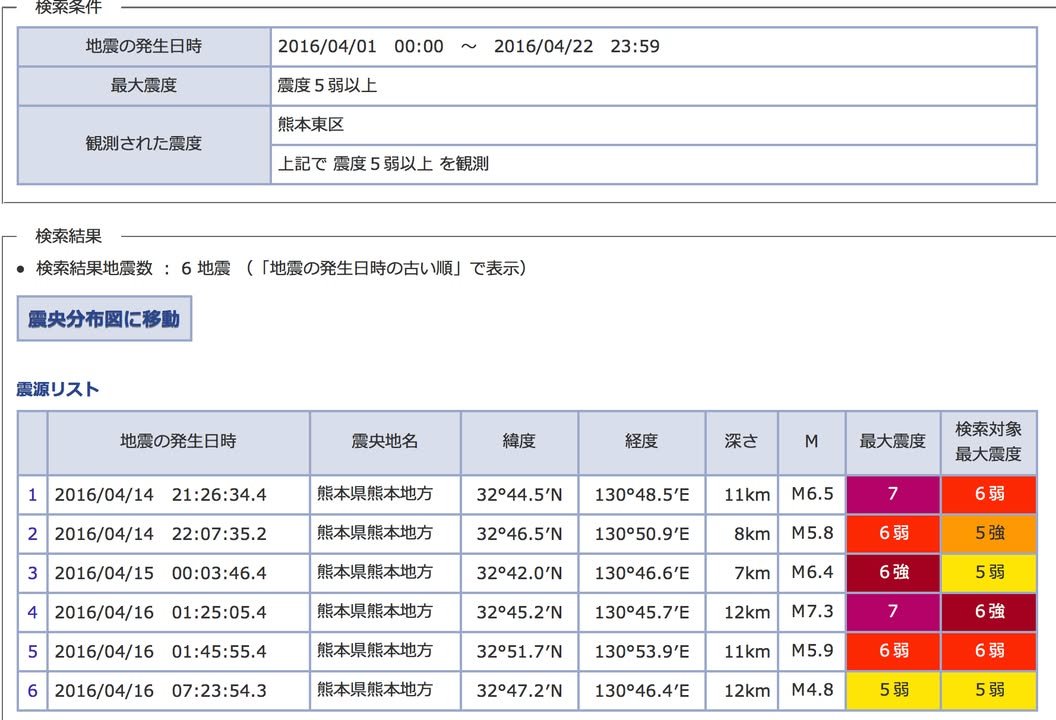
The epicenter was in Mashiki.
The magnitude is reported to be 6.4. We're still experiencing after shocks.
We've just had a major earthquake focused on Kumamoto. Actually, we are still experiencing some tremors but the major jolt from the quake seems to be over. I was amazed to see that the shindo rating (Japan's rating scale) was 7 -- the highest level on the scale. I'lll follow up with more information as soon as I can.
--- Kirk
This is not a particularly interesting story save for a new piece of vocabulary for those who collect English loan words mashed into Japanese. A policeman was arrested in Kumamoto yesterday for riding a motorcycle without a helmet; as the headline notes, this was apparently a ノーヘル violation. The article also notes that we are in the midst of the spring traffic safety campaign, so keep your head about you, folks! http://www.sankei.com/region/news/160414/rgn1604140068-n1.html
熊本東署の警察官が勤務中、道交法で義務づけられたヘルメットを着用せずにオートバイを運転していた。熊本県警が、取材に明らかにした。数百メートル走行した後、ヘルメッ…
William here. It has been suggested that I introduce myself. I am an American expat who has lived in Kumamoto almost a quarter-century - long enough for "the pebbles to grow into boulders, lush with moss," to paraphrase the national anthem. My Japanese wife and I have raised two children here, who are now in American university limbo-land. Kumamoto is more my home than any place I have ever lived - yet I still have many things to learn, and as such, Kumamoto-I is a valuable source for me. I will try to summarize articles from the Japanese press related to Kumamoto so that you don't have to dig through them yourselves. Yoroshikuonegaiitashimasu.
The Meiji restoration was a revolution that was largely bloodless. After the the revolution's initial success, however, disgruntled samurai waged a major revolt here in Kumamoto. It was the last series of battles of comparable scale in Japanese history. This was when Kumamoto Castle was burned down. (The current edifice was rebuilt in 1960.)
-- Kirk
P.S. The article is by Mandy Bartok, who has published many articles about Kumamoto in the Japan Times.
http://www.japantimes.co.jp/life/2016/04/09/travel/exploring-tabaruzakas-idyllic-forgotten-samurai-battleground/
Exploring Tabaruzaka's idyllic but forgotten samurai battleground | The Japan Times
The gray spring clouds have given way to a gentle drizzle by the time I pull my car into a spacious parking lot bordering the Tabaruzaka battlefield. It's
定置網漁 (teichiami-ryō, or a method of fishing using a fixed shore net - Google it for photos) seems a sure bet for those too impatient for the more time-consuming, uncertain method of pole fishing. Fishermen in Ariake, Amakusa are inviting groups of up to five people on their boats to observe and participate in this traditional method, in which smaller nets attached to poles are used to scoop out fish such as shad, flounder and squid trapped in the fixed net. The price is 13,000 yen per net scooped, though the article was a bit vague on the details. The program will run through July 28. Contact info for questions and reservations is provided at the bottom of this article: http://kumanichi.com/news/local/main/20160411001.xhtml
Coming on the weekend of the 16th and 17th . . .
http://kumanago.jp/en/events/detail/430000003562.html
Ushibuka Haiya Festival Kumamoto Nagomi Tourism Site
Why not take it easy in the breathtaking nature of Kumamoto, the “Land of Fire”? Nagomi Travel Journal, the sightseeing website of Kumamoto Prefecture, features a wealth of information on Kumamoto, including diverse sightseeing areas, delicious local specialty products, traditional handicrafts, even…
Kirk here with a bit of information and some questions about mobile phone deals in Japan. Today I went with my daughter to Yamada Denki to compare AU, Docomo, and Softbank phone deals. To be honest, I was pretty disappointed. First, we were told that we had to buy a new phone offered by the company that would provide service (that is, using a separately purchased sim-free phone was out of the question). Second, the minimum fee per month for a smart phone deal was about 3,000 yen with no option to reduce the fee by eliminating internet services (we have wi-fi at home and think basic phone service would be enough when away from home). Third, we were told that the contract period for each company was 2 years at the minimum and that discontinuing service before that would entail an additional fee.
After coming home, I got on the web and found that I could do better on all three counts with Rakuten's R-Mobile: 1) Separately purchased sim-free smart phones OK (I found a deal on a new ASUS Zenfone that looked pretty good for just over 20,000); 2) Basic service starts at 525 yen per month for internet service only (no phone service -- with phone service and messaging the price rises to 1,250 yen); 3) the minimum contract period is 1 year, not 2.
Here are my questions:
1. Are the options provided by AU, Docomo, and Softbank really as bad as I was led to believe?
2. The impression I got from my research on the net is that Rakuten's R-Mobile is the best deal but am I right about that?
I'm particularly interested in learning about solutions found by people who plan to be in Kumamoto longer than a typical tourist but less than two years.
Thanks in advance!
P.S. Here's the address for the ASUS Zenfone I mentioned:
http://www.expansys.jp/asus-zenfone-2-laser-dual-sim-ze550kl-unlocked-lte-16gb-black-282293/
http://mobile.rakuten.co.jp/sim/?l-id=header_pc_sim
Unfortunately, Kumamoto's Kaketsuken has a long history of malfeasance. Here's a quote from an older article:
"In the 1980s and ’90s, Kaketsuken was a defendant, along with the central government and several other drugmakers, in lawsuits filed by people who contracted the AIDS virus through contaminated blood products. It admitted responsibility, reached a settlement with the plaintiffs and apologised. "
Older article URL:
http://www.asianews.network/content/japanese-drugmaker-blasted-40-year-cover-4799
Japan Times article URL:
http://www.japantimes.co.jp/news/2016/04/08/business/corporate-business/kaketsuken-talks-sell-vaccine-business-astellas/
Kaketsuken in talks to sell vaccine business to Astellas | The Japan Times
The Chemo-Sero-Therapeutic Research Institute, or Kake-tsuken, is negotiating with major Japanese drugmaker Astellas Pharma Inc. on the sale of its vaccine
Should you find yourself with a surfeit of cash and a desire to take a train on a circuitous route of Kyushu, JR's ridiculously luxurious Nanatsuboshi (Seven Stars, http://www.cruisetrain-sevenstars.com/ ) is just the ticket! First rolled out in 2013 to cover track in northern Kyushu, JR has gradually extended the Star's reach to finally circumnavigate the island. April 5 saw its first traversing of the Hisatsu Orange Railway line (more on that in a future post), connecting Kagoshima's Sendai and Yatsushiro. The locals went loco, with the train met by flag-wavers in Minamata and fireworks in Yatsushiro. The top fare for the 3-night, four-day excursion is 850,000 yen per person based on double occupancy. Save your pennies (or ichi-yen damas)! Following is a Kumanichi link: http://kumanichi.com/news/local/main/20160408001.xhtml
Voyapon, a travel website catering to English-speakers, has recently added Kumamoto to the list of cities they introduce. Though not yet on the main menu, Kumamoto can be accessed via the search bar at upper right. Perhaps they would welcome contributions from our community! http://voyapon.com/?s=kumamoto
--- start quote ---
“It’s gratifying that I was able to keep it open for so long,” said Tsunematsu, 64, an authority on Soseki and a professor at Sojo University in Kumamoto City in southwestern Japan, who opened the museum in 1984. “I’d be happy if young scholars follow in my footstep.”
--- end quote ---
http://www.japantoday.com/category/arts-culture/view/soseki-museum-in-london-to-close-due-to-financial-difficulties
Soseki Museum in London to close due to financial difficulties
A museum in London dedicated to Japanese novelist Soseki Natsume (1867-1916), who spent two years in the British capital, plans…
Who loves Yatsushiro? - Giant cruise ships, apparently! Their love of that magnificent town is such that the 36 days heretofore assigned to cruise ships at the berth sufficiently deep to handle them will be tripled to 100 (for the mathematically challenged, that's almost 1/3 of the year) thanks to cooperation with cargo lines. Priority will be given to cruises which dock in town for multiple days, ensuring tourists ample time to tour the many sites Yatsushiro has to offer. The town expects 70 cruise ship visits in 2017, a huge increase from the 16 this year and 10 last. This compares with 400 berthings in Hakata this year and 190 in Nagasaki. Local shops may want to prepare for some explosive shopping. Banpeiyu, anyone?
http://kumanichi.com/news/local/main/20160406001.xhtml