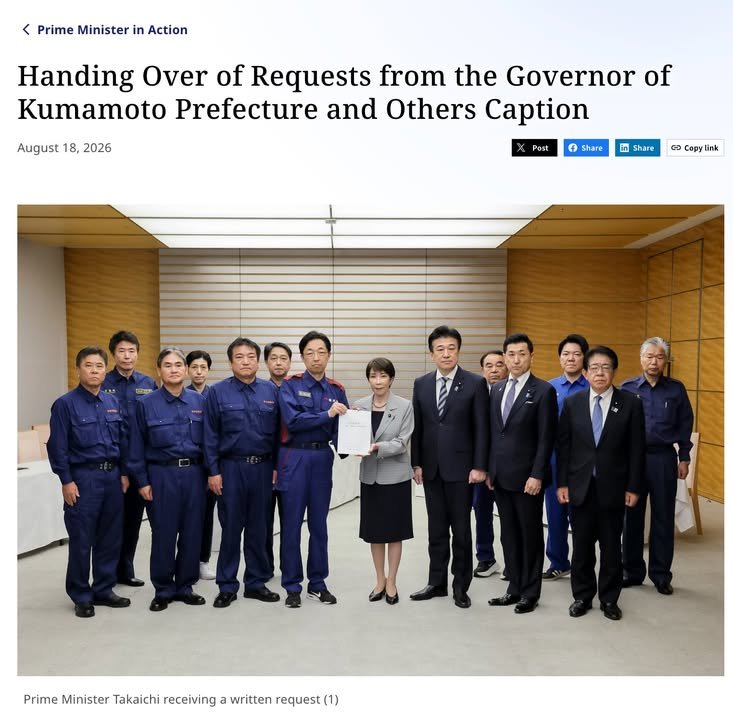
Kirk here with an example of your tax yen at work producing extremely odd English (and placing it prominently on the website of the Prime Minister, for the world to see). The original Japanese title of the announcement you see is 熊本県知事等による要望書手交 (https://www.kantei.go.jp/jp/105/actions/202608/18shukou.html). Here are some (but not all) of ChatGPT's criticisms of this translation.
--- quote from ChatGPT, slightly modified ---
1. “Caption” clearly does not belong in the title.
There is nothing corresponding to “Caption” in the Japanese title. Moreover, immediately below the photograph on the English page is an actual photo caption: “Prime Minister Takaichi receiving a written request (1).” This strongly suggests that “Caption” is a stray field label or other artifact of the English publishing workflow that somehow became attached to the title.
2. “Handing Over of Requests” is extremely unnatural English.
手交 (shuko) is formal bureaucratic Japanese meaning the physical presentation or delivery of a document. 要望書 (yobosho) is a written request or request document. Translating the combination mechanically as “Handing Over of Requests” produces something that an English-language government office would be very unlikely to use as a headline. Something like “Prime Minister Takaichi Receives Written Request from Kumamoto Governor and Others” would be much more natural.
3. “Requests” is misleading.
要望書 is a single document — literally a “written request.” The document may contain several individual requests, but the Japanese headline refers to the presentation of the 要望書 itself. “Handing Over of Requests” makes it sound as though a number of separate requests are being transferred. The event itself was very simple: Kumamoto Governor Takashi Kimura and others met Prime Minister Takaichi and presented her with a written request. Ironically, the English photo caption — “Prime Minister Takaichi receiving a written request” — communicates the event much more clearly than the English headline does.
--- end quote ---
Now to the question of how this happened. I asked ChatGPT if this is most likely to have been the work of AI (or some form of machine translation) or humans working for the government.
--- start ChatGPT's analysis ---
The evidence points more toward a longstanding human/institutional translation process than toward a modern AI simply being asked to translate this Japanese title from scratch.
The strongest clue is that the awkward phrase “Handing Over of Requests from the Governor of ... Prefecture and Others” has appeared on English Kantei pages for years. In other words, this does not look like a new translation generated specifically for this article. It looks more like an established government translation, perhaps preserved in a style guide, translation memory, database, or previous-page template and repeatedly reused.
That kind of consistency is very characteristic of institutional translation. Once an English equivalent has been adopted for a bureaucratic Japanese expression such as 要望書手交, later translators may continue using it even if the English sounds unnatural.
The stray word “Caption” appears to be a different kind of mistake. There is nothing in the Japanese title that could reasonably have been translated as “Caption,” and the page actually does contain a photo caption immediately below the image. That makes “Caption” look much more like a publishing, template, or content-management-system error in which a field label somehow became attached to the headline.
AI or machine translation could conceivably be involved somewhere in the government's current workflow, so this cannot be proved from the finished page alone. But the historical reuse of the awkward translation, combined with what looks like a separate publishing error involving “Caption,” makes a longstanding human/institutional process the more likely explanation than a modern AI independently producing the whole thing.
--- end ChatGPT's analysis ---
I think this is a good example of why humans working in languages they don't understand well (or, at least, are not native speakers of) should use AI to check their work. I don't mean that they should just throw Japanese text at an AI bot and go with whatever it produces. That would be irresponsible. But, in an age where high-quality AI is available, not getting a "second opinion" from AI and blithely following bureaucratic precedent when producing translations strikes me as equally irresponsible.
The URL of the English article is https://japan.kantei.go.jp/105/actions/202608/18shukou.html.