Hi Atsuko here.
It's good season to enjoy Hanami and short trip.
The cherry blossoms are in full bloom in Kariakusa Park in front of my house, and every day it is crowded with parents and children with tents and children on spring holiday.
Here is the next tradition after cherry blossom viewing.
ーーーーーーーーーーーーーーーーーーーー
Annual Carp Streamer Festival at 杖立温泉 Tsuetate Onsen
The event will be held again this year starting April 1.
During this period, the lights will be illuminated from 7:00 p.m. to 10:00 p.m.
More information about Tsuetate Onsen
https://en.minamioguni.jp/archives/220431

2022-03-31 15:18 JST

William Cherry blossom season is most over - or is it? This depends on the variety of the tree: some bloom early, some late. Pictured are two gorgeous photos from our friend Liz Suenaga taken at Honmyoji (本妙寺). Note the color difference in the right photo: those are different varieties.
A link to a recipe on how to preserve cherry blossoms in salt for a tasty snack: https://www.lettuceclub.net/recipe/dish/5701/
and a link to cherry blossom varieties: https://www.japan-guide.com/e/e2011_species.html

2022-03-31 09:15 JST

William While the tragedy unfolding in Ukraine has resulted in a positive security impact for Japan as Russia moves its troops from Asia to Europe, Japan's Self Defense Forces (SDF - read army, air force, navy, marines) have not been inactive. Kumanichi reports on, well, reports of bright lights in the sky. Do not be alarmed: these are not aliens having come to harvest your organs.
This is training the SDF conducts from their Yamato base several times a year to illuminate nighttime destination and targets of troops - or so the SDF says, per this article. I personally have never seen it. If anyone notices anything unusual, please PM us. Video at the link.
熊本の空に「謎の光」 相次ぐ目撃…正体は?|熊本日日新聞社
 「東の空に不思議な光が見えました」。熊本市東区の女性会社員(47)から、29日午後6時25分ごろに撮影したという動画が「SNSこちら編集局」(S編)に寄せられた。同様の目撃情報はSNSでも投稿が相次いでおり「UFOか!?....

2022-03-30 21:39 JST

William Divisions exist akin to geologic fault lines among Japanese ramen types. Kumamoto is particularly famous for its pork-based ramen, while Tokyo goes soy sauce-based. Eww. Keika Ramen 「桂花拉麺」, founded in Kumamoto in 1955, introduced tonkotsu ramen to Tokyo and is known among ramen lovers world-wide. In addition to their in-store bowls, they sell instant ramen in supermarkets. Recently, due to personal circumstances, I have found myself consuming them: thumbs up, though obviously their restaurants are best. Google a location near you. https://keika-raumen.co.jp/shop.html

2022-03-30 17:47 JST

Kirk here with news about a deer crossing the Shirakawa in Toroku (渡鹿), an area in Kumamoto City that means "deer crossing." Click on the link to see the video.
https://rkk.jp/news/index.php?id=NS003202203291747310111

2022-03-29 21:07 JST

William Translation is tricky. Generally, I term Kumamoto pre-1600 as "Higo fief" or "Higo domain" and post-1600 "Kumamoto," though I have seen examples otherwise. One reason I do so is that Kumamoto was not unified until the rivalry between two daimyo, Konishi Yukinaga and Kato Kiyomasa, was resolved.
Both were born outside Kumamoto. Both received their fiefs - Konishi in the south, centered around Yatsushiro, and Kato in the north, centered around Kumamoto City - for their service in Hideyoshi Toyotomi's Kyushu Campaign to pacify the Shimazu Clan, which ruled over most of the island at the time. Both later served in Hideyoshi's two Korean invasions (during one of which Kato famously killed a tiger).
However, no love was lost between the two. Konishi was a devout Christian; Kato loathed Christians. Their rivalry ended in the decisive Sekigahara campaign of 1600, during which Konishi supported Ishida Mitsunari, while Kato supported Tokugawa Ieyasu. After Tokugawa's victory, Yukinaga was offered the privilege of committing seppuku but refused due to his Christian faith and was executed; Kato thereupon received Konishi's fief, and Kumamoto in its modern dimensions was created.
This is why I refer to pre-1600 Kumamoto as "Higo." What is your opinion?
Below: Kato (left) with his monkey (right) - the fusuma behind him is marked with his kamon (家紋, family crest), which is still the symbol of Kumamoto; and Konishi decked out for battle.

2022-03-29 17:00 JST

William Tsujunkyo (通潤橋, literally "moisture passage bridge"), a symbol of Kumamoto located in the town of Yabe, was completed in 1854 and, at 84m in length with an arch spanning 27m, is the largest stone aqueduct in Japan, built to irrigate an otherwise arid plateau to its south. The bridge was designed to sag in the center, with openings created to allow flushing of sediment. Removing the stump-sized wooden plugs to do so results in cascades of water, and this has become a major tourist attraction.
Kumanichi notes that access to the bridge, previously free, will now cost Y500 for adults and Y300 for children through HS age. My wife suggested that, as a rapidly depopulating town whose remaining residents are mainly elderly, Yabe simply needs the money.
https://kumanichi.com/articles/602968

2022-03-28 15:00 JST

Charles Waterman here:
Does anyone know how to send something from Kumamoto to the US using **FedEx or UPS**? We will need *speedy* delivery for some visa related documents for an incoming teacher that will be ready in a week or so, we hope. The Japan Post will be way too slow, unfortunately.

2022-03-28 13:49 JST

William A crime almost as heinous as Chisso Corp. releasing methylmercury into Minamata bay is the glacial pace at which the government proceeds with lawsuits. Kumanichi takes up the case of Mr. Hideki Sato (67), plaintiff leader, who suffered from methylmercury poisoning during fetal development and childhood. The group filed its appeal In October, 2015 - finally rejected yesterday - after their original suit was defeated in 2013, with the Fukuoka High Court ruling that the plaintiff's symptoms, which include leg cramps, dizziness, tinnitus, and difficulty in holding objects, were likely due to other illnesses. Mr. Sato noted that, even though the dangers of eating local fish and shellfish were vaguely known since 1957, poverty demanded that Minamata residents nonetheless continue to consume them.
汚染魚、家族で食べていた 原告団長佐藤さん、両親と祖母は「患者」|熊本日日新聞社
 水俣病被害者互助会の裁判闘争は15年目に入った。原告団長の佐藤英樹さん(67)=水俣市=はきつい時があっても、「自分一人だけのことではない」と自らを奮い立たせてきた。案じ続けてきたのは、自分たち原告と同.....

2022-03-27 13:19 JST

William Fumarolic gasses (噴気孔ガス, funkikō gasu) are those emitted by a fumarole, a vent into what is mostly groundwater heated to steam by volcanic activity. They are a potential source of energy and are already being utilized throughout Japan, including in Kumamoto, in Oguni and Aso Village (an image of the Oguni plant is below). It seems much potential remains for this free, renewable power source. More can be read (just a bit) about the topic here: https://www.renovainc.com/en/development/minamiaso_yunotani_geothermal/202009_1674/

2022-03-26 20:31 JST

William A bit more about Kumamon's profitability. I'd stated before that cumulative profits have reached Y1 trillion. This article states a figure 810 billion yen since 2011, when the prefectural government began tracking figures (Kumamon was "born" in 2010), and 157.9 billion yen in 2019 alone - so close to a trillion, though perhaps not quite. Still, that's a whole lotta yen, much of which comes from licensing fees by Taiwanese, Chinese, and Korean companies, where Kumamon remains quite popular. No wonder he (she?) always looks so content. English-language article at the link.
Sales of Kumamon mascot goods hit record 158 billion yen in 2019
Products bearing the image of "Kumamon," the black bear mascot of Kumamoto Prefecture, racked up sales of at least 157.9 billion yen ($1.4 billion) in 2019, according to the local government

2022-03-26 14:03 JST

Kirk here with a followup to William's post about Isahaya Bay. William has already introduced the gist of the issue but I thought I'd share this English-language news article as well.
As William pointed out the estuary has been important to the health of the entire Ariake Sea. Fishers are angry about the damage to the environment that chopping off the mud flats did. In fact, the loss of the wetlands may be one factor in the decline in clams (asari) that we've reported about. It's hard to know exactly how much of the asari probably can be blamed on the damming of the estuary but it certainly didn't help.
Finally, here's a good web page on the history of the issue:
https://www.jawan.jp/e/news/081015isahaya2.html
https://www.asahi.com/ajw/articles/14582114
High court rules Isahaya Bay floodgates can remain closed | The Asahi Shimbun: Breaking News, Japan News and Analysis
FUKUOKA--Four years failed to dampen the Fukuoka High Court's view of a protracted legal battle in Nagasaki Prefecture between fishermen and farmers over reclaimed land in a once bountiful bay.

2022-03-25 21:44 JST

William Though Isahaya Bay (諫早湾) is located in Nagasaki, as it served as an estuary for Ariake Sea, its health affects Kumamoto. Isahaya was diked off in 1989 for two purposes: to protect against typhoons and to provide farmland. While the former purpose may have been fulfilled, the latter has not: the soil quality of the reclaimed land is too poor to grow anything.
Estuaries are crucial for the health of such a narrow body of seawater as the Ariake. The crustaceans and plants that populate an estuary constitute a natural filtering system. Kumanichi reports that a group of Ariake fishermen, concerned about the damage the dike causes, sued to force the government to keep the gates permanently open and to reconstitute the estuary. Though the fishermen won in the lower courts, the Fukuoka High Court ordered that the gates remain shut. The dissatisfied fishermen have vowed to appeal to the Supreme Court.
https://kumanichi.com/articles/600447

2022-03-25 20:36 JST

William Hay fever - or pollen allergy - season is upon us, and it is a largely self-inflicted phenomenon. The biggest culprit is the sugi (杉), or Japanese cedar. During WWII, deforestation was a huge problem as mountains were denuded for fuel. I have read that Tatsudayama and Mt. Kimpo were completely denuded, so all current growth on both mountains are entirely post-war.
The government decided to grow mammoth sugi plantations due to the tree's rapid growth rate and its suitability for lumber. What they did not factor in was that sugi produce a prodigious amount of pollen in the spring. Furthermore, with imported wood undercutting domestic prices, many of these plantations have been abandoned, leading to the growth of larger, more mature trees which produce more pollen. More can be read here: https://blog.gaijinpot.com/strange-story-hay-fever-japan/
Our friend Jeff Cairns, who lives perched atop Mt. Kimpo, provided us with these stunning images of the snow-like pollen sweeping down from the sugi towards the city. Those affected by pollen are encouraged to stay indoors, keep windows and doors shut, and change clothes often.

2022-03-25 17:20 JST

Kirk here reporting on a group of doctors that held a press conference to criticize the recent Supreme Court decision not to hear an appeal by persons seeking certification as Minamata disease patients. Their critique (as summarized in the news story) is that the idea the court sited that "we can't be sure what caused the symptoms" ignores research on Minamata disease that has accummulated over the decades. For my summary of the Supreme Court's rejection of the plea, see the following post:
https://www.facebook.com/Kumamotoi/posts/7050309825042389
医師が最高裁を批判「水俣病研究を無視」 【熊本県】(KKT熊本県民テレビ) - Yahoo!ニュース
3月8日、最高裁判所が水俣病の未認定患者8人の訴えを棄却したことに対して、23日に水俣病患者の治療や検診にあたる医師らが、最高裁の判断を批判する声明を出した。 声明を出したのは、メチル水銀中毒症研

2022-03-25 14:13 JST

Kirk here reporting that RKK broadcast an interview with the boy from Ukraine and his family this evening. It's only in Japanese but it's available on YouTube if you're interested.
https://www.youtube.com/watch?v=EKKsvg3mjWc
https://rkk.jp/news/index.php?id=NS003202203241702000111

2022-03-24 21:53 JST

William Between 1932 and 1968, Chisso Corporation produced acetaldehyde, a precursor to polyvinyl acetate, which is used to make glue - such a basic thing! - in Minamata. The company dumped its waste, which included mercury sulfate, used as a catalyst, into Minamata Bay. This mercury was rapidly absorbed by fish and shellfish, which went up the food chain to humans, resulting in what is known as "Minamata disease," or mercury poisoning.
That is well-known. What is less well-known is how well Minamata has recovered since then. My wife and I gleefully eat oysters from the rocks with no worries. The government has poured in money as a sort of apology, making the small town a delightful place to visit. Of particular interest at this time of year is their cherry blossoms. Going by car is best, but JR also has a delightful line with wonderful walks from the station. https://www.rome2rio.com/map/Kumamoto/Minamata#r/Train The locals must still make a living, and they will welcome your visit.

2022-03-24 20:53 JST

Hi, Atsuko here.
桜, Sakura, Cherry blossoms!
Cherry blossom season is here!
@健軍神社 Kengun shrine street, today.(*Ü*)♡

2022-03-24 20:25 JST

Kirk here with news that Kumamoto Prefecture is preparing to accept refugees from Ukraine. At this point, there have been no specific requests but since the number of displaced persons is very large (over 10 million now, according to the report) there will clearly be a need for help in settling people in many areas of many countries. Kumamoto has raised its hand (or is preparing to raise its hand?) as one possible destination.
https://rkk.jp/news/index.php?id=NS003202203231624110111

2022-03-23 21:30 JST

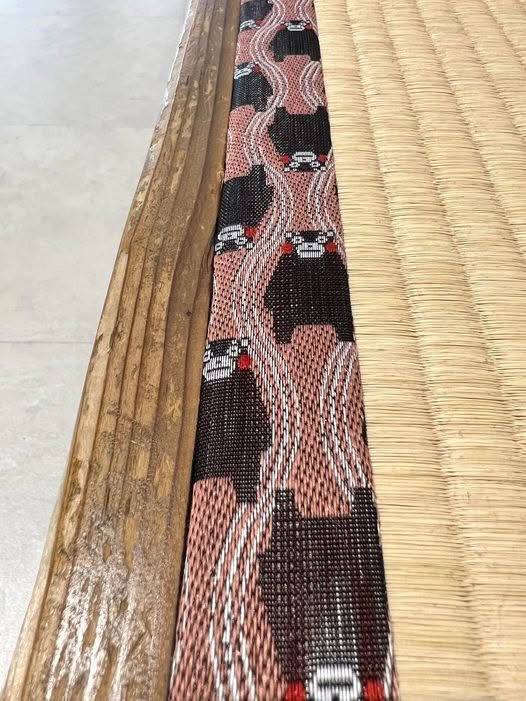
William Kumamon continues to rake in the yen. Since licensed commercial use of his (her?) image was permitted in December 2010, the prefecture has clawed (pawed?) in in excess of one trillion yen. No word on where the money has gone, but one hopes it has helped to alleviate local taxes and increase services, particularly for the elderly and those with young children. Kumamon would approve of that. Pictured: くまモンに小判.
https://kumanichi.com/articles/596772

2022-03-23 16:42 JST